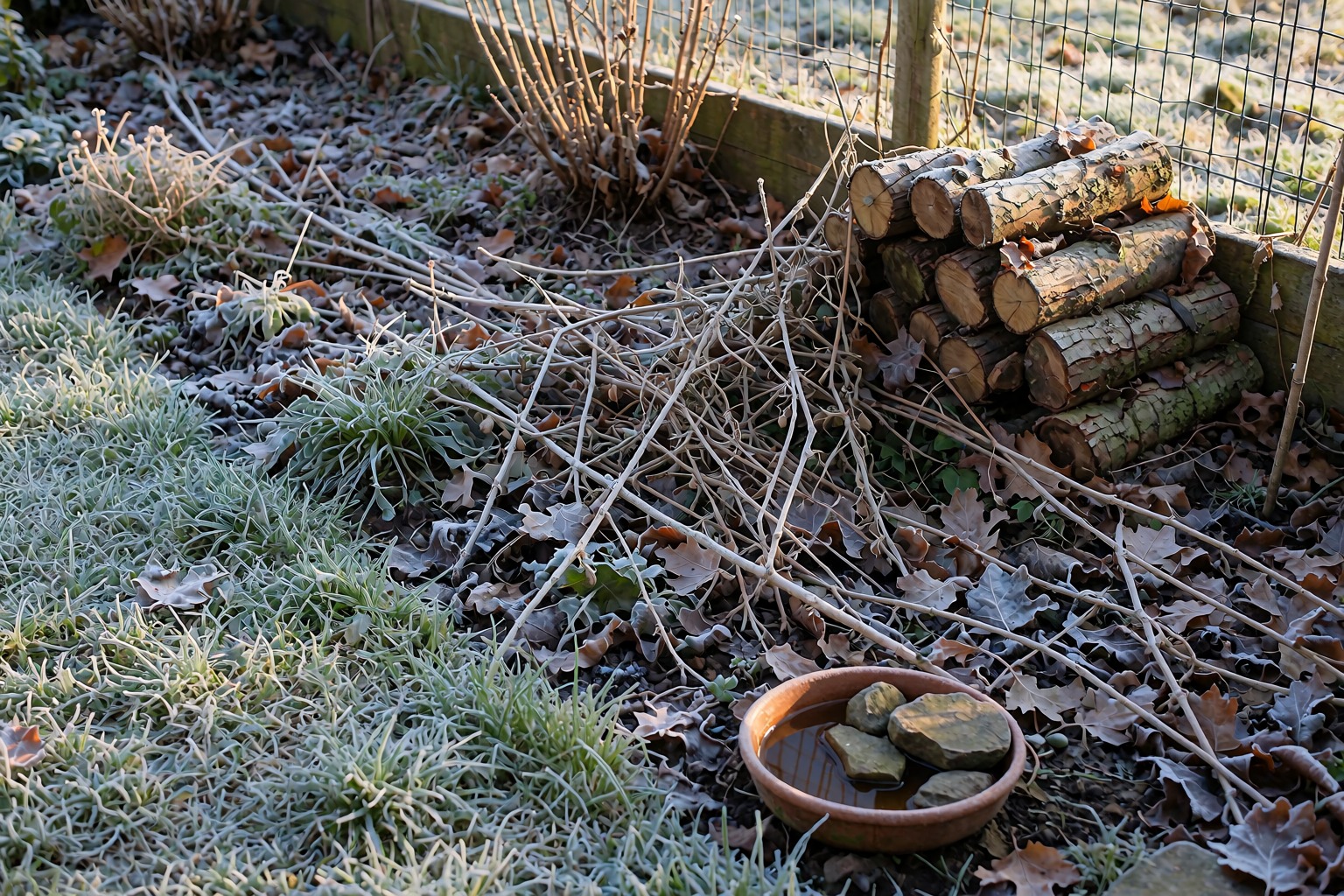
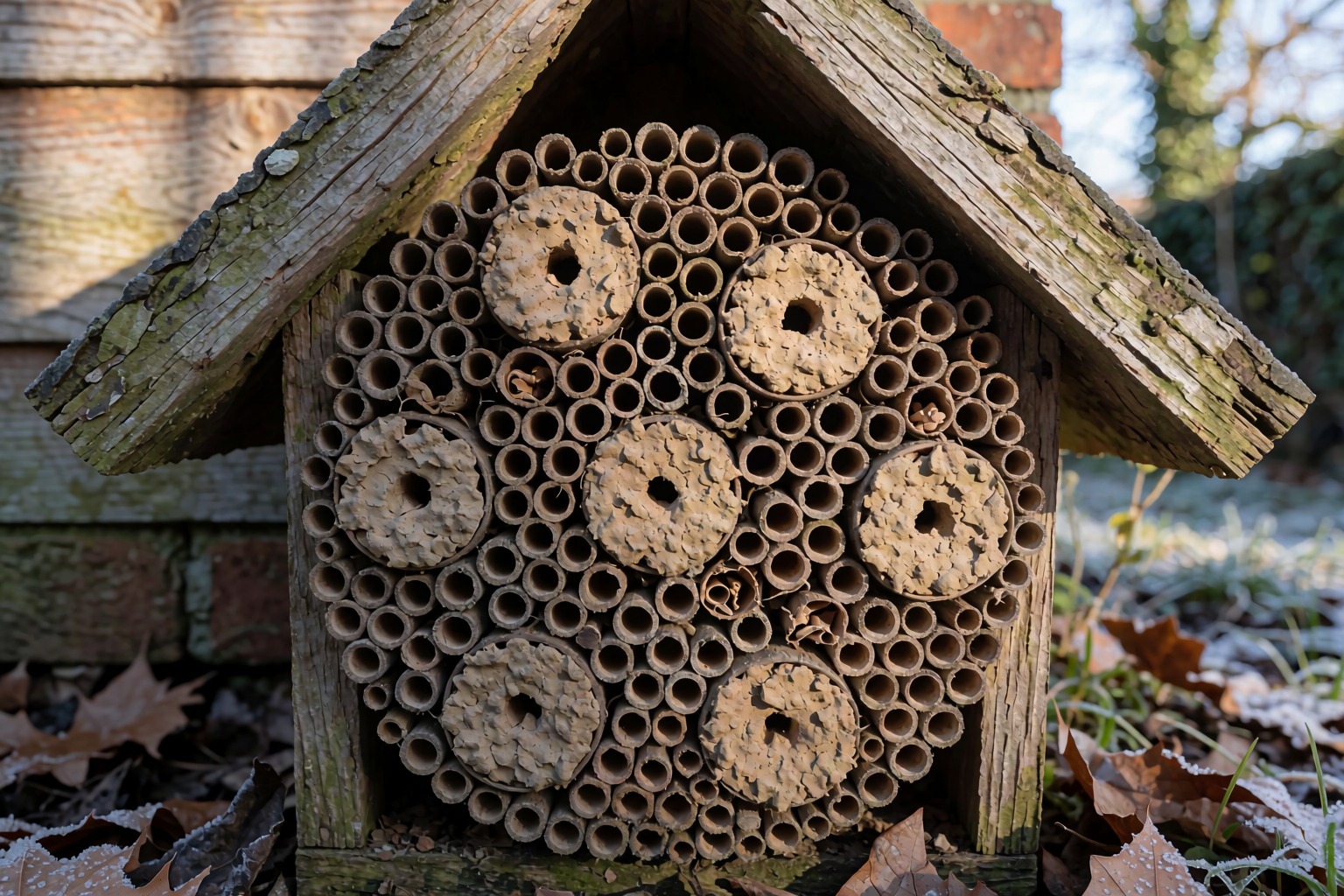
A bee hotel left out in the garden over winter is not an empty box. If it had visitors in spring and summer, several of its tubes are likely plugged shut with a disc of dried mud or a wad of chewed leaf, and inside each one a bee has already finished growing. It is waiting, not absent, and it will not reappear until the weather turns reliably mild next year.
Looking after a bee hotel properly over the cold months comes down to three things: knowing what is actually inside it, keeping it dry and out of reach of hungry birds, and understanding when it is safe to open, clean or swap the tubes without disturbing something that is still very much alive in there. None of it is complicated, but the order matters, and doing any of it at the wrong time of year can undo a whole season’s nesting.
What is actually living in a bee hotel over winter
A bee hotel is built for solitary bees, not honey bees. In most UK gardens the tubes are taken up by red mason bees and by leafcutter bees, both of which nest alone rather than in a colony, each female sealing her own eggs into a tube, cell by cell, with mud or chewed leaf. How that nesting actually happens, tube by tube, is its own story and is told in full elsewhere on this site. What matters here is what happens next, once a tube is capped and the season’s building work is done.
Each egg hatches into a larva that eats its way through its own pollen store over several weeks, then spins a cocoon and pupates inside its own sealed cell. By the time autumn arrives, that pupa has usually already finished changing into a fully formed adult bee. It does not break out of the cocoon at that point, though. It stays folded inside it, dormant, right through the autumn and winter, and only stirs and chews its way out when the weather outside tells it the time is right. A capped tube that looks still and lifeless from the outside, with no sign of movement for months on end, can hold several adult bees already sitting out the cold in exactly this state. It should never be assumed empty just because nothing is happening on the surface, and a tube should never be snapped open out of curiosity.
Should the bee hotel come indoors, or just move
A bee hotel does not need to come into a heated house, and in fact it should not. Warmth indoors can trick a dormant bee into waking long before there is any pollen or nectar outside for it to feed on, which leaves it stranded with nowhere to go and nothing to eat once it does finally emerge. The better move is a much smaller one: shift the hotel, or just the filled tubes themselves, into somewhere cool, dry and unheated, such as a garden shed, a garage, or a sheltered spot tucked well under eaves, out of the path of driving rain and standing water.
The two real dangers over winter are damp and birds, and both are worth taking seriously rather than treating as a minor risk. Prolonged wet gets into tubes, soaks through cardboard and paper liners, and breeds mould, which is one of the more common causes of a cocoon failing before spring ever arrives. Great tits, in particular, have learned to peck straight through cardboard or thin paper tubes to reach the grubs inside, and in some gardens woodpeckers will do the same to thicker wooden blocks, so a hotel left fully exposed on an open fence for the whole of winter carries some risk from both. Moving it under cover, or fixing a simple layer of small-gauge wire mesh over the front if it has to stay outside in full view, deals with both problems at once without costing much effort.
Whatever you do, avoid sealing the whole thing inside an airtight bag or box in an attempt to protect it further. The tubes need air moving gently through and around them, not trapped moisture building up against the cocoons inside, which only recreates the damp problem you were trying to avoid in the first place. A simple open-fronted shelf in a shed, or the hotel’s own roof overhang left in place, usually gives enough protection on its own.
Cleaning the tubes, and whether to replace them
Once a tube is capped, that particular nest is finished for the season. The female who built it has either moved on to start another tube elsewhere or has died, as most solitary bees live only a matter of weeks as adults, so there is no harm in handling a sealed tube carefully, provided the mud or leaf cap at the open end is not knocked off or damaged in the process. That cap is doing real work: it is what keeps damp, dust and predators out until the bee inside is ready to leave on its own terms, so it is worth treating gently even once you are confident nothing more is going to happen in that tube until spring.
If the bee hotel uses a simple tray system with removable paper liners, the tidiest approach is to take those liners out once the season’s nesting is clearly over, usually from late autumn into early winter. Each liner can be gently opened along its seam to check the cocoons inside for mould, for a persistent musty smell, or for the small grubs and tiny parasitic wasps that do occasionally get into a tube before it is sealed. Healthy, firm, light-coloured cocoons can be lightly brushed free of loose debris and old pollen crumbs, then kept somewhere cool and properly ventilated over winter, a plastic container or an old jar with a handful of air holes punched in the lid is enough, until it is time to put them back outside in spring.
Plain cardboard tubes that cannot be opened along a seam are a slightly different case, and need a slightly different approach. Because they cannot be checked or cleaned on the inside in the same way a liner can, mites, mould spores and general debris from one season are liable to sit inside them and build up if the same tubes are reused year after year without a break. Once a cardboard tube has done its job for a season, it is generally better retired and replaced with a fresh one the following spring, rather than kept going indefinitely on the assumption that it still looks fine from the outside. A hotel with a mix of tube types, some that open and some that do not, is often easier to manage well over several years than one built entirely from tubes that cannot be inspected at all.
Timing matters here as much as the cleaning itself does. This sorting and tidying should happen once nesting activity has clearly stopped for the year, from autumn into early winter, not while there is still a realistic chance that a tube somewhere in the hotel is still being actively filled or finished. Doing the job too early in the season risks disturbing or opening a cell that has not finished its work yet; doing it in reasonable time before spring, once things have properly settled, simply gives next year’s occupants a cleaner, drier, better-smelling start than they would otherwise get.
When the bees actually come out, and what helps them
There is no fixed calendar date for this, because the bees themselves are not working to one. What wakes a mason bee or a leafcutter bee from its winter dormancy is a run of consistently mild days and rising ground temperature, not one unseasonably warm afternoon in the middle of February that then turns cold again. In practice, across most of the UK, red mason bees typically start appearing somewhere between March and May, with leafcutter bees generally following a little later, from around May into the summer months, and the exact timing shifts noticeably from one year to the next depending on how mild, late or changeable that particular spring turns out to be, and on how far north or south, or how exposed, the garden itself is. As with many solitary bees, the males tend to emerge a few days to a couple of weeks ahead of the females, clustering near the nest entrances and waiting for the females to follow once conditions have settled further.
The practical job for a garden owner, once all this is understood, is simply to have the hotel back out in its usual spot, somewhere sheltered and ideally facing a bit of morning sun, before that first reliable mild run of the year properly arrives, rather than scrambling to move it back outside once bees are already noticeably active elsewhere in the garden or neighbourhood. A south or east facing spot that warms up early in the day and holds that warmth suits most solitary bees well, and keeping the entrance tubes clear of cobwebs, leaf litter or winter debris over the preceding weeks means nothing blocks a bee on its way out. It also helps considerably to have some early flowering plants nearby, since a bee that has just chewed its way out of a cocoon after months of complete inactivity needs food close at hand straight away, not a long and risky flight across the garden or beyond to find any.
None of this takes much beyond a bit of patience and a dry shelf somewhere out of the worst of the weather. Once you understand what is really happening inside those sealed tubes over the cold months, a fully grown bee simply sitting it out and waiting for its moment rather than an empty space with nothing left inside, the rest of winter care follows on quite naturally from there: keep it dry, keep it out of reach of a hungry bird, check and tidy the tubes only once the season is properly finished, and let the bees come out in their own time, on their own weather, the following spring.