
Naturalist Series · 1 October 2026
Winter in the Honey Bee's Year
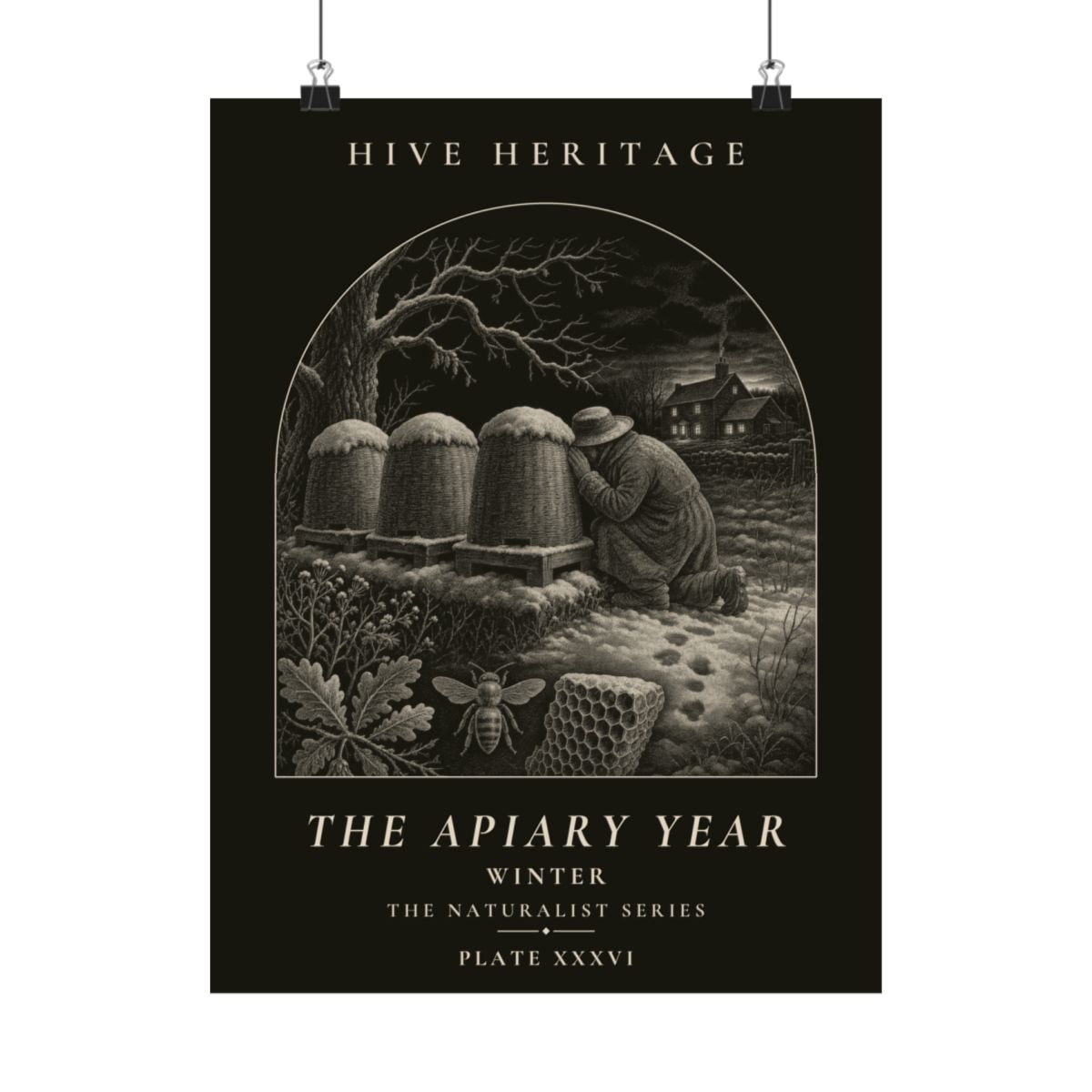
Honey bees do not go anywhere in winter. The whole colony stays together inside the hive, huddled in a tight cluster and kept warm through their own effort, living off the honey they stored during summer.
Winter is the quietest chapter in the honey bee's year, but it is not an empty one. Everything that follows in spring depends on what a small, tightly packed group of insects manages to do through the darkest months. This is the story behind our Winter plate, and we think it deserves to be told properly.
Do honey bees hibernate in winter?
The first thing to put right is a common assumption. Honey bees do not hibernate. A bumblebee queen does something closer to it, sleeping alone underground while the rest of her colony dies. A honey bee colony instead survives as a whole, with a queen and thousands of workers, and it stays warm by working at it.
As the air cools towards about 10°C, the bees draw together into a ball known as the winter cluster. The bees on the outside pack in shoulder to shoulder and form an insulating mantle. Inside it, other bees keep the heat up by shivering. They uncouple their wings from the flight muscles and vibrate those muscles instead, so the bee stays put and only makes warmth. It is a striking piece of engineering for an animal the weight of a paperclip's shadow.
The cluster is not one fixed temperature. When there is brood, the developing young need the warmth of a summer nest, and the bees hold that part at roughly 34 to 35°C. When there is no brood, the core can run considerably cooler, and the outer edge cooler still. The colony spends its fuel according to need. As the weather turns colder the cluster contracts and tightens. On a milder day it loosens and spreads across more comb.
The bees do not stay in fixed positions either. Those on the cold outer layer work their way inward to warm up, and others take their turn at the edge. Meanwhile the whole cluster creeps slowly across the comb, eating the honey stored there as it goes. The honey is the fuel. Through the winter the colony eats its way through the summer's work, and beekeeping guidance in the UK commonly speaks of needing around 20 kilograms of stores to get a colony safely through. In the coldest parts of North America, where winter is longer, colonies need considerably more.
There is a particular hazard here that surprises people. A cluster can starve with honey only a few centimetres away, if a hard cold spell stops it from moving across the comb to reach it. Beekeepers call it isolation starvation, and it is one reason the position of the stores matters as well as the amount.
Bees made for the season
A summer worker lives for around six weeks, worn out by foraging. If the same bees had to carry a colony through winter, there would be none left by the first snowdrop. So the colony does something clever in late summer and autumn. It raises a different kind of worker, often called a winter bee or diutinus bee. These bees are built with larger reserves of body fat and protein, and they do little foraging. They live for months rather than weeks, long enough to bridge the gap until new brood can be raised in the spring.
Other things change in autumn too. The drones, who have no role in a winter nest and would only eat stores, are turned out of the hive by the workers. The queen slows her laying and, in many colonies, stops for a spell. The colony shrinks from the tens of thousands of high summer to a fraction of that, perhaps ten to twenty thousand. Small, compact and well provisioned is exactly what winter asks for.
Not every colony makes it, and the reasons are worth naming. A colony that goes into winter too small, too short of stores, or weakened by disease will struggle. The varroa mite is the best-documented pressure on winter bees, because mites feeding on the developing bees and the viruses they carry can shorten the lives of the very bees the colony is counting on. That is why beekeepers in both the UK and North America put so much attention on controlling varroa in late summer and autumn, before those winter bees are raised. It is not a story we want to dress up. It is simply part of the natural history now.
Then, around midwinter, something turns. As the days begin to lengthen the queen usually starts laying again, in a small patch at first. The exact timing varies with the colony and the climate, generally earlier in the milder parts of the UK and later in a hard northern winter. But the small patch of brood matters. It means the cluster has to warm that area to nest temperature again, burning more stores just as the weather may still be at its worst. Late winter is often the riskiest stretch of all, and many colonies that seem to have survived the frost are lost in February or March.
What do bees forage on in winter?
A bee cannot live on stored honey alone forever, and the first forage of the year matters more than its size suggests.
In the UK, the last big flowering of the year is ivy, which blooms from about September into November and is a dependable source of late nectar and pollen. It is not always an easy gift. Ivy nectar tends to set very quickly in the comb, and stores that have crystallised hard are more difficult for bees to use in the cold.
After that the picture thins, but it does not go blank. On mild days in a British winter, bees may find gorse, which can flower through much of the year, and winter-flowering shrubs such as mahonia and winter heathers. Hazel catkins release pollen from about January and are among the first significant pollen sources of the new year. Then come the snowdrops and winter aconite in the last weeks of winter, and willow catkins as the season begins to lift. Pollen matters especially, because it is the protein the colony needs to feed the growing brood.
Temperate North America runs on a wider range. In the colder north, in Canada and the northern states, the ground is often under snow for months and nothing is in flower at all. The colony is entirely on its stores, and the bees may not fly for weeks. The first pollen there often comes from trees, with maples and willows among the early sources, and from skunk cabbage, a wetland plant that generates its own warmth and can push through the thaw very early. Further south, or in milder places on the western side of the continent, the winter can be a working season. In California's Central Valley the almond bloom arrives in February, and colonies are famously moved in for it.
Whether a bee can reach any of this depends on a simple rule. Honey bees generally need it to be about 10°C or a little above before they will fly. Below that they stay in. On a bright, still day that crosses the line, you may see bees at the hive entrance on what looks like a winter afternoon. Many of them are on cleansing flights. Honey bees keep their nest very clean, and after weeks confined they take the chance to relieve themselves outside. It is a small, sensible bit of hygiene, and it is why you can sometimes see spots on nearby washing or cars after a mild spell.
What does a beekeeper do in winter?
The best answer here may surprise people who imagine beekeeping as constant activity. In winter the main skill is restraint.
A beekeeper does not open the hive during cold weather. Doing so would break the cluster's carefully held warmth and gain nothing. Instead, they work from the outside. Many lift or tilt the hive to feel how heavy it is, a technique known as hefting, which tells them roughly how much honey remains. Some put an ear to the wall of the hive on a cold day and listen for the low hum of a living cluster.
There are practical jobs, too. Entrances are reduced or fitted with guards to keep mice out, because a mouse would happily nest in the warm comb. The entrance is kept clear so that dead bees, which accumulate naturally over winter, do not block the way. In the UK, where green woodpeckers can hammer into hives in hard weather, some beekeepers protect them. Hives are strapped or weighted against winter gales. Ventilation matters as well. Many beekeepers hold that damp, rather than cold itself, is the bigger danger to a wintering colony, because condensation dripping onto the cluster chills it. In colder parts of North America, wrapping hives or setting up windbreaks is common practice for the same reason of managing heat and moisture.
If a colony is running short of food, a beekeeper may give an emergency feed of solid fondant on top of the frames, so that the bees can reach it without breaking the cluster. Some also treat for varroa in midwinter, when the colony is broodless or nearly so, since the mites are then exposed and cannot hide inside sealed brood cells. The timing depends on the place and the colony, and the guidance from bee inspectorates and beekeeping associations is where a keeper should look for the details.
Much of the rest is the quiet work of the off season: repairing and cleaning equipment, building frames, and planning for a season that still feels far off. It is a time for craft as much as for bees.
That, in the end, is what we tried to hold onto in the Winter plate. It is a piece of digital artwork drawn in the manner of an engraving, made to show a season most people think of as bare. If you look closely, it is anything but. It is the cluster holding steady, the stores being drawn down, the promise of the first pollen, and a beekeeper wise enough to wait outside. We have made it for anyone who has ever stood beside a hive in January and felt the quiet hum through the wood.
See it in the Naturalist Series: The Winter plate