
Naturalist Series · 29 September 2026
Why Honey Bees Hang Outside the Hive in Summer
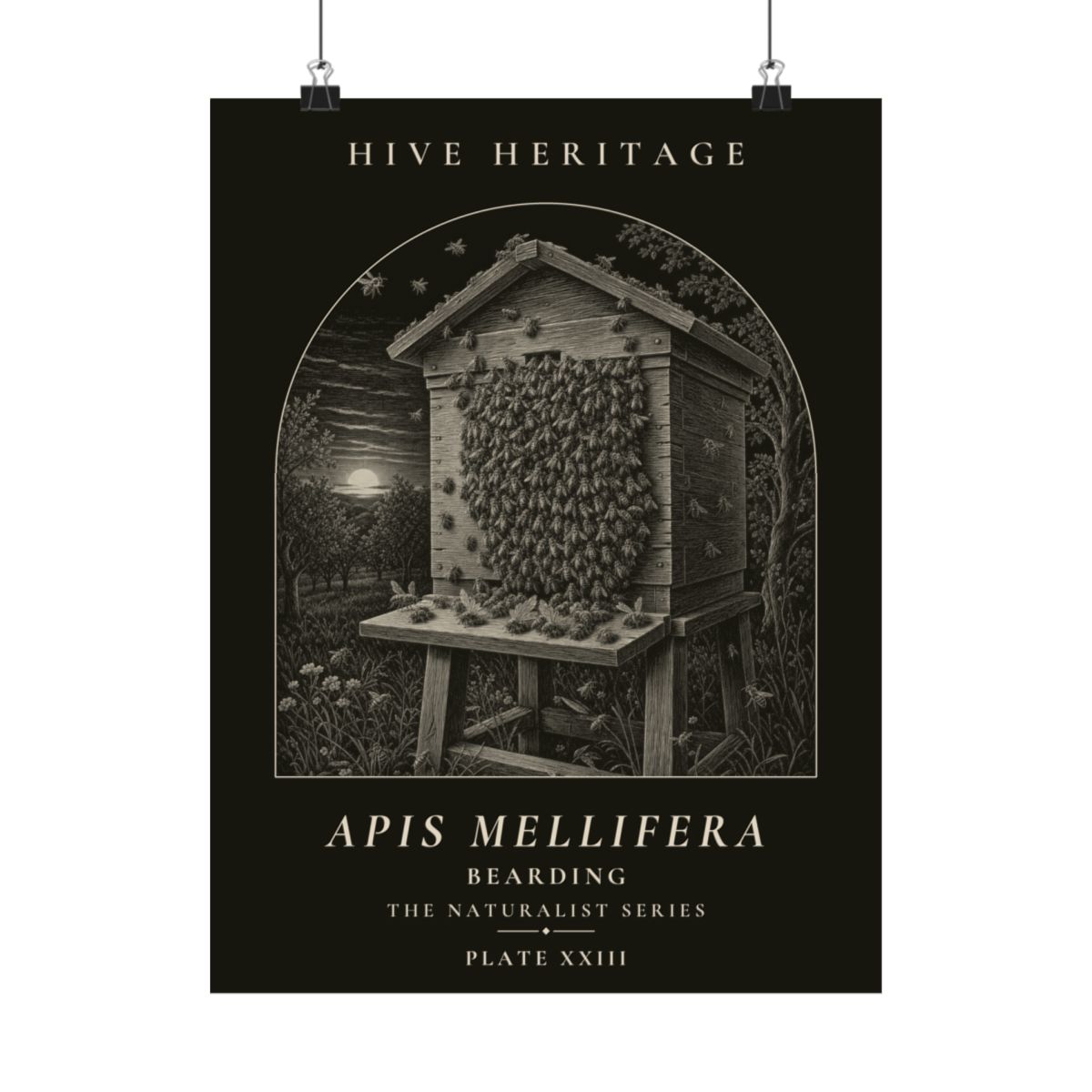
Honey bees hang outside the hive in a mass called bearding to keep the colony cool: moving outside takes their body heat out of the box and clears room at the entrance so the fanning bees inside can pull more air through the nest. It happens on warm, close evenings, when the foragers have come home for the night and the hive's population is at its daily peak just as the box is at its warmest.
It looks alarming the first time you see it: the front of the hive hidden under a living curtain of bees, nobody flying, nobody going in. It is not a colony giving up on its home. We made the Bearding plate in our Naturalist Series because it shows something a honey bee colony does that most people have seen in photographs but few have had explained.
What you actually see at the hive
Bearding is the clustering of large numbers of honey bees on the outside of the hive, usually around the entrance and the front face. The bees hang on to one another and to the wood, packed close, often several layers deep. The cluster can be a modest patch or a heavy hanging curtain, depending on the size of the colony and the weather.
Several things about the pattern are consistent, and they are the clues to what is going on.
- It is most often seen in warm, close weather, particularly in the late afternoon and evening.
- The bees are adult workers that have chosen to stay out, not bees that have left for good. Many will go back in as the air cools, and the beard shrinks or vanishes overnight or by the next morning.
- The colony carries on with its ordinary work at the same time. Foragers still come and go through the entrance, and there is often fanning at the doorway.
That last point matters. A beard is not the sign of a colony that has stopped working. It is a colony working at a problem.
Why do bees hang outside the hive?
A honey bee colony is not a collection of insects that happen to share a box. It behaves closely enough like one organism that beekeepers and scientists often talk about it that way, and one of the things it manages is temperature. The part of the nest where the young are raised is kept warm and fairly steady, at somewhere around 35 degrees Celsius. In cold weather the bees pack together and use their flight muscles to make heat. In hot weather they have the opposite job.
To lose heat, the bees have a small kit of methods, all of which are well documented in the standard beekeeping and bee biology literature. Workers stand at the entrance and fan their wings to pull air through the hive. Others bring in water and spread it in thin films or droplets so that evaporation can carry heat away, much as a damp cloth cools a room. The colony also uses the shape of its own cluster to help: in winter it draws tight, and in summer it loosens and spreads.
Bearding fits into that picture in a way that makes sense once you think about a hive as a crowded room. Every bee is a small source of heat, and a full colony on a warm evening is thousands of them. Many of the foragers have come home for the night, so the population inside is at its daily peak just as the box is at its warmest. Moving a portion of the bees outside does two things at once. It takes their body heat out of the enclosed space, and it clears room for air to move through the hive, which lets the fanning and the water evaporation work better. The bees outside are still part of the colony and still close to the entrance. They are, in a sense, standing in the corridor while the room airs.
The researchers who have studied honey bee thermoregulation have been careful about how far this explanation goes, and we should be too. Heat and congestion are the reasons most consistently given, and they fit what can be observed: bearding follows warmth, humidity and a busy, full hive. What is harder to say is exactly how each individual bee decides to stay out, or whether it is heat, crowding or a mixture that tips it at any given moment. Colonies do not all behave the same way. A strong colony in a small box will beard sooner than a modest one in a roomy hive, and the same colony may beard on one warm evening and not on the next.
Does bearding mean the hive is about to swarm?
Because the sight is so striking, it has collected a few beliefs that do not hold up well. It is fairer to name them than to pretend they are not there.
Myth: bearding means the colony is about to swarm. This is the most common one, and it is a half truth that has been stretched. A swarm is a very different event. When a colony swarms, the old queen leaves with a large share of the workers, they gather in a temporary cluster somewhere nearby, often on a branch, and scouts go looking for a new home. Bearding bees stay on the hive and return inside. What is true is that the conditions that produce bearding, a crowded and busy colony in warm weather, are also conditions in which a colony may be preparing to swarm. That is a reason for a beekeeper to look carefully, and for the beekeeper to check whether the colony has room. It is not evidence, on its own, that a swarm is imminent, and many colonies beard all summer and never swarm.
Myth: bearding means the hive is sick or failing. A beard has no connection to disease in itself. A healthy, strong colony is the kind most likely to have enough bees to make a beard. If anything it tends to be a sign of numbers.
Myth: the bees are being lazy. They are not idle. They are dealing with a temperature and space problem in the most direct way available to them.
We would also rather say plainly what we do not claim. Bearding is a normal behaviour, and we are not suggesting that it can be read as a measure of a colony's health, its honey yield or its future. It is one observation among many, and a beekeeper reads it alongside everything else at the hive.
What should a beekeeper do about bearding bees?
The sensible first response is to do very little, and the second is to look at the conditions.
A beekeeper will usually ask a handful of practical questions. Is the hive in full sun with no relief through the afternoon? Is there enough ventilation, whether that is an open or mesh floor, a well positioned entrance, or a crown board that lets air move? Is the colony running out of space, with frames filling and no room to store or to work? Is there a source of clean water nearby, so that the bees collecting it for cooling are not travelling far or trying to drink from somewhere unsuitable?
Where the answers point to a problem, the fixes are simple and are the kind of thing any beekeeping association or standard handbook will talk through: shade for the hottest part of the day, improved airflow, and more room where a colony has outgrown its box. If the question is whether the colony is thinking of swarming, the beekeeper's method is the ordinary one, a proper inspection at the right time, looking at the state of the brood nest and for signs of swarm preparation, instead of judging from the outside alone.
Just as important is what not to do. Bearding bees are not in an emergency and do not need rescuing. There is nothing to be gained from disturbing them, and beekeepers who understand the behaviour tend to leave the beard alone and work around it. It is usually gone by morning.
It is worth a moment of quiet appreciation too. Bearding is one of the few times when a colony's internal life is visible from the outside without opening the hive. The bees have not been moved or interfered with. They are simply showing, on a warm evening, how much effort it takes to keep a home at the right temperature.
Why we drew it
The Bearding plate in our Naturalist Series shows this moment: a colony hanging in a curtain from the front of the hive, seen the way you would see it if you stopped in the garden at the end of a warm day. It is digital artwork in the style of an engraving, made for us. It is not an antique, and it is not a hand engraved original. What it does is give the fine, patient line work that a natural history plate deserves to a behaviour that deserves the attention.
If this is the kind of thing you enjoy, the plate is a way to keep a little of it on a wall or on something you wear. And the next time you see a hive wearing a beard of bees on a summer evening, you will know what you are looking at: a colony keeping cool, with room to spare in the corridor.
See it in the Naturalist Series: The Bearding plate