
Naturalist Series · 29 September 2026
The Western Honey Bee and How a Hive Really Works
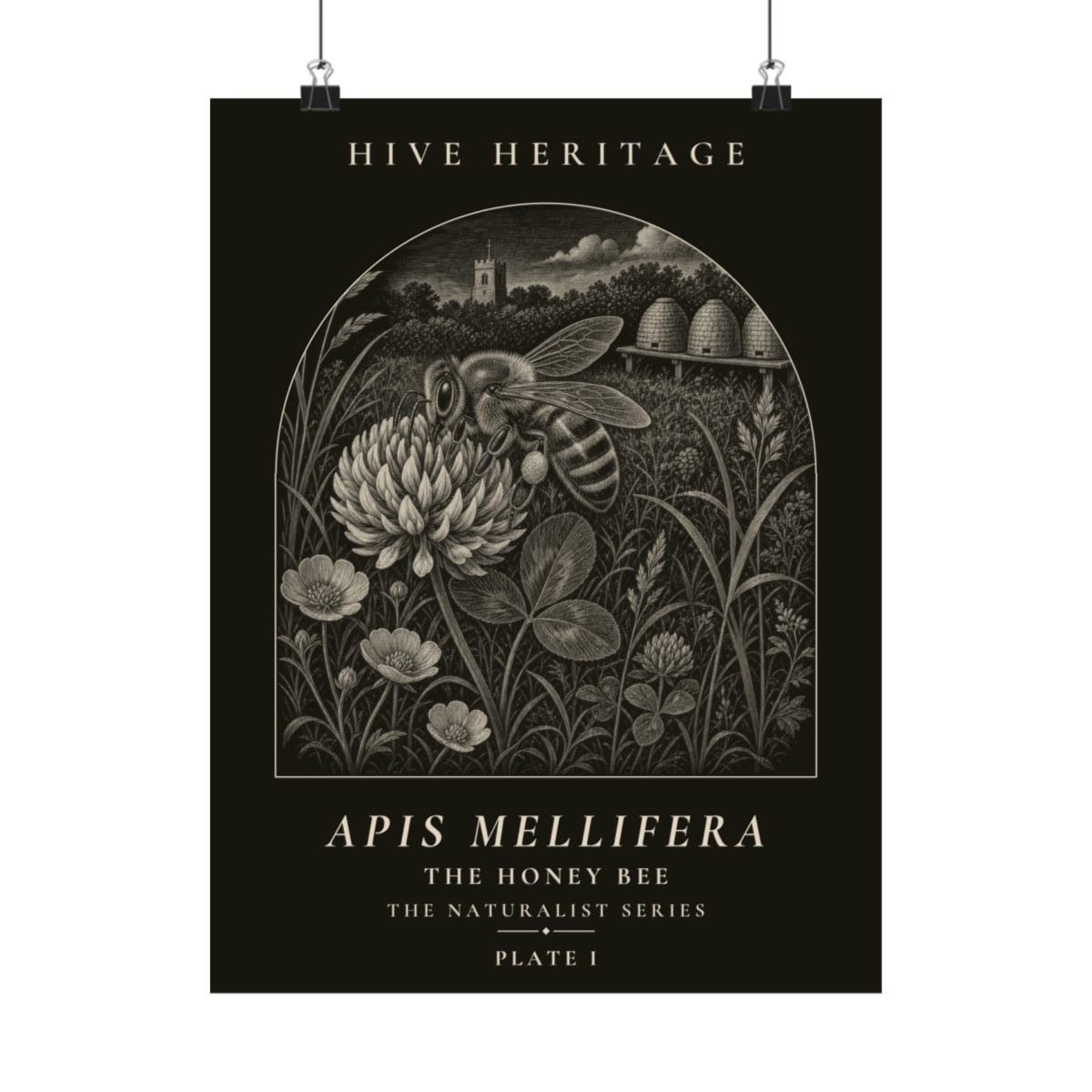
The western honey bee, Apis mellifera, is the only honey bee among more than 270 bee species recorded in Britain, and a colony of them works less like a swarm of individual insects than like a single animal. One queen lays every egg, thousands of workers forage, build and defend the nest, and together they hold the brood at a steady 34 to 35 degrees Celsius even through winter. This is the bee on our Honey Bee plate, and we wanted to tell its real story rather than repeat the short version.
A long name and a long reach
The western honey bee carries the scientific name Apis mellifera. Linnaeus described it in 1758, and the name means, roughly, honey-bearing bee. A few years later he suggested mellifica instead, as a more accurate form, but the earlier name had already been published and it is the one that stuck. Naturalists call this the rule of priority, and it explains why so many species names look slightly odd to a modern eye.
Its native range covers Europe, Africa and parts of western Asia. Across that range the bee has split into a number of geographical subspecies, adapted to very different climates. In Britain the native form is the dark bee, Apis mellifera mellifera. Beekeepers have imported other subspecies for many years, so the bees in a given hive may be a blend, and some beekeeping groups work to keep native and near-native stock going. Through human help the species now lives on every continent except Antarctica, which makes it one of the most widely travelled insects there is.
Look closely at a worker and the body is a neat piece of engineering. She has five eyes: two large compound eyes and three tiny simple eyes, called ocelli, on top of the head. Her sight reaches into the ultraviolet, which shows her patterns on flowers that we cannot see, but red looks dark to her. Two pairs of wings are hooked together by a row of tiny hooks so that they work as one surface in flight. On her hind legs sit the pollen baskets, called corbiculae, flattened and fringed with stiff hairs, where she packs pollen into the loads that so often show as bright pellets on a returning bee.
The sting deserves a plain word too. A worker's sting is barbed, and when she stings the skin of a mammal it usually stays behind, which is fatal to her. A queen's sting is smooth and can be used repeatedly, though she rarely leaves the hive to use it. Drones, the males, have no sting at all.
How does a honey bee colony actually work?
The odd thing about a honey bee is that the honey bee, in a sense, is not the individual. A colony holds a single egg-laying queen, thousands of workers, and in the warm months a few hundred drones. In high summer the workers can number in the tens of thousands. None of them can survive for long alone, and the colony behaves in many ways like one organism, with a body temperature, a memory of where the food is, and a way of reproducing.
Every worker is female. The queen lays each egg in a wax cell, and the timing is remarkably regular. A worker emerges 21 days after the egg is laid, a queen after about 16, and a drone after about 24. A queen larva is fed royal jelly throughout her development, while a worker larva gets it only for the first days, and this difference in diet, not a difference in the egg, decides which one she becomes. At the height of the season a queen may lay well over a thousand eggs in a day.
Drones come from unfertilised eggs, so they have a mother but no father. A young queen leaves the hive on mating flights and mates in the air with a number of drones, often a dozen or more, then returns and may not leave again for years except to swarm. A queen can live several years. A summer worker is far shorter lived, roughly five or six weeks, most of it spent working. The bees that carry a colony through winter are different: they live for months.
Winter is where the colony shows what it is. Honey bees do not hibernate. They form a cluster, and the bees on the outside pack tightly while those inside shiver their flight muscles to make heat. Where there is brood, the bees hold the nest at around 34 to 35 degrees Celsius, even in the cold. To do that all winter they rely on the honey stored the summer before, which is the reason the stores exist at all. Honey is the colony's winter fuel, and beekeepers take only what a hive can spare.
In spring, a strong colony may divide. In a swarm, the old queen leaves with a large part of the workers and clusters on a branch, a wall or a fence post, while scout bees go looking for a new home. The biologist Thomas Seeley studied how these scouts decide, and found that they report candidate sites by dancing and that the swarm settles on one only when enough scouts agree. Behind, in the old hive, new queens are reared, and the first to emerge takes over. A swarm looks alarming but is generally gentle, since the bees are carrying a full load of honey and have no home or brood to defend.
How do bees communicate and make honey?
The best-known fact about the honey bee is the waggle dance, and it is worth getting right. The Austrian zoologist Karl von Frisch spent decades decoding it, and shared the 1973 Nobel Prize in Physiology or Medicine for his work on animal behaviour. A forager who has found a good source of nectar or pollen returns to the dark of the hive and dances on the vertical face of the comb. She waggles her body along a straight run, then loops back and repeats. The angle of the run, measured against straight up, matches the direction of the food measured against the sun. The length of the waggle tells the others roughly how far to fly. The other bees follow the dance closely in the dark, then leave and search the place it describes.
This is a communication system with real content, direction and distance, in a creature with a brain smaller than a sesame seed. It also took many careful experiments to prove, and we would rather you heard that than a vague line about bees "talking".
The comb itself is a craft. Young workers turn honey into wax, which they produce as tiny flakes from glands on the underside of the abdomen. They chew each flake, soften it and build it into cells. The cells are hexagons, and a hexagon is an economical shape: cells share walls and leave no gaps, so no wax is wasted. The queen lays in some of these cells and the workers store pollen and honey in others.
Honey begins as nectar, a thin sugary liquid gathered from flowers. Back in the hive, workers pass it from bee to bee, add enzymes, and spread it in the cells. Bees at the entrance and inside fan their wings to drive off moisture, and once the honey is thick enough they seal each cell with a cap of fresh wax. That capping is the sign a beekeeper looks for. We say nothing here about what honey does for people. What we can say is what it does for the bees, which is to carry them through the months when nothing flowers.
What is the varroa mite and how does it affect honey bees?
People have kept honey bees for a very long time, and the history shows how slowly we learned what was going on inside the hive. For centuries, many beekeepers in Britain used the skep, a domed basket of coiled straw, and in many cases the honey was taken by killing the colony. The queen was long assumed to be a king. In 1609 Charles Butler published The Feminine Monarchie, arguing that the ruler of the hive was female, and later in the seventeenth century the Dutch naturalist Jan Swammerdam, working with a microscope, found that the queen has ovaries.
The next step was a matter of space. In the 1850s, the American clergyman Lorenzo Langstroth patented a hive with movable frames, built around what beekeepers call bee space. Bees leave a passage of roughly six to nine millimetres open and fill smaller gaps with a sticky plant resin called propolis, and larger ones with comb. If the frames are spaced to that gap, the bees do not glue them down, and a beekeeper can lift out a frame, look at it, and put it back without destroying the colony. Modern beekeeping grew from that idea, and the wooden hive many people picture is its descendant.
The modern chapter has a hard part, and it is the varroa mite, Varroa destructor. It originally lived on the Asian honey bee, Apis cerana, and it moved to the western honey bee, which had no defences against it. Varroa was first found in Britain in 1992, in Devon, and it has since become a routine concern for every beekeeper, who must monitor and manage it in each colony. We mention it because a fair natural history has to include what threatens the animal, and because it shows a bee that people have moved around the world and that now depends on people looking after it.
That raises a point we would like to be straight about. The western honey bee is managed by beekeepers in most places where you see it, and it is not the same as the wild bees that are in trouble in some regions. Putting up a hive does not, by itself, help wild bees, and some researchers argue that large numbers of managed hives can add competition for flowers. If you love bees, then the other 270 or so species in Britain deserve your interest too.
The Honey Bee plate is our way of giving this animal the attention its story deserves. It is digital artwork in an engraving style, made for us rather than dug out of an old book, and it is drawn with the seriousness of a natural history plate: the wings, the legs, the fringe of hairs on the body. If you have ever stood beside a hive on a warm day and listened, you will know why we chose to begin the series with the bee that gave the brand its name. The plate is in the shop, and there is a link below.
See it in the Naturalist Series: The Honey Bee plate