
Naturalist Series · 29 September 2026
The WBC Hive and Its Place in Beekeeping History
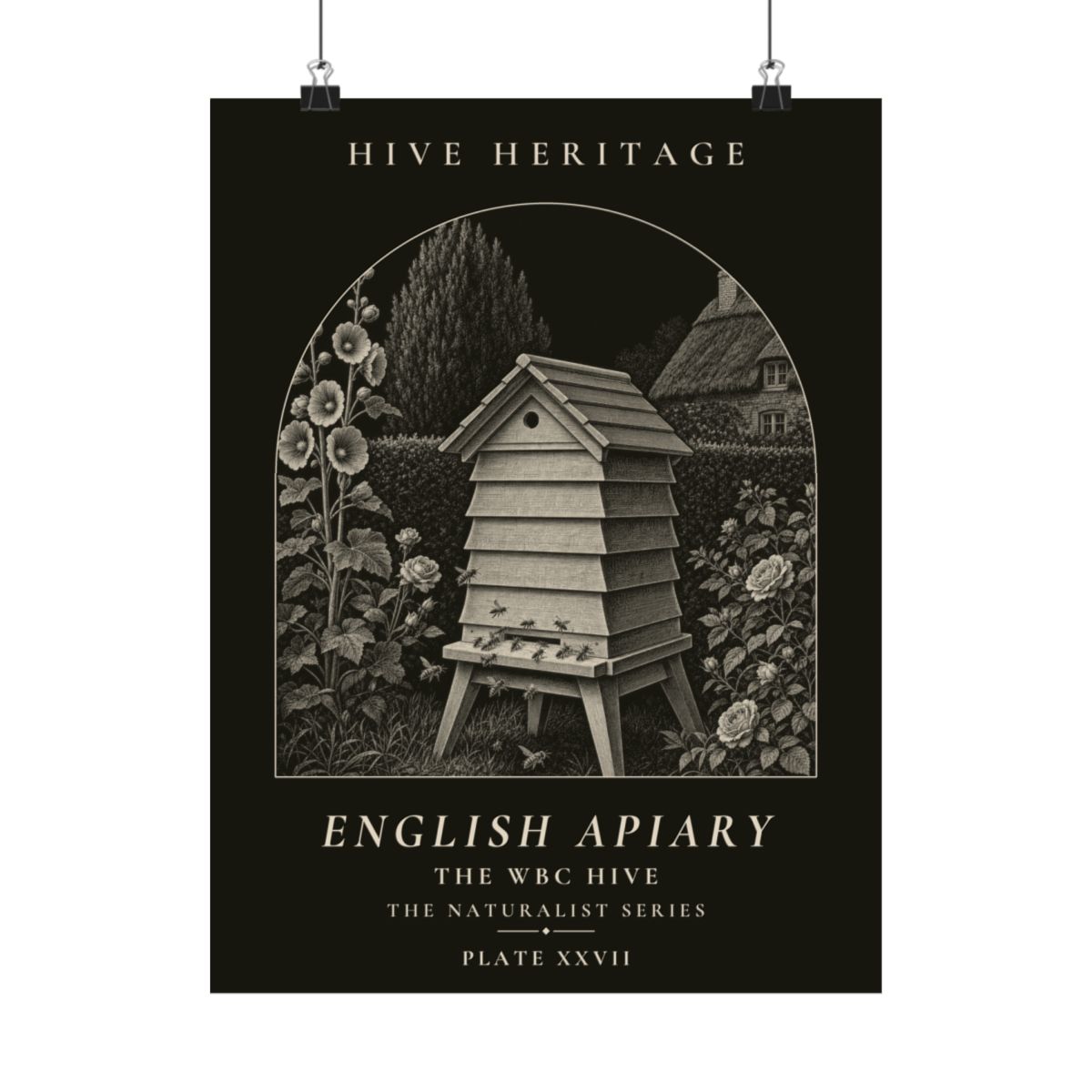
A WBC hive is the pale, tiered beehive with a gently pitched roof and a small landing board that most people in Britain picture when they think of a beehive. It takes its name from William Broughton Carr, the beekeeper credited with designing it around 1890, whose plain inner box for the frames is wrapped in tapering outer "lifts" that shelter it from the weather.
It sits in cottage gardens, on biscuit tins and in children's books, and has come to stand for beekeeping itself, even though most working beekeepers have long since moved to something plainer. We think that makes it more worth knowing, not less.
Who was WBC?
The letters are initials. The WBC hive takes its name from William Broughton Carr, a British beekeeper who is generally credited with the design, which is usually dated to around 1890. It is not named for a company or a place, and it was not, as people sometimes assume, a traditional country hive handed down through the centuries. It is a Victorian design, and a fairly late one.
That date matters. To see why, it helps to look at what came before.
For a very long time in Britain, bees were kept in skeps, the domed baskets of coiled straw that many people still picture first when they think of old beekeeping. A skep has one great drawback: the combs are fixed inside it, built wherever the bees choose. You cannot lift them out to look at the colony without largely destroying them, and in many cases the colony was killed in order to take the honey. Beekeeping in that form was more of a harvest than a husbandry.
The change came in the nineteenth century. In 1852 the American clergyman Lorenzo Langstroth patented a hive with removable frames, built around what is now called the bee space. Bees will fill a very small gap with propolis and a large gap with extra comb, but they leave a passage of roughly a centimetre clear, and Langstroth designed his frames to respect it. Because nothing was glued fast, a keeper could lift out a frame, inspect it, and put it back. Almost every modern hive descends from that idea, and the WBC is no exception.
So the WBC is not a rival to the movable frame. It is one of the British answers to it, arriving several decades after Langstroth, and using the same principle inside a very different outer shell.
How does a WBC hive work?
Look at a WBC and you are really looking at two hives, one inside the other.
At the centre is a plain, square box that holds the frames where the bees raise their young and store their food. This inner box is the working hive. It is where the colony lives. Around it, and slightly wider, stand the outer boxes known as lifts. These have no floor and no frames. They slide down over the inner box like sleeves, one on top of the other, and a roof with a shallow gable caps the whole thing. The sides of the lifts are traditionally tapered, which gives the WBC its familiar splayed, bell-like outline.
The purpose of that outer casing is protection. The lifts hold a layer of still air around the inner box, and they keep rain and wind off it. The idea, as it was put by the design's supporters, was to give the colony something like a coat: a hive that would be steadier through a cold, wet British year than a single thin wall of wood. The roof shelters the top, and the outer walls shelter the sides.
We should be careful here. That is what the design was meant to do. How much difference the double wall makes to the bees themselves is a question on which keepers have disagreed for generations, and we are not aware of a settled, decisive answer. What can be said plainly is that the outer walls keep the weather off the inner box, and that this was the intention behind them.
The inner box uses the standard British frame, which gave the hive a common language with other British equipment. Frames of that size can be moved between compatible boxes, and boxes can be added on top as the colony grows and the season's stores build up. A keeper adds extra boxes above the main one for the bees to fill, and in a WBC the outer lifts are stacked up to match, so the sleeve keeps pace with what it covers.
Why did the WBC hive fall out of everyday use?
If the WBC is so handsome and so well protected, why do you see so many plain boxes in an apiary instead?
The answer is work. To look inside a WBC, the keeper first has to take off the roof and then lift away each outer sleeve in turn before the inner box can be reached. Then everything has to go back in order. On a warm afternoon with a single hive in the garden, that is a small chore. With a dozen hives, or with hives that must be moved from one site to another, it becomes a real burden. The outer lifts are extra timber to buy, extra timber to paint, and extra timber to keep in good repair. They also add weight and awkward corners to anything that needs carrying.
There are other drawbacks that beekeepers point to. The layers can shelter pests and damp between them if the hive is not kept in good order, and all that additional woodwork is more to maintain over the years. None of these is fatal. They are simply the price of the design, and for people running more than a few colonies the price came to seem too high.
The plainer single-walled hive took over. In Britain that meant above all the National hive, a standard design associated with the British Beekeepers' Association in the early twentieth century, along with the larger commercial box favoured by those who keep bees for a living. They are less picturesque and easier to work. Today, if you visit a working apiary in Britain, the chances are that you will see boxes of that sort, and only the occasional WBC.
Yet the WBC did not disappear. It survived, and in a way it thrived, in exactly the place where its weaknesses matter least: the garden. A keeper with one or two colonies, no need to move them and a wish to see something lovely at the bottom of the lawn will very often choose a WBC. It has become, in the best sense, a hobbyist's hive. It is looked after with affection, painted with care, and shown off.
Where does the WBC hive fit in beekeeping history?
It helps to think of the history of the hive as a series of answers to a single question: how do you keep bees without harming them, and how do you keep them well?
The skep answered it with shelter and simplicity, but gave the keeper no way of seeing inside. Langstroth answered it with movable frames and the bee space, and that changed everything. The WBC came afterwards as a British reply, keeping the movable frame but wrapping it in a protective shell and giving the whole thing a form that people found beautiful. The National and the commercial box came later still and took away the shell for the sake of speed and practicality.
Seen that way, the WBC is a stage in a longer conversation and not a relic. It records a particular moment, when beekeepers had the movable frame and were still thinking hard about how best to house it, and when a hive could be a piece of garden furniture as well as a piece of equipment.
A few myths tend to gather around it, and it is fair to name them. One is that the WBC is an ancient design. It is not; it belongs to the late nineteenth century. Another is that the letters stand for something to do with bees. They stand for its designer's initials. A third is that a WBC is somehow kinder to bees than any other hive. There is no good basis for saying so, and we would rather leave that claim out than repeat it.
What remains is the shape, which is real and which is lovely. The tapering sleeves, the gabled roof, the small entrance low down and the white paint against green leaves have given the hive a hold on the imagination that no plain box is ever likely to have. It is the beehive as most of us first learned to see it, and it deserves to be looked at properly.
That is the spirit in which we made the plate. Our Naturalist Series artwork is digital, drawn in the manner of a classic engraving: it is not an antique, and it is not a hand-engraved original. It takes the WBC hive as its subject and gives it the patient, detailed treatment that natural history illustration has always given its subjects, the tiers, the roof and the entrance all studied with care. If this piece has made you want to look at the hive more closely, the plate is the place to do it, and you will find it linked below.
See it in the Naturalist Series: The WBC Hive plate