
Naturalist Series · 29 September 2026
The Warré Hive and Abbé Warré's People's Hive
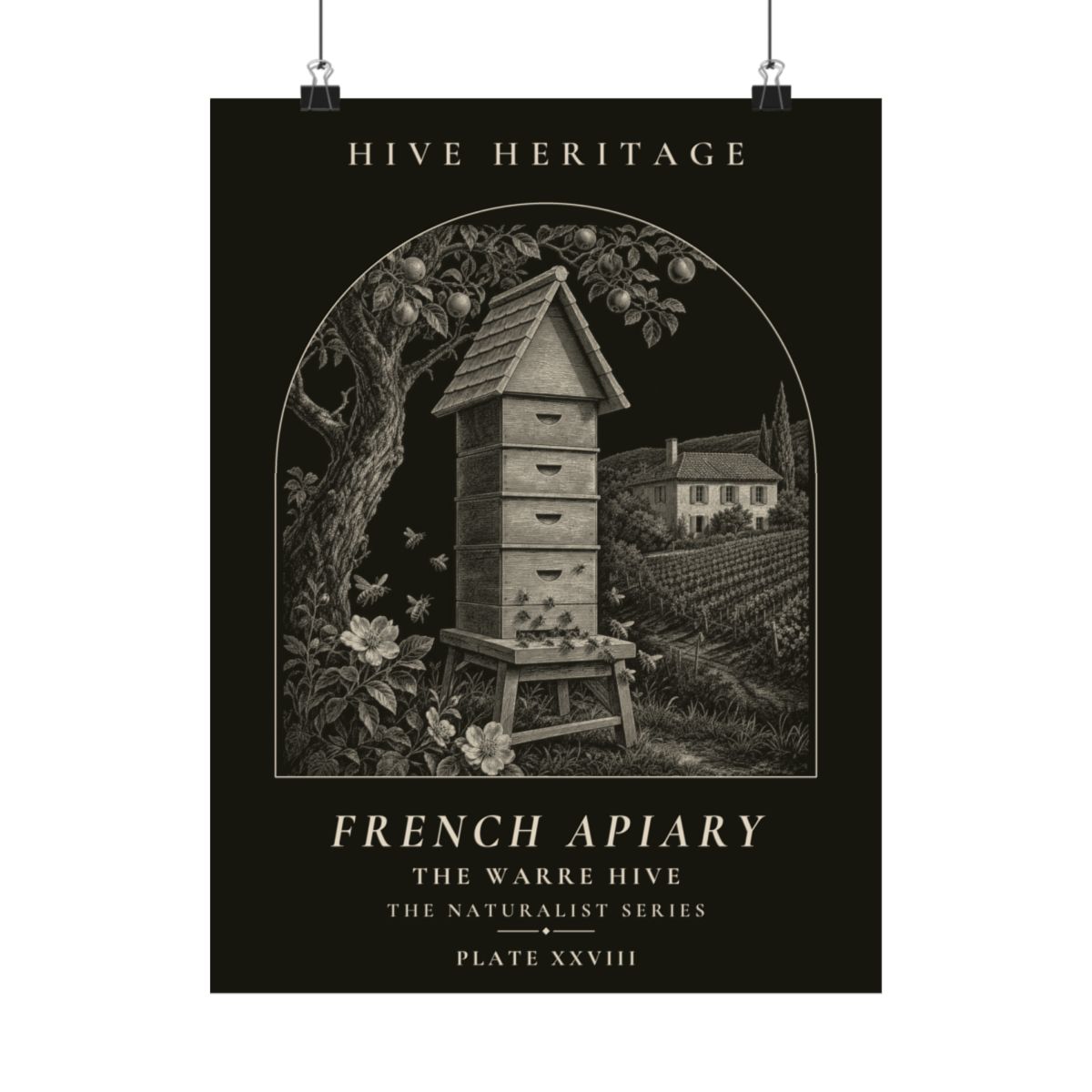
The Warré hive is a stack of identical square wooden boxes, each roughly 30 cm across and 21 cm deep, fitted only with wooden top bars so the bees build their own comb rather than using frames or foundation. It takes its name from Émile Warré (1867-1951), a French Catholic priest known as Abbé Warré, who compared many hive designs before settling on this one and called it la ruche populaire, the People's Hive, because he wanted a hive an ordinary person could build cheaply and manage with a light touch.
Most hives ask the beekeeper to think like a manager: frames, foundation, queen excluders, supers going on and coming off. The Warré hive asks a different question: what if the box were as close as possible to the cavity a swarm would choose for itself? That question is at the heart of the plate in our Naturalist Series called The Warré Hive. Here is the real story behind it, as far as the record supports it, including the places where the record runs out.
Who was Abbé Warré?
The hive takes its name from Émile Warré, a Frenchman who lived from 1867 to 1951. He is usually called Abbé Warré, because he was a Catholic priest as well as a beekeeper. His working life sat in the early twentieth century, when the movable-frame hive was well established in France and elsewhere, and when many keepers still worked with traditional straw skeps and simple fixed-comb boxes.
Warré did not begin with a theory and build a hive to suit it. By his own account, he kept bees in a great variety of hive designs and compared how they did in practice, over many years. The design that came out of that comparison he called la ruche populaire, the People's Hive. The word "people's" matters. He wanted a hive that an ordinary person with little money and modest workshop skills could make and manage, without specialist equipment and without spending long hours at the hive.
He set out his method in a book, L'Apiculture pour tous, first published in 1923 and revised in later editions. The title translates as "Beekeeping for All". An English translation, Beekeeping for All, was later prepared by David Heaf, and it is largely through that translation that English-speaking beekeepers came to read Warré in his own words. The book is brisk and practical. It reads like a man who has done the work and sees no need to dress it up.
One caution is worth stating plainly. Warré is sometimes turned into a romantic figure in modern retellings, a monk quietly defying industrial beekeeping. The documented picture is simpler and more interesting: a working priest and keeper, doing careful comparison, aiming for a low-cost hive and light-touch management. We have kept to that.
How does a Warré hive work?
A Warré hive is a stack of identical square wooden boxes, each roughly 30 cm across inside and roughly 21 cm deep. Each box carries wooden top bars across its opening. There are no frames and no sheets of wax foundation. The bees are left to build their own comb, hanging from the bars, in whatever pattern suits them.
Above the top box sits a shallow box called the quilt, filled with an insulating material such as straw or wood shavings, and above that a roof. Below the bottom box sits a floor. The quilt is there to buffer temperature and take up moisture rising from the cluster, so that condensation does not drip back onto the bees. That is the reasoning Warré gave for it, and it is a sensible reading of what a hollow tree does, where the thick wood around a colony does similar work.
The most distinctive feature is the direction in which the hive grows. In a modern Langstroth-style hive, the beekeeper adds boxes on top, a practice called supering. In a Warré hive, the beekeeper adds new empty boxes at the bottom, beneath the existing stack. This is called nadiring. It fits the way honeybees expand a nest in nature: they build comb downwards from the top of a cavity, keep brood in the middle and store honey above it. As the colony grows and moves down, the oldest comb ends up at the top, where the stores are.
At harvest, the beekeeper takes the top box, which by then is mostly honey comb. Because the comb is attached to the bars and the box walls rather than held in a frame, it is cut out. It is not spun in an extractor. This gives the beekeeper wax and honey together, and it also means the comb is used once and rebuilt, rather than reused year after year.
Here is the whole cycle, in order:
- A colony is housed in one or two boxes, with the top bars set across.
- As the bees fill the space, an empty box is added underneath.
- Through the season, the stack grows downwards.
- The top box, with the oldest comb and the stores, is removed at harvest.
- The colony is left with the boxes beneath to overwinter in.
Warré intended that the keeper would look at the hive from outside far more than from within. The bars are not lifted one by one the way frames are. Much of the reading of a colony is done by watching the entrance, listening, and judging the weight of the stack. That is where the "hands off" reputation comes from, and it is an accurate description of his intent.
Is a Warré hive better for bees?
The appeal of the Warré hive is that it resembles a natural nest. It is worth being exact about how far that comparison goes.
Studies of wild honeybee colonies nesting in trees, notably the work of Thomas Seeley, found that colonies choosing their own homes prefer cavities of roughly 40 litres, with a small entrance near the bottom. Two Warré boxes together hold something close to that volume, which is a neat coincidence. But it is only a comparison we are drawing now. Warré did not build his boxes to fit that research, and we would be inventing a history if we said he did. His dimensions came out of his own trials and his aim of a hive that was simple to make and to handle.
There is also an honest limit to the claims sometimes made for the design. It is often said that a Warré hive is better for the bees, or gentler on them, than a frame hive. The available evidence does not settle that. A hive shape is one factor among many, and colony survival depends heavily on the keeper's care, on the season and on the pests and diseases present in the area. The Warré hive was designed to be simple, cheap and low-intervention. Those are real virtues. Whether it produces healthier colonies than other well-managed hives is a claim we will not make on the bees' behalf.
A practical point sits alongside this. Warré wrote well before the varroa mite spread through European and British apiaries. That mite reached the United Kingdom in 1992, when it was first found in Devon. Keepers who use fixed-comb or top-bar systems today have to think about how to monitor and manage it, since combs cannot simply be lifted out and inspected like frames. Many rely on watching debris on the floor and on carefully chosen management, and beekeeping associations are the right place to learn current practice. Warré's book is a historical and practical source. It is not a modern disease-management manual.
Where it sits in the story of beekeeping
To see why the Warré hive matters, put it in its place in the long line of hives.
For most of history, people kept bees in hollow logs, clay pots, baskets and straw skeps. In many of these the comb was fixed, and taking honey usually meant cutting comb out, sometimes at the cost of the colony. In 1852 in the United States, Lorenzo Langstroth patented a hive with movable frames, built around the idea of "bee space", the gap bees will leave open rather than fill with wax or propolis. That single idea made it possible to lift out comb without destroying it, and it changed beekeeping across the world.
Warré's hive comes after all of that, and it is best understood as a deliberate step sideways. It keeps some of the tidy modularity of a stack of boxes, a lesson from the movable-frame era. But it turns away from frames and foundation, and it turns back towards a hive shaped like a natural cavity, managed lightly. It sits between the skep and the frame hive, borrowing something from each.
In the decades after Warré's death, his hive was known mainly in France. From the beginning of the twenty-first century, and especially as English editions and forum discussions spread, it became well known among keepers interested in more natural, lower-intervention methods. It sits alongside the top-bar hive, which many keepers use in a horizontal form, as one of the best-known alternatives to the standard frame hive. It is a minority choice, and we would rather say so than imply that it has replaced anything.
What makes it lasting is not a claim about yield or health. It is the clarity of the idea. A hive is a home before it is a tool for honey, and a stack of boxes can be made to serve a colony's habits instead of forcing them into a keeper's routine. Whether you keep bees or simply like reading about them, that is worth sitting with.
The plate we have made for The Warré Hive is digital engraving-style artwork. It is our own drawing in the manner of an old natural-history plate, not an antique print. It shows the stacked boxes, the quilt and the roof, the parts described above, in the quiet, careful way this series tries to treat every subject. If the story here has stayed with you, the plate is waiting in the shop, linked below.
See it in the Naturalist Series: The Warré Hive plate