
Naturalist Series · 29 September 2026
Tupelo Forage: The Swamp Tree Behind a Famous Honey
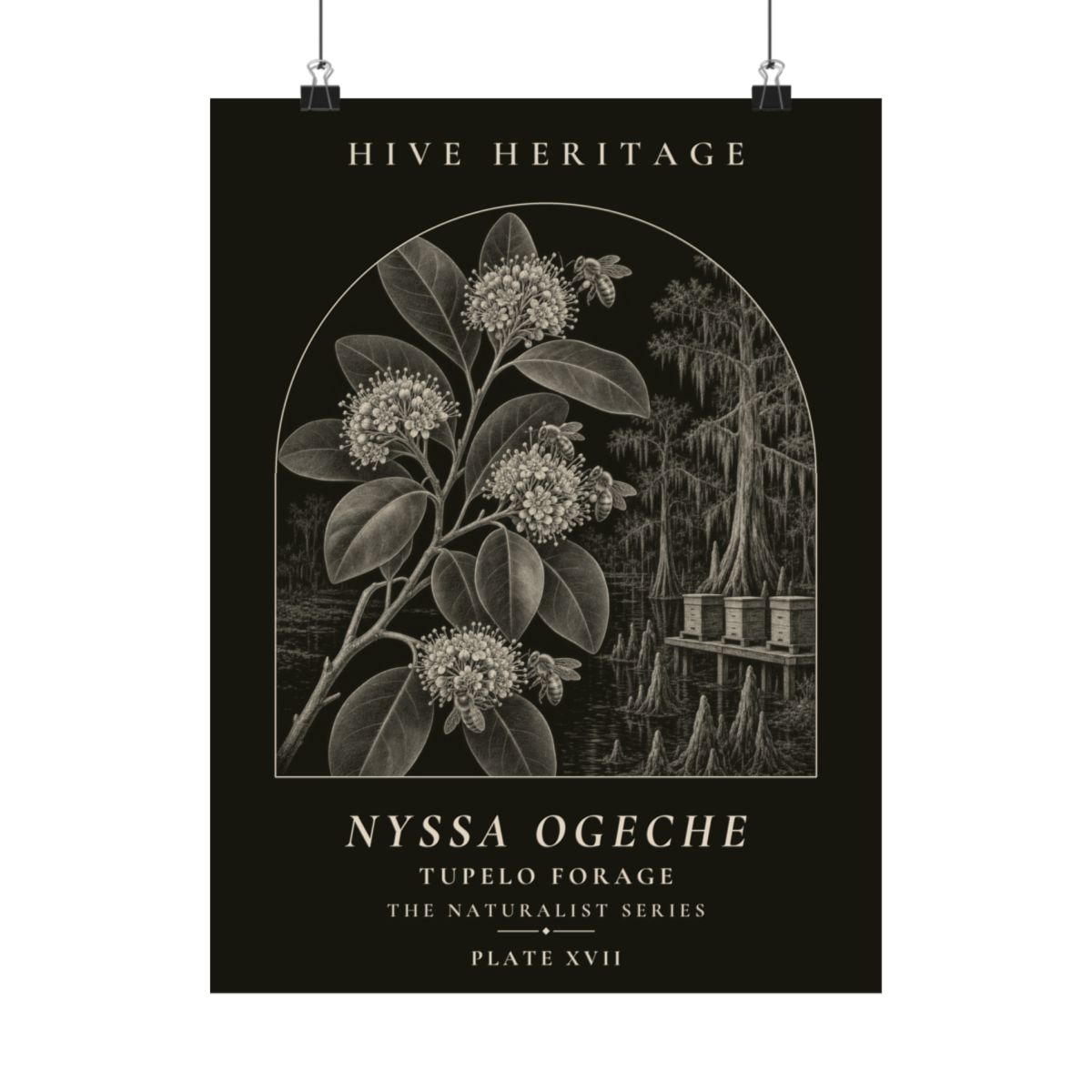
Tupelo honey comes from the Ogeechee tupelo (Nyssa ogeche), a swamp tree native to the river floodplains of the Florida panhandle and southern Georgia. It flowers for only a few weeks each spring, and the honey it yields has a lasting reputation among beekeepers because it is slow to crystallise, staying liquid far longer than most honeys thanks to a sugar balance rich in fructose.
When we drew the Tupelo Forage plate for the Naturalist Series, we wanted to begin with the plant rather than the jar. It is the tree that explains everything else, so that is where this piece starts.
What is tupelo and where does it grow?
"Tupelo" is the common name for trees in the genus Nyssa. The one most tied to beekeeping is the Ogeechee tupelo, Nyssa ogeche, a native of the south-eastern United States. It grows in the floodplains and swamps of rivers in that region, and it is particularly associated with the river valleys of the Florida panhandle and southern Georgia. The common name Ogeechee comes from the Ogeechee River in Georgia. The word tupelo itself is commonly traced to the Creek language, from words meaning roughly "tree" and "swamp", which is a fair description of where you find it.
There are other tupelos, and it helps to keep them apart. The water tupelo, Nyssa aquatica, also grows in wet ground across the south-east. The black tupelo, Nyssa sylvatica, has a much wider range and is a familiar tree in eastern North America, valued for its brilliant autumn colour. Each of these can be visited by bees. When people speak of tupelo honey in the sense that has made the name famous, they are usually speaking of the river-swamp trees of the panhandle region, and it is the Ogeechee tupelo that most often carries the story.
The genus name has its own small piece of classical borrowing. Nyssa is generally explained as a Greek water nymph, which suits a tree that keeps its roots wet. The Ogeechee tupelo has a swollen base, widening where the trunk meets standing water, and it can look a little like a column rising out of a mirror on a still day. It is deciduous, and in the wild it is a tree of the wet margins rather than the open forest.
The fruit is worth a mention, because it is the other reason this tree gets remembered. It is a small, oval, reddish to purplish drupe with a sharp, acid flesh. It has traditionally been known as the Ogeechee lime, and it has been used in preserves. That is a food use of the fruit rather than of the honey, and I mention it only as a reminder that the tree gives more than one thing to the people who live near it.
Why doesn't tupelo honey crystallise?
The Ogeechee tupelo flowers in spring, commonly around April into early May in the panhandle region, and the flowering is brief. Beekeepers describe a window of a few weeks. The flowers are small and inconspicuous, greenish white, and the trees have separate male and female flowers, borne in clusters on the same tree or on different ones depending on the individual. That is a detail worth knowing if you want to look closely, because you will not find a showy petal to point to.
What the bees want is the nectar. A colony working the tupelo bloom brings in a sudden flow, and the honey stored from it is the reason the tree is known beyond its swamp. It is described by beekeepers as light in colour, often with a golden or slightly greenish cast, with a mild and distinctive flavour. Flavour is personal, and I would not tell you what you will taste. What can be said with more confidence is a well-known physical trait: tupelo honey is widely reported to be slow to crystallise, because of the balance of its sugars, with more fructose than glucose. Honeys that are rich in glucose set solid sooner, and those richer in fructose stay liquid for longer. This is a matter of chemistry and storage, and says nothing about whether the honey is good for you. We make no such claim, and neither should anyone selling honey.
Pollen is a fair question, given that a bee forage plant is usually judged on both. Honey bees do visit tupelo flowers, and the tree is described in beekeeping literature chiefly as a nectar source. I have not found a source I would trust for the detail of its pollen, so I will not guess at how much or how good it is. The nectar is the part of the story with a long record behind it.
Weather matters here more than it does for many plants. Because the bloom is short and the trees stand in wet, low ground, a cold snap or a run of poor weather at the wrong moment can cut into the flow. Beekeepers in every region know this feeling. A plant with a flowering of only a few weeks gives no second chance.
How is tupelo honey harvested?
The interesting thing about tupelo is not only the plant but the way people have kept bees around it. The trees grow in ground that is wet, sometimes flooded, and not made for a row of hives on a flat farm field. Beekeepers in the tupelo country have long had to solve the problem of getting colonies close to the trees. Accounts of the trade describe hives being placed on raised platforms or moved on boats and barges on the rivers, so that the bees are set down among the flowering trees and can be reached when the flow is on. It is a practical answer to a landscape that does not give you a road.
There is a second problem, and it is the one that shapes the whole craft. Tupelo does not flower alone. Other plants in the same region bloom before and around it, and bees will happily gather from all of them. A beekeeper who wants a honey that is mainly tupelo has to manage the hive so that earlier honey is out of the way before the tupelo flow begins, and so that the boxes filled during the bloom are taken off promptly at the end. Titi, another swamp shrub of the region, is often mentioned as a neighbour whose earlier bloom can mix into the stores. The method, as beekeepers describe it, is timing and attention: watch the trees, clear the boxes, add fresh space, and take the honey off at the right moment.
This is why the phrase "pure tupelo" carries weight in that trade. Purity there is not a slogan. It is the result of a beekeeper reading the season closely and managing the boxes around a short window. I would not wish to attach a number to how pure any particular jar is, and I will not, since I have no source that gives one. The point is only that the reputation was built by careful work rather than by luck.
If you keep bees in Britain, some of this will sound familiar. We have our own short flows: the oilseed rape that comes and goes, the lime that can be brilliant or nothing depending on the week, the heather on the moor that demands a lorry or a long walk. The instinct is the same. You learn where the forage is, how long it lasts, and what else is flowering nearby, and you arrange your boxes to suit. Tupelo simply asks the same questions in a wetter place, with a boat instead of a trailer.
A well-known film of the late 1990s, about a beekeeper in the Florida panhandle working tupelo, brought the tradition to a wide audience. I mention it for what it is, a piece of popular culture that pointed at something real, and not as evidence of anything about the honey or the trees.
Why the plant deserves a plate
A natural-history plate is a way of looking slowly. It asks you to stop at a plant you might otherwise skip, and to notice the leaf, the flower, the fruit, the habit of the tree. Tupelo repays that attention because it is a case where the plain-looking plant has the bigger story. Nothing about the blossom prepares you for its reputation among beekeepers.
The habitat is part of it. A river swamp is a landscape defined by water, and a tree that stands in it is bound up with the rise and fall of the river. I would like to say more about how that habitat is faring today, but I do not have a source I trust to make specific claims, and this series does not make conservation claims that it cannot support. What I can say is that the tree grows where the water is, and that the bees and beekeepers who work it have to go where the water is too.
The plate itself is digital engraving-style artwork. It is not an antique, and it is not a hand-engraved original. It is a modern drawing made in the manner of the old natural-history engravers, and it is there to help you look at the plant, the way a good plate always has. We made it for beekeepers, and for anyone who loves bees and natural history and wants to see a swamp tree given the same care as a rose or an oak.
If this piece has made you curious about tupelo, the design is in our shop, on apparel and art made to order. Take a look at the plate and see whether it earns a place with you.
See it in the Naturalist Series: The Tupelo Forage plate