
Naturalist Series · 29 September 2026
How the Top-Bar Hive Lets Bees Build Their Own Comb
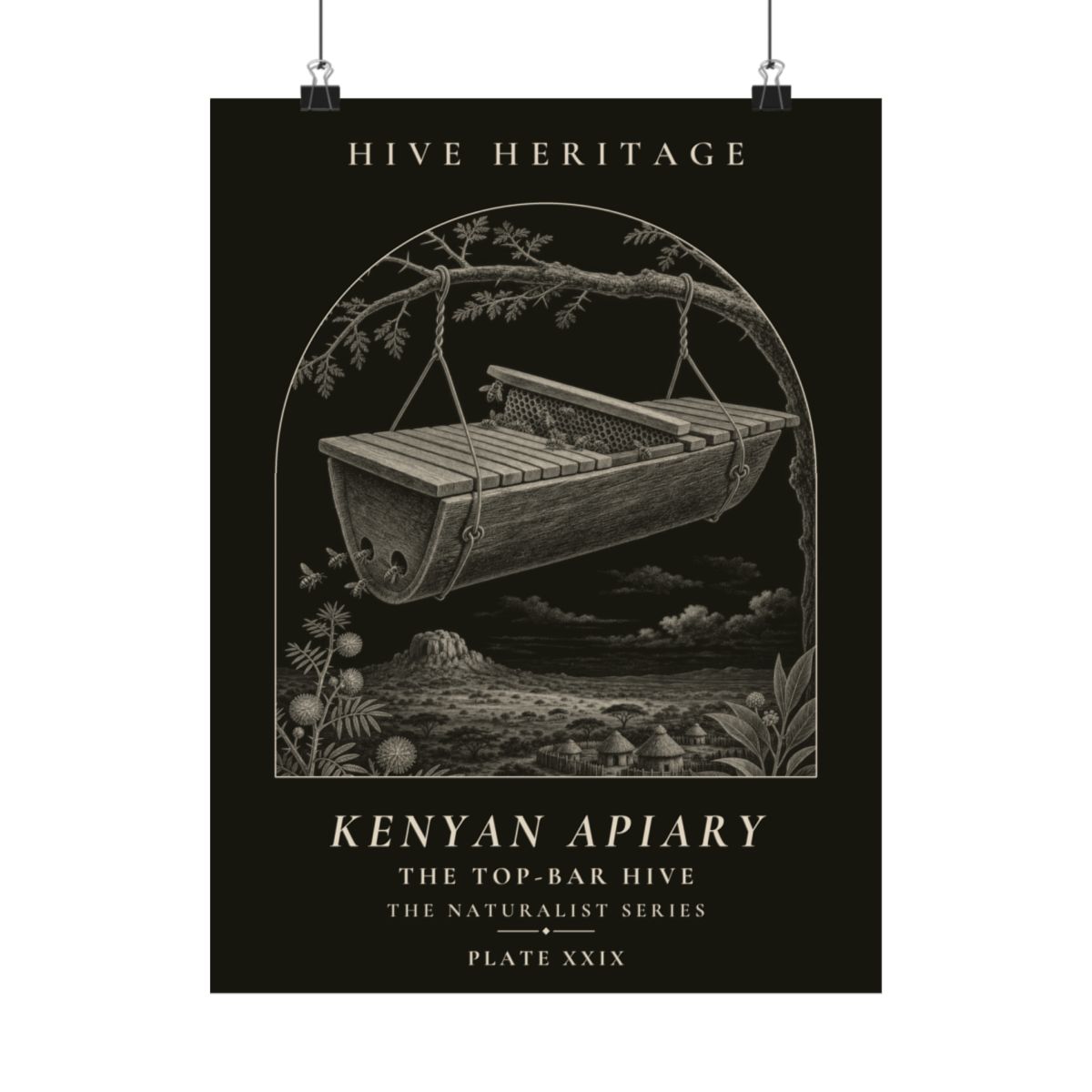
A top-bar hive lets bees build their own comb by giving them nothing but a bar to hang it from: no frames, no sheets of pre-printed wax foundation, just a row of wooden bars forming the roof of a long, shallow box. The bees fasten each comb to the underside of a bar and build it downwards in whatever shape and spacing suits them, which is why we wanted it among the plates in our Naturalist Series.
The hive itself is usually set horizontally on legs at about waist height, with the bars laid side by side across the top of the cavity. That single difference, comb left to grow as the colony shapes it, is what sets the hive apart from the stacked boxes most people picture when they think of beekeeping.
How do the bars in a top-bar hive work?
Honey bees in a natural cavity, such as a hollow tree, build parallel sheets of wax comb hanging from the roof. Each sheet sits a set distance from its neighbour so that bees can pass between them and work on both faces. The bars of a top-bar hive are sized to suit that habit. A bar is commonly somewhere in the region of 32 to 35 millimetres wide, close to the spacing bees themselves tend to keep from one comb's centre to the next. Many bars carry a small guide along the underside, such as a bevelled edge, a wedge or a thin line of wax, to encourage the bees to start their comb straight along the bar rather than wandering across several.
The bars also make the hive movable-comb. Each comb hangs from its own bar, so the beekeeper can lift out one comb at a time and look at it, then put it back. That matters more than it sounds. Before movable comb, a beekeeper could not properly inspect a colony without destroying part of it. Being able to see the brood, the stores and the state of the colony without wrecking the nest changed what beekeeping could be, and the top bar is one of the oldest ways of achieving it.
Most top-bar hives are also made with sides that slope inwards towards the bottom, giving the cavity a shallow trapezoid section. The slope is a practical trick. Bees tend to fasten comb to the walls, and with sloping sides they are less inclined to attach it there, which makes the combs easier to free. Some designs use vertical sides instead, and the two are argued over cheerfully by people who keep them.
Inside, a movable board, often called a follower board, closes off the empty end of the box. The colony starts at the entrance end, and as it grows the beekeeper moves the board back to open up more room. Bars are added ahead of it. In this way the nest expands along the length of the hive, one comb after another, rather than upwards in added boxes.
Who invented the top-bar hive?
It is tempting to give every hive a name and a date, and the top-bar hive resists it. Beekeepers have kept bees in baskets, pots, logs and boxes for a very long time, and in parts of the Mediterranean, including Greece, hives fitted with a row of bars across the opening have a long record of use. We would rather say plainly that the bar principle is old and was arrived at more than once than pretend to a tidy origin story we cannot support.
What the record does give us is a clear sequence of steps towards movable comb in Europe. In the early nineteenth century, Petro Prokopovych in Ukraine developed a frame hive, and in 1838 the Silesian priest Jan Dzierzon introduced a hive with movable combs hanging from bars. Dzierzon's combs were often fixed to the walls by the bees, which made them awkward to lift. The missing piece was described in the early 1850s by the American clergyman Lorenzo Langstroth, who recognised what is now called bee space: a gap of roughly 6 to 9 millimetres that bees leave open as a passage and will not usually fill with wax or propolis. Build a hive so that the gaps between its parts fall in that range and the combs stay free. His patented hive of 1852, with its rectangular frames, went on to shape commercial beekeeping across much of the world.
The top-bar hive as many people now know it, especially the sloping-sided design usually called the Kenyan top-bar hive, belongs to a later chapter. It was developed in Africa in the twentieth century and promoted through development work as a low-cost hive that a beekeeper could build from local timber, without the precision-cut frames and foundation of the Langstroth system. A version with straight sides is known as the Tanzanian top-bar hive. Its appeal in that setting was simple: a box, some planks cut to width, and a bee colony that does the rest.
From there the design travelled. It found a following among people in Europe and North America who wanted a simpler and lower-lift way to keep bees, and among those who liked the idea of interfering as little as possible with the way a colony builds. It has stayed a smaller part of beekeeping than the frame hive, but a persistent one.
What are the pros and cons of a top-bar hive?
Here we should be straightforward, because top-bar beekeeping is sometimes described more dreamily than it deserves. It has real strengths and real demands.
On the plus side, there are no heavy boxes to lift. The beekeeper works along the side of the hive, handling one comb at a time, which is gentler on the back. The equipment can be simple to make. And because the bees draw their own wax, the comb they build follows the shape and spacing they choose.
On the other side of the ledger, natural comb is soft, especially when new and warm, and a heavy comb full of honey hanging from a single bar can break away if it is turned carelessly. Combs must be lifted and kept vertical, because tilting one sideways can put it under strain it was never built for. If the bars are not lined up carefully, the bees may build across two bars at once, and the tangle, known as cross-combing, is a nuisance to untangle. Harvesting usually means cutting comb away, which asks the bees to build replacement wax, and so top-bar hives are generally reckoned to give a smaller honey surplus than frame hives whose combs are emptied and returned. That is a trade-off the top-bar beekeeper accepts, and often welcomes, rather than a fault to be engineered out.
There is also a wider question of rules. Requirements for keeping bees, and for how colonies can be inspected, differ from place to place. Anyone thinking of keeping bees in a top-bar hive should look at the guidance in their own area and speak to an experienced local beekeeper first. A hive is a living colony, not an ornament.
Where it sits in the story of beekeeping
Seen from a distance, the history of the hive is a long negotiation between two wishes. One is to see and manage the colony without harming it. The other is to leave the bees to do what bees have always done. The skep, a coiled basket that had to be sacrificed or driven to harvest, gave the beekeeper little sight. The frame hive gave a great deal, at the cost of uniform frames and a good deal of equipment. The top-bar hive lands somewhere between them: movable comb, yes, but comb shaped by the bees themselves rather than by a printed sheet of wax.
That is why we find it worth a plate. The design is so plain that the whole idea is visible at a glance: a row of bars, and the pale combs hanging beneath them. Nothing about it needs decoration to be interesting, which is a good discipline for a piece of natural-history artwork too.
The plate for this article is digital artwork made in the style of an engraving. It is a modern piece, not an antique or a hand-cut original, and we have tried to draw the hive as the bees would recognise it, with the bars, the sloping sides and the combs hanging in their parallel sheets. If this story has made you look twice at a humble box of planks, the plate is our way of keeping that look on a wall or on something you wear.
See it in the Naturalist Series: The Top-Bar Hive plate