
Naturalist Series · 29 September 2026
The Worker: the bee that runs the whole colony
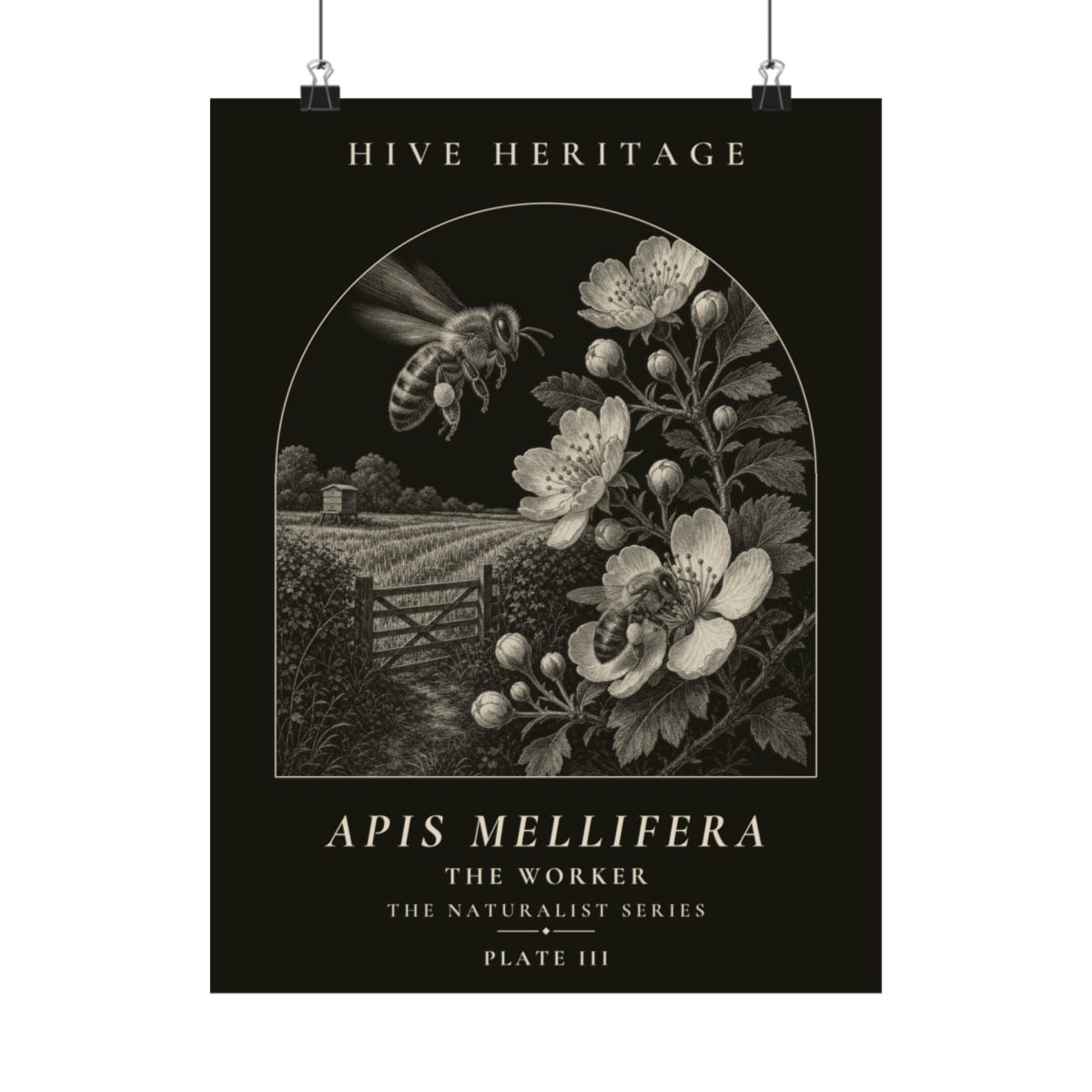
A worker bee is a female bee that does almost every job a colony needs: cleaning cells, feeding larvae, building comb, guarding the entrance and, in her last weeks, foraging for nectar and pollen. A colony in summer holds tens of thousands of her against a single queen, and she is the only reason that queen and hive survive at all.
We drew her for the Naturalist Series because she is the least celebrated member of the hive and the one who does nearly all the work. The queen gets the crown and the drone gets the myth. The worker gets on with it.
How is a worker bee made?
A worker starts as an egg laid by the queen in a hexagonal cell of wax comb. The egg hatches into a larva after about three days. Nurse bees feed the larva for roughly the next six, and then the cell is capped with wax while the larva changes inside it. The adult worker chews her way out around 21 days after the egg was laid. A queen takes about 16 days and a drone about 24, so the worker sits in the middle of the colony's timetable.
What separates a worker from a queen is not her egg but her food. Every female larva starts on the same rich secretion from nurse bees. Larvae destined to be queens keep receiving it in abundance, while worker larvae are moved on to a plainer diet, and the difference in feeding steers their development. A worker is a female whose reproductive organs stay undeveloped, so in a healthy colony she does not mate. Under some circumstances, in a colony that has lost its queen and cannot raise another, workers may begin laying unfertilised eggs. Those can only become drones, which is why beekeepers treat it as a sign of a colony in serious trouble, not a solution.
Numbers are hard to state honestly, because they swing so much with the season and the size of the colony. What can be said with confidence is that a colony in summer holds tens of thousands of workers, against a single queen and a much smaller number of drones. The colony is, in effect, a workforce with a queen at its centre, and the workforce is what a beekeeper spends the year looking after.
What jobs does a worker bee do?
For a long time people assumed that bees were simply born into a trade. Watching workers closely, and marking them so that individuals could be followed, showed something more interesting. A worker's tasks change as she ages, in a broad sequence that beekeepers and researchers have described for generations.
In her first days she cleans cells, so that the queen has clean comb to lay in. She then turns to the brood, feeding and tending larvae. Glands in her head produce the food that nurse bees give to the young, and she visits the same cells many times in a day. Later she may work on the comb itself. Wax is made by glands on the underside of a worker's abdomen, and it appears as tiny flakes that she pulls off, chews and shapes into the cell walls of the comb. Around the same stage she receives nectar from returning foragers, passes it mouth to mouth, and helps turn it into stored food. She packs pollen into cells. She fans her wings at the entrance to move air through the hive. She removes debris and the bodies of dead bees.
Later still she stands guard. Guard bees at the entrance check arrivals by scent, and a bee that does not smell like the colony may be challenged. The last chapter of her life, generally in her third week or later, is foraging. She leaves the dark of the hive for open air and does the work everyone pictures: collecting nectar, pollen, water and the sticky plant resins that bees use as propolis.
It is worth being careful about how rigid this is. The sequence is a tendency, not a rule. If the colony loses its foragers, some of the younger workers start foraging earlier. If there are too few nurses, some foragers can return to nursing duties. The colony adjusts its workforce to what it needs, and the worker's job depends on both her age and the state of the hive around her. That flexibility is one of the reasons a colony is so hard to defeat.
The forager's craft
A foraging worker is a remarkable piece of equipment. She carries nectar in a honey stomach, separate from the part of her gut that digests food. She carries pollen on her hind legs, in the stiff-haired hollows known as pollen baskets, and if you watch bees on a flower on a good day you can see the loads in bright colours that depend on the plants they have visited. She finds her way home by the sun, by landmarks and by scent, and at the entrance other workers can fan a scent from a gland near the tip of the abdomen to guide returning bees in.
Her best-known trick is the waggle dance, which the Austrian zoologist Karl von Frisch decoded over many years of patient watching, and for which he shared a Nobel Prize in 1973. On the vertical comb, a forager who has found a good source runs in a figure of eight with a waggling straight section in the middle. The angle of that straight run, measured against the vertical, corresponds to the angle of the food source from the direction of the sun. The length of the waggle relates to the distance. Other workers follow the dance, take in the information and fly out to look. Later research confirmed and refined the picture, and it still stands as one of the clearest demonstrations that an insect can pass on directions in a symbolic language.
The nectar she brings back does not become honey on its own. Workers in the hive add enzymes, pass the nectar between them and spread it thinly in cells while other workers fan their wings over the comb to drive off water. When it is thick enough, the cell is capped with wax. It is a slow, cooperative process, and no single bee could do it.
The work is hard on her body. A summer worker typically lives only around six weeks, and a forager's wings wear and fray. She often dies away from the hive, and this is one reason beekeepers do not find piles of bodies inside a healthy colony. Individually she is short-lived. It is the colony that persists.
The worker through the colony's year
The rhythm of the year is a rhythm of workers. In spring, as forage arrives and the queen lays more, the population climbs quickly. In early summer, a colony that has grown crowded may prepare to swarm, and a large part of the workers leave with the old queen to found a new nest, a moment that has fascinated observers and beekeepers for centuries. In the high season, workers store the surplus that a beekeeper may or may not take.
Then the year turns. Late summer and autumn workers are made differently from those of the busy months. The bees that carry a colony through winter are often called winter bees. They are raised as the season closes, they carry more fat body reserves than summer workers, and they can live for months instead of weeks. Drones are driven out of the hive as the forage ends. The workers do not hibernate. They form a cluster around the queen, and by working their flight muscles without moving their wings, they generate heat. Bees on the cold outer edge of the cluster move inwards, and warmer bees take their turn outside. Through the darkest weeks, the colony stays alive on stored food and on that shared warmth.
When the days lengthen, the winter workers begin rearing the first new brood of the year. They are the bridge between one season and the next. Once spring is established, they are replaced by a new generation of summer bees, and they wear out and are gone.
What have beekeepers learned from the worker bee?
Much of the craft of beekeeping is a matter of respecting what workers already do. The movable frame hive, developed in the nineteenth century, depended on the discovery that bees leave a small gap, about the width of a bee's passage, between combs. Leave that space free and the bees will not glue frames together with propolis or fill the gap with comb. A hive designed around that space lets a keeper inspect a colony without destroying its work.
The other lesson is about scale. You cannot really understand a colony by looking at one bee. A worker is a small creature with a short life, and yet the colony she belongs to regulates its temperature, chooses where to forage and manages its stores with a subtlety that still occupies researchers. When we say the worker runs the colony, we mean it quite literally. There is no manager. There is a great deal of individual effort, guided by scent, temperature, dance and the needs of the brood.
We have tried to draw her in that spirit, with attention and without sentiment. The plate is digital artwork made in the manner of an engraving. It is not an antique or a hand-engraved original, and we would not want you to think so. It is a modern study of a very old subject, and it is our way of giving the worker a little of the attention she has always earned. If the article has made you look twice at the next bee on the ivy, you will find the plate in the shop below.
See it in the Naturalist Series: The Worker plate