
Naturalist Series · 29 September 2026
The Wax Moth and the Honey Bee Colony
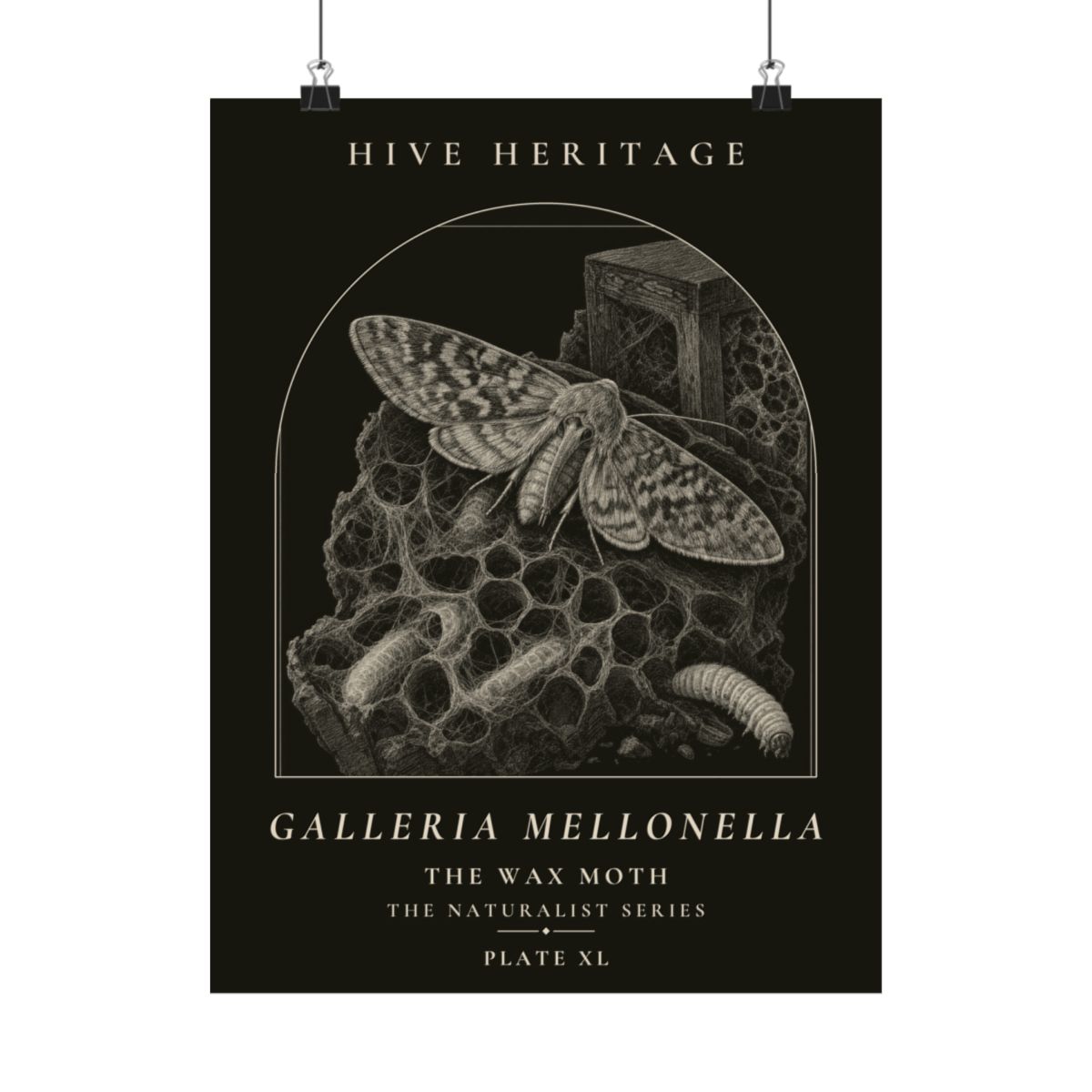
The wax moth is an insect whose caterpillars feed on old beeswax comb, tunnelling through it and leaving it laced with fine silk webbing. There are two species beekeepers meet, the greater wax moth (Galleria mellonella) and the smaller lesser wax moth (Achroia grisella), and most beekeepers meet one or the other sooner or later.
We included it in the Naturalist Series because it deserves better than its reputation. It is usually painted as a pest and left there. The truth is more useful, and a good deal more interesting: an insect that has made a living from the bees' own architecture, and a hive that has plenty of ways of keeping it in check.
Two moths, one habit
When people say "wax moth" they usually mean one of two species. The greater wax moth, Galleria mellonella, is the one most often discussed. The lesser wax moth, Achroia grisella, is a smaller relative that lives in much the same way. Both belong to the moth family Pyralidae, and both have made their living in and around honey bee nests.
The adults are not much to look at. They are dull, greyish or brownish moths, and they hold their wings folded over the body like a little roof. The greater is the bigger of the pair, the lesser noticeably smaller and paler. Neither adult feeds. The adult's job is to find a mate and a place to lay eggs, and then its short life is done.
The damage, where there is any, comes from the larvae. The eggs are laid in small crevices, in cracks in the hive body, in the gaps between frames, or on stored comb, where the bees cannot easily get at them. The caterpillars that hatch are pale, and they feed on what old comb is made of: beeswax, along with the pollen, cocoon remnants and cast larval skins that build up in it over years of use. As they feed they tunnel through the comb and spin silk behind them. That is the webbing you find, and it can mat a neglected frame into a tangled, gritty mess.
When a caterpillar is ready to pupate it spins a tough cocoon. It will often chew a shallow groove into the wood of a frame or box to make a bed for it, and beekeepers who have scraped old woodwork will know the small scars those cocoons leave behind. From the cocoon comes the adult moth, and the cycle begins again. How fast it turns depends heavily on warmth. In a cold shed it slows to a crawl, and in a warm one it speeds up.
Where do wax moths live?
The wax moth follows the honey bee. Wherever people keep honey bees, or wild colonies nest in hollow trees and cavities, wax moths are generally to be found, and the greater wax moth in particular is recorded across much of the world. That is not surprising. A bee nest is a warm, sheltered, food-rich place, and wax comb is an unusual food that few other insects have adapted to eat.
Here in Britain the wax moth is more of a nuisance in some places and seasons than a threat. The trouble tends to arise late in the year and in stored equipment, rather than in busy, healthy colonies in high summer. We would rather say that plainly than dress it up. The wax moth is part of the picture of keeping bees, and it is worth understanding, but it is not a reason for alarm.
Do wax moths harm a healthy bee colony?
A strong colony is the best defence there is. Worker bees patrol the comb, and they notice and remove wax moth eggs and young larvae. They also keep the nest packed with bees, so that there are few undisturbed corners where a moth could lay in peace. The comb in the centre of a populated nest is being tended, cleaned and used all the time, and that constant traffic is what wax moth larvae cannot stand up to.
Trouble arrives where that watchfulness fails. A colony that has become weak, has lost its queen, or has died out will leave comb that nobody is guarding. Wax moths can then move in, and in a short time the abandoned comb can be reduced to silk and debris. This is the thing to grasp about the wax moth: it is generally an opportunist that takes advantage of an already struggling or empty colony, and it is rarely the original cause of the trouble. Beekeepers sometimes find wax moth in a failed hive and blame it for the loss, when it arrived after the colony had already gone wrong.
There is one more quirk of the natural history that we cannot leave out. Moths are hunted by bats, and many moths have evolved ears to hear them coming. Researchers studying the greater wax moth have reported that it can hear at extremely high ultrasonic frequencies, among the highest recorded for any animal. Male lesser wax moths, for their part, are known to produce ultrasonic calls as part of courtship. All of this goes on in the dark, beyond the range of human hearing, in the same sheds and hives where beekeepers store their frames. It is a reminder that even the humblest hive pest has a hidden life.
How do beekeepers get rid of wax moths?
Beekeeping guidance on wax moth is broadly consistent, and most of it comes down to good habits rather than anything dramatic.
- Keep colonies strong. A populous colony guards its own comb. This is the first and best line of defence.
- Do not leave weak or dead colonies unattended. Comb from a colony that has died should be dealt with promptly rather than left standing in the apiary.
- Store spare comb with care. Supers and frames kept in a cool, airy, well lit place with good ventilation are much less inviting to the moth than those piled up in a dark, warm corner.
- Freeze frames when you can. Freezing is widely recommended as a way to kill every stage of the moth in comb that is going into storage, and it does so without chemicals.
- Look regularly. Checking stored equipment every few weeks means that any webbing is found early, when it is easy to put right.
Beekeepers in different countries use various other methods, and the rules about what may be used differ from place to place, so anyone keeping bees should follow the advice of their own national or local beekeeping body. What holds everywhere is the underlying idea: the moth is best kept at bay by good housekeeping, not by panic.
It is also worth saying what the wax moth is not. It is not something that attacks healthy, thriving bees, and it does not pass anything harmful to people. It is simply an insect that has found a food that beekeepers happen to leave lying about. An old comb that has been well stored is one the moth will never touch.
An insect that turned up in the laboratory
The greater wax moth has led a second life outside the hive. Its caterpillars are easy to rear, and they have long been sold as bait for anglers and as food for pet reptiles and birds. They have also become a familiar model animal in laboratories, where researchers use them to study how infections behave, because they are cheap to keep and simple to work with. So a creature that most beekeepers would happily see the back of is quietly doing useful work in science.
You may also have read that wax worms can "eat plastic". A 2017 paper did report that caterpillars made holes in polyethylene film and appeared to change it chemically, and it attracted a great deal of attention. The result has since been questioned, and researchers are still working out how much of it is real chewing and how much is real chemistry. We would call it an open question, and no more than that. It is a good example of how easily a natural history story can run ahead of what has been established.
Why it belongs in the series
We chose the wax moth for the Naturalist Series because a hive is not only bees. It is a small, warm world with its own residents, some welcome and some not, and the story of beekeeping is partly the story of learning to live among them. The moth is a fine subject for that. It is modest in appearance, patient in its habits, and closely tied to the wax the bees build.
The plate shows the wax moth as digital engraving-style artwork, drawn in the spirit of the natural history illustration tradition. It is our own artwork, made for this series, and we do not present it as an antique or a hand-engraved original. If this article has made you look twice at a pale flutter near a storage box, or at a cocoon groove in an old frame, the plate is there for you. You will find it in our shop, made to order.
See it in the Naturalist Series: The Wax Moth plate