
Naturalist Series · 29 September 2026
The Hornet, the Honey Bee and What Beekeepers Really See
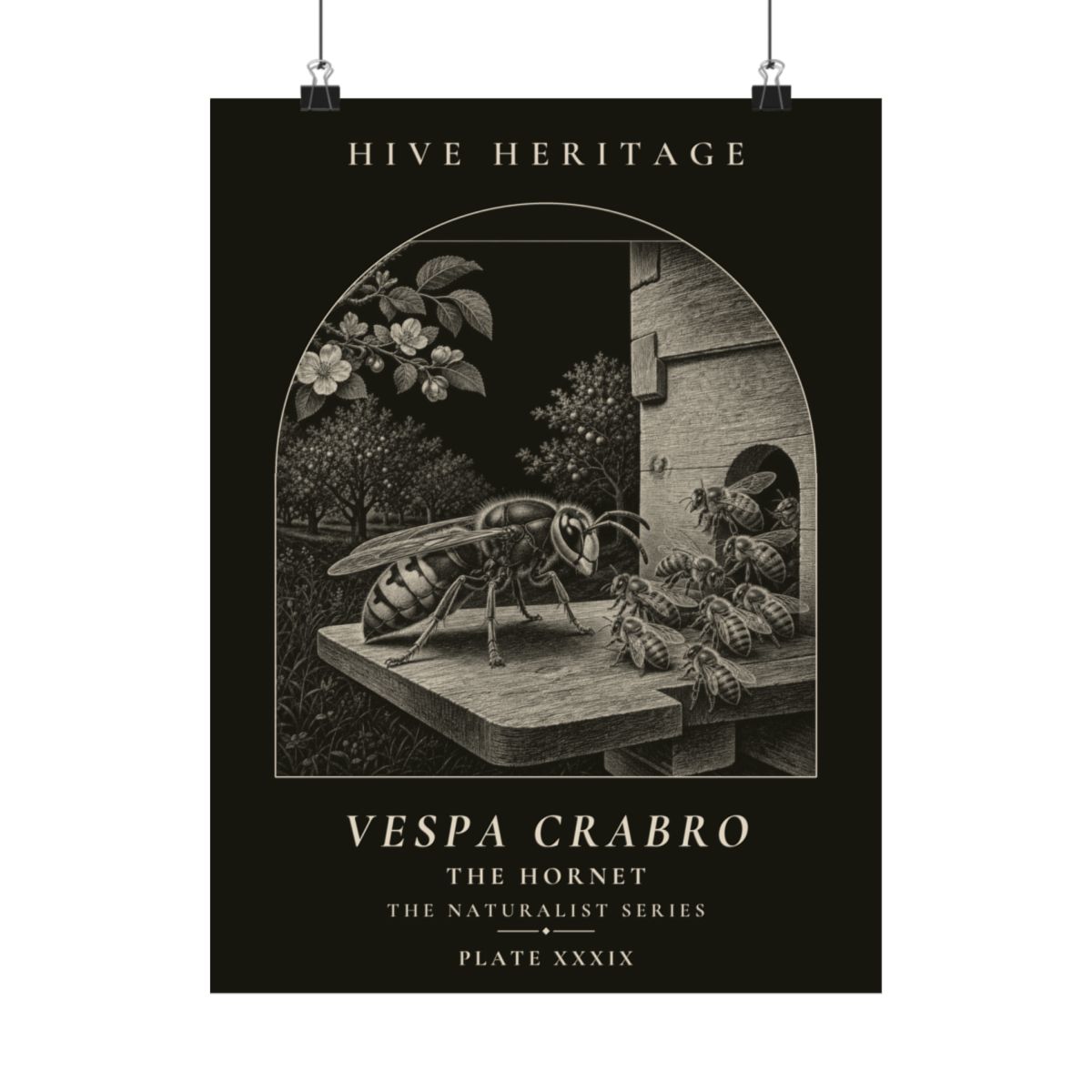
There are two hornets people mean when they say the word, and beekeepers see them very differently. The European hornet, Vespa crabro, is a large, amber-and-brown native insect that only occasionally picks off a bee near a hive entrance; the Asian hornet, Vespa velutina, is a smaller, darker, introduced species that specialises in hovering at entrances and can seriously weaken a colony.
We drew the plate called The Hornet because the animal deserves better than a scare story. This is the natural history behind it, told the way we prefer to tell it: what is known, what is not, and no more drama than the facts carry.
What's the difference between a European hornet and an Asian hornet?
The hornet most people in Britain meet is the European hornet, Vespa crabro. It is the largest social wasp we have. A queen can be well over three centimetres long, and workers are noticeably smaller but still bigger than the common wasps that crash a picnic. The colouring is warmer than a wasp's: a reddish brown head and thorax, and an abdomen banded in amber and dark brown rather than the sharp black and yellow of a wasp.
It is a genuine native, part of the insect life of Europe and reaching well into Asia. It was also carried to eastern North America long ago, where it settled. In Britain it is most often recorded in the south and east, though the map is not fixed, and we would rather you check a current recording scheme than trust a sentence in an article.
The second insect is the Asian hornet, Vespa velutina, and in Europe usually the form called nigrithorax. It is native to south-east Asia and is an introduced species in Europe, where it arrived in France and has since spread across a good part of the west of the continent. It is smaller than the European hornet, and it looks darker: a mostly dark brown or black body, one broad yellow-orange band further down the abdomen, and legs that are yellow at the tips, as if dipped. The rest of the field marks are best learned from an official identification sheet with photographs rather than from a paragraph, and if you think you have seen one in Britain, the right move is to report it rather than to argue with yourself about it.
In Britain the Asian hornet is treated as a notifiable concern, with sightings followed up by the National Bee Unit and its inspectors, who trace and destroy nests. That is the working response, and it is why a single sighting is a matter for reporting rather than for panic.
How a hornet colony lives
Both species live in colonies that last a single year. In spring a lone queen, who has survived winter tucked away in a sheltered crevice, wakes, feeds, chooses a site and builds the first cells of a paper nest. She rears the first workers herself. Once they hatch, she stays inside and lays eggs while they build, forage and feed the young.
The paper is made of chewed wood fibre mixed with saliva. It is the same trick a wasp uses, and the result is the papery, layered, grey-brown envelope most of us have seen hanging in a shed or a hollow tree. European hornets like enclosed spaces: hollow trunks, roof voids, old outbuildings, bird boxes. Asian hornets often begin low, then move and build very large nests high in trees, which is one reason they are hard to find in leaf.
Late in the season, a colony produces new queens and males. The new queens mate, feed up and disperse to hibernate. The old queen, the workers and the nest itself do not survive the winter, and a nest is not reused the following spring. This is worth knowing, because a tatty empty nest in a loft in January is simply an abandoned nest, not a threat.
Adults feed themselves largely on sugars: tree sap, ripe fruit, nectar. It is the grubs that need protein, so the workers hunt other insects, chew them into a pulp and carry it home. Flies, caterpillars, other wasps and bees all go into the pulp. That is the hornet's role in the wider picture. It is a predator among many, and in a healthy landscape it sits inside a web rather than on top of it.
Do hornets kill honey bees?
The honest answer is that it depends which hornet, and how many of them.
European hornets do take honey bees, among plenty of other prey. A hornet may be seen at an apiary now and then, and it can pick off a bee near the entrance. Beekeepers tend to describe them as a passing nuisance rather than as a serious threat to a colony. They are also unusual among their relatives in being active at night, which is why they turn up at lit windows, and they are generally placid unless someone disturbs a nest.
The Asian hornet is a different matter for honey bees, because it specialises. Workers hover close to a hive entrance, seize returning foragers in flight and carry the bodies off to feed the brood. With enough hornets at a hive, foraging can fall away, because bees that will not leave cannot bring home nectar or pollen. A colony under that kind of pressure can weaken. Whether a given colony is lost depends on the number of hornets, the strength of the bees and the time of year, and we will not put a percentage on it, because we have no verified figure to give you.
There is also a wider concern, which is the pressure on other insects that these hornets eat. That is a matter for ecologists to measure, and we would rather say so than guess at it.
One myth is worth naming. You will sometimes hear that three hornet stings can kill a person. We cannot support that, and it should not be repeated as if it were fact. A hornet sting hurts, sometimes a great deal, and anyone with a serious allergy to insect stings has good reason to take care around any wasp or hornet. But the frightening reputation is out of proportion to what the European hornet actually does, and it is the reason so many harmless hornets are destroyed each year.
How do honey bees defend against hornets?
The most striking piece of evidence in this whole story comes from Japan. The Japanese honey bee, Apis cerana japonica, has lived alongside large native hornets for a very long time, and it has learned a defence that is easy to admire. When a hornet scout arrives at the entrance, the bees do not sting it. A crowd of workers gathers around the intruder and forms a tight ball, and they vibrate their flight muscles. The heat inside the ball climbs until it is lethal for the hornet, but not for the bees, which can tolerate a slightly higher temperature. Research on this behaviour also points to the raised carbon dioxide inside the ball contributing to its effect. The hornet, in effect, is cooked.
This is a defence that evolved between animals that shared a landscape for a long time. The Western honey bee, Apis mellifera, the species kept in hives across Europe, has not shared its landscape with the Asian hornet, and it does not do this reliably. Beekeepers in Europe have reported that some colonies show defensive behaviour and some do not. It is an area of continuing study, and we would rather be honest about that than claim the bees have already adapted.
Bees do have simpler responses. Guard bees at the entrance become more numerous and more watchful. Foragers may hesitate to leave. Some colonies will cluster at the entrance and mob the hornet. None of this is a guaranteed answer to a determined predator, but it is real behaviour and it is worth watching.
How beekeepers respond
Beekeepers do not talk about winning a war against hornets. They talk about watching, managing and reporting.
The first job is to know what you are looking at. Learn the difference between the European hornet, the Asian hornet and the common wasp, using official identification material. The second is to watch the apiary during warm weather, especially late summer and early autumn, when hornet colonies are at their largest and hunting hardest. The third, if you suspect an Asian hornet in Britain, is to report it promptly to the official scheme rather than trying to deal with a nest yourself. Nests can be large, high and defended, and this is work for trained people.
On the hive itself, a smaller entrance is easier for the bees to guard. Keeping colonies strong, well fed and free of avoidable stress is sound husbandry in any case, and it is the best general protection a beekeeper can give. Some beekeepers use physical barriers over the entrance, and some use traps. Traps are debated, because they can catch harmless insects as well as the target, so anyone considering one should look at current guidance from the official bee health bodies and not at a forum thread.
Why the hornet belongs on a plate
We are a brand about bees and the natural world around them, and the hornet is part of that world. It is not a villain, and it is not simply a pest. A European hornet is a large, handsome, mostly peaceable insect that builds one of the most elaborate paper structures in the British countryside. The Asian hornet is a serious concern for beekeepers and a reminder of how far a single introduced species can travel. Between them, and alongside the Japanese bee's remarkable heat ball, they tell a story about predators, prey and the slow business of adaptation.
The plate The Hornet is digital engraving-style artwork, drawn in the tradition of natural-history illustration rather than copied from any antique original. It gives the animal the same careful attention a good plate always gave: the long body, the banded abdomen, the wings, the eye. If this article has made you look at a hornet a little more closely, it will look right on the wall or worn close to home, and you can find it in the shop below.
See it in the Naturalist Series: The Hornet plate