
Naturalist Series · 29 September 2026
The Eastern Honey Bee and How It Lives
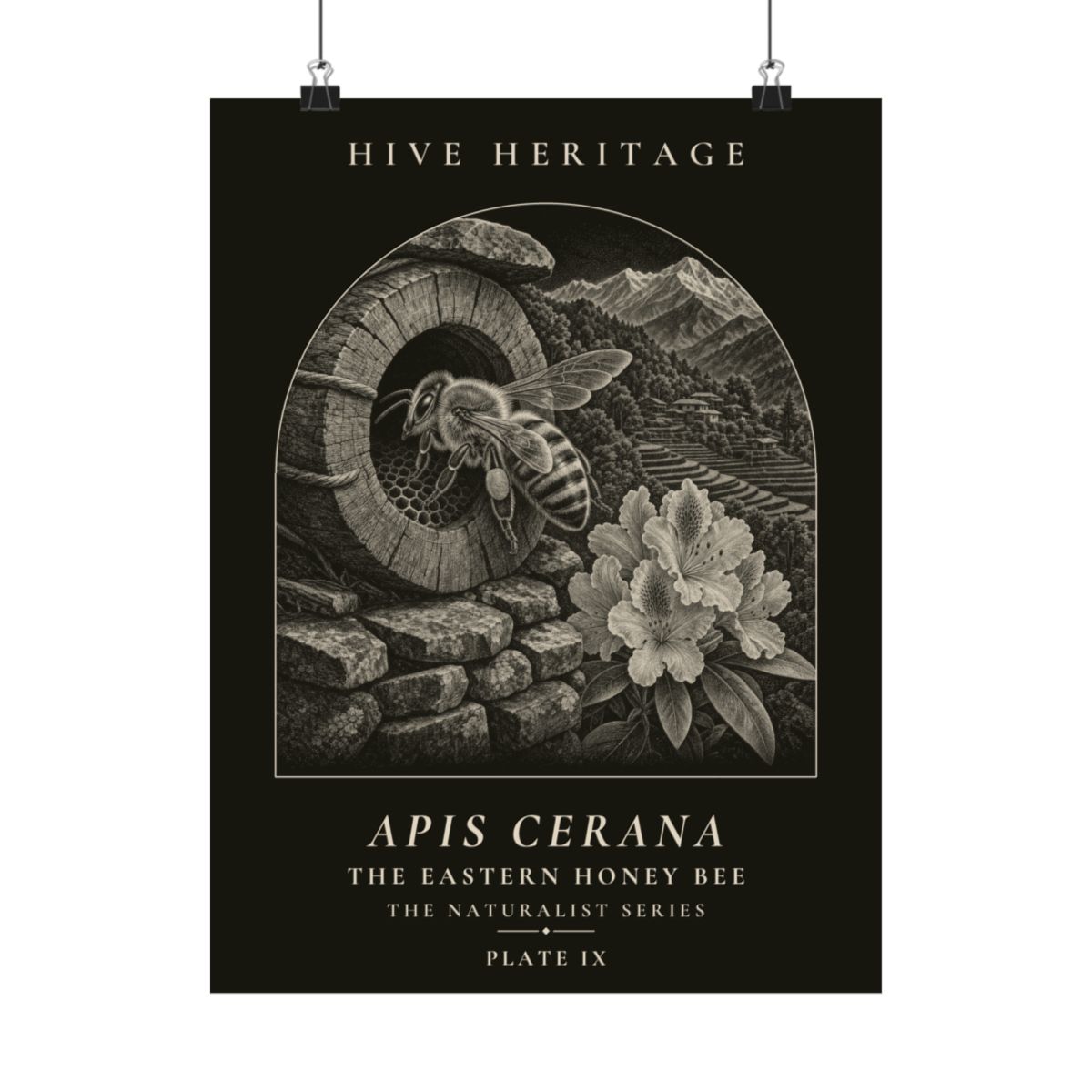
The Eastern honey bee, Apis cerana, is a honey bee native to Asia, found from Afghanistan and India through South-East Asia to China, Korea, Japan and the Russian Far East, where people have kept it in log and wall hives for generations. Like its better-known relative Apis mellifera, the western honey bee, it nests in cavities and builds parallel wax combs, but it keeps smaller colonies, dances a different dialect, and has evolved its own defences against hornets and the varroa mite. It is the subject of the plate in our Naturalist Series that this article accompanies.
We are a brand that makes apparel and natural-history art, not a laboratory, so we have leaned on published entomology and on the accounts of beekeepers who work with this bee. Where something is uncertain or varies from place to place, we say so.
What is the Eastern honey bee and where does it live?
The scientific name, Apis cerana, was given by the Danish naturalist Johan Christian Fabricius in 1793. It is sometimes called the Asiatic or Asian honey bee, and in Japan and parts of Korea and China, where it has been kept for a very long time, it has local names of its own.
Its natural range is Asia. It lives across South Asia, from Afghanistan and Pakistan through India and Sri Lanka, on through South-East Asia, and up through China to Korea and Japan, reaching into the Russian Far East. It is not a single uniform bee. Across that enormous span it breaks into regional forms, adapted to everything from tropical lowlands to cold mountain valleys. Some populations are pale and golden, others are darker, and they vary in size. Specialists separate them using measurements of body parts and the pattern of veins on the wing, as well as genetics. Taxonomists have argued over how many true species and subspecies lie inside what we call Apis cerana, and that discussion has not entirely finished.
What the regional forms share is the way of life. They are the honey bees of Asian forests, hillsides, farms and villages, and they were doing this work long before the western honey bee was carried across the continent by people.
How does the Eastern honey bee build its nest?
The Eastern honey bee is a cavity nester. That puts it in the same broad camp as our familiar western honey bee, and it separates it from its larger cousins in the genus, the giant honey bees, which hang a single enormous comb in the open from a branch or a cliff. Apis cerana looks for a hollow: a tree cavity, a gap among rocks, a hollow in a wall. Inside, in the dark, the workers make wax and draw out a set of parallel combs, hanging side by side with a narrow passage between them, just as a western colony would.
A colony has the usual three kinds of bee. There is a single queen, who lays the eggs. There are the workers, all female, who do everything else: cleaning cells, feeding larvae, making wax, guarding the entrance, foraging for nectar, pollen and water. And there are the drones, the males, who exist to mate with queens from other colonies. The brood is raised in the combs, with stores of honey and pollen arranged around and above it.
The differences from the western honey bee are ones of degree, but they are real:
- Colony size. Colonies of Apis cerana are generally smaller than those of a well-established western colony, and they store less honey. That is one reason the species has never been a natural fit for the large-scale honey production that western bees are used for.
- Restlessness. They are more inclined than the western bee to abandon a nest altogether and move on when food is short or the colony is disturbed. Beekeepers call this absconding, and it shapes how the bee is managed.
- Body and comb. The workers are generally a little smaller and the cells a little smaller than those of the western honey bee, though this varies with region.
- Weather. In many places this bee will fly in cooler, duller conditions than a western bee would consider, which suits its mountain and woodland habitats.
These are tendencies drawn from many studies of different populations, not rules to be applied to every hive. A hill population in one country may behave quite unlike a lowland one in another.
Defence and communication
Two things make this bee especially well studied: how it talks and how it defends itself.
Like the western honey bee, the Eastern honey bee communicates the location of food with a waggle dance on the comb. The angle of the dance relative to vertical points the way, in relation to the sun, and its length tells other bees how far to fly. Researchers have found that the two species do not use the same conversion between dance and distance, so their dances are in effect two dialects of the same language. This was a useful discovery for scientists who wanted to understand how much of the dance is inherited and how much is learned.
Hornets are the great threat to bees across much of Asia, and here Apis cerana has some striking defences. Where large hornets hunt at the entrance of a hive, workers of some populations respond by gathering in a tight mass around the intruder, a "bee ball", and raising the temperature and carbon dioxide levels enough to kill it, while the bees survive. This has been documented most closely in the Japanese honey bee, a form of Apis cerana, against the Japanese giant hornet. Other Asian populations shake their abdomens together in visible waves when hornets approach, a display that appears to warn and deter. In one study in Vietnam, bees were reported to smear animal dung around the nest entrance, which appears to discourage hornets from attacking. These behaviours are known largely from careful field observation, and they are not identical everywhere.
The Eastern honey bee also has a longer history with the varroa mite than the western honey bee does. The mite that now troubles beekeepers worldwide began as a parasite of Apis cerana, and the two evolved together. In the Eastern bee the mite mostly reproduces in drone brood, and the colony copes far better than western colonies do with the mite's later jump to Apis mellifera, when the western bee was introduced into Asia during the twentieth century. It is a useful reminder that a parasite and its natural host often reach some kind of truce, and that a new host has not had time to do so.
What is the difference between the Eastern and western honey bee?
Because the two bees are so alike at a glance, it is worth being clear about how they differ, and how they do not.
They are separate species. They do not normally interbreed, and their queens and drones have different behaviours and chemistry. They live in different parts of the world by origin: Apis mellifera is native to Europe, Africa and parts of western Asia, while Apis cerana is native to Asia. They are both cavity nesters with parallel combs and a similar social structure. The western bee tends to build larger colonies with bigger honey stores and to be more settled in the hive. The Eastern bee is generally smaller in colony size and quicker to leave a nest that has become unsuitable.
You will sometimes read that one is simply a better bee than the other. That is not a fair comparison. Each is adapted to its own home, its own forage and its own enemies, and beekeepers working with either bee, in their own countries, use methods that suit it.
Bees and people
People have kept Apis cerana for a very long time in traditional hives, often log hives or hollow sections of tree trunk, sometimes wall hives set into the structure of a house. In parts of Asia, small-scale beekeeping with the Eastern honey bee has been part of village and farm life for many generations, and the bee has a long working relationship with the crops and wild flowers around it as a pollinator.
Modern history has been more troubled. In many countries western honey bees were brought in because they produce more honey, and the Eastern bee lost ground in places where beekeepers switched over. Diseases have also hurt it: a strain of sacbrood virus has caused heavy losses in Asian honey bee colonies in parts of Asia. Habitat loss will not have helped, though we do not want to claim more than the sources support, and the state of the species differs from country to country.
The bee has also travelled on its own account. Apis cerana has established itself outside Asia, in Papua New Guinea and the Solomon Islands, and it was detected in northern Queensland in Australia in 2007, where an eradication effort was later ended. This is a caution against thinking of any honey bee as belonging everywhere. A bee is native to one place and an arrival in another, and what each does there is a matter for research, not assumption.
We find the Eastern honey bee a good subject for a plate because it stands against the assumption that "the honey bee" means only one bee. It has its own nests, its own dance dialect, its own answers to its enemies and its own long companionship with people in Asian countries.
The plate that goes with this article is digital artwork in the manner of a natural-history engraving. It is a modern piece of art that we designed, and not an antique or hand-engraved original. It shows the Eastern honey bee as we have set out to describe it here, and you can find that design in our shop by following the link below.
See it in the Naturalist Series: The Eastern Honey Bee plate