
Naturalist Series · 29 September 2026
The Drone: The Honey Bee Colony's Male, Explained
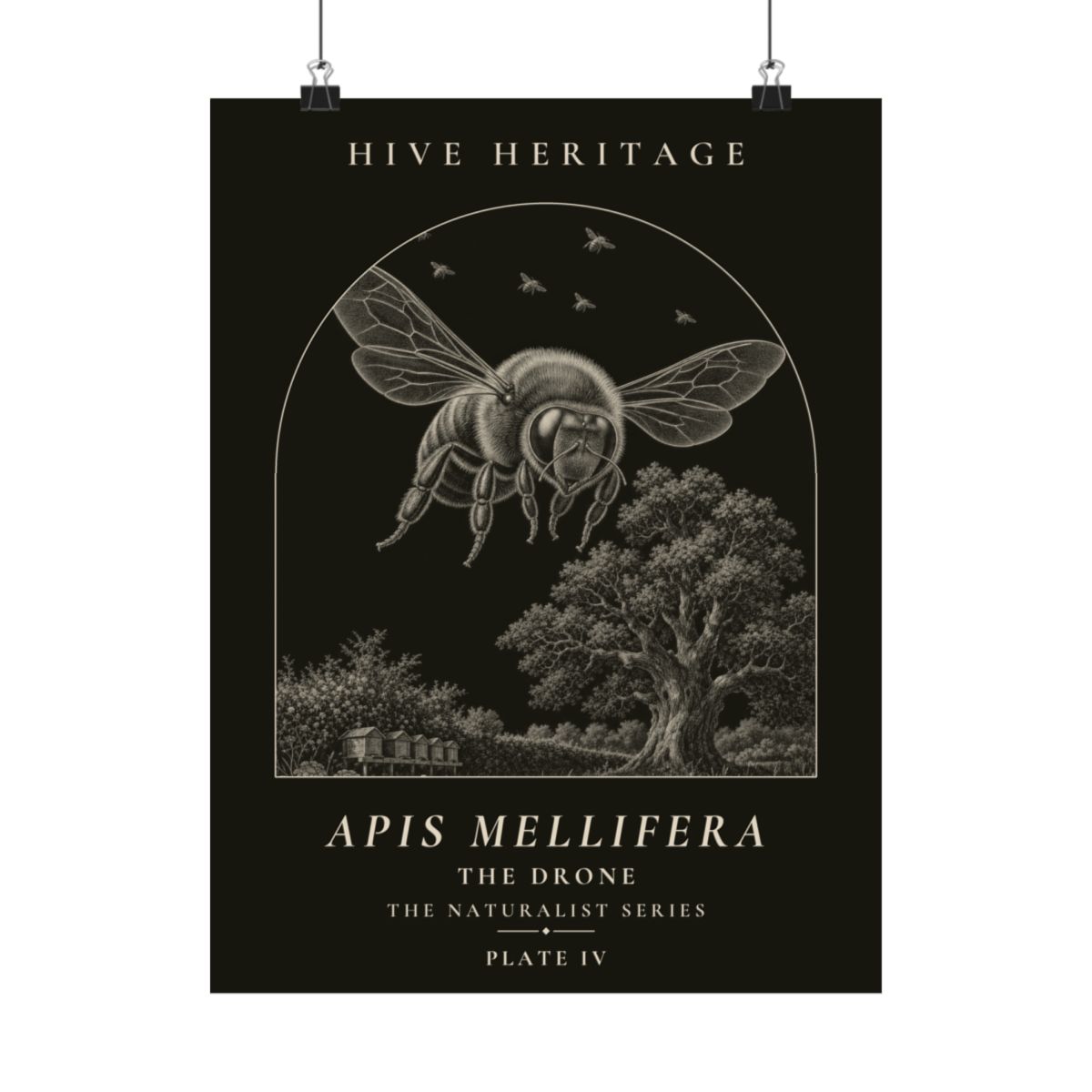
A drone is the male honey bee, and his one job is to mate with a virgin queen in flight. He has a mother and no father, because he hatches from an unfertilised egg rather than a fertilised one, and he carries no sting, no pollen baskets and no interest in foraging. Beside his sisters he looks wrong: bigger, blunter, with a barrel of a body and eyes so large they almost meet on top of his head, ambling across the comb instead of hurrying, and lifting off with a heavier, louder drone than any worker.
He is also one of the most misjudged bees in the hive. In ordinary speech, a drone is an idler who lives off other people's work. It is a fair enough description of how he looks from a distance, and a poor description of what he is for. This is the account beekeepers have pieced together, and the plate for this article is the picture that goes with it.
How is a drone bee born without a father?
The first odd thing about a drone is how he begins. A queen can lay two kinds of egg. A fertilised egg, one that has met sperm she stored during mating, becomes a female: a worker, or, if the colony feeds her differently, a queen. An unfertilised egg becomes a drone. So a drone has a mother, and no father at all.
The consequence is that a drone carries only one set of chromosomes, where his sisters carry two. Sixteen in the drone, thirty-two in workers and queens. Biologists call this arrangement haplodiploidy, and it is shared with other bees, wasps and ants. The idea that a queen could produce sons without mating was worked out by beekeepers in the nineteenth century, partly from a simple observation: a queen who had never mated could still lay, and every bee she raised was a drone.
It has a knock-on effect that beekeepers can see for themselves. A drone passes on his genes in full, unmixed, to every daughter he ever fathers. He has a grandfather, through his mother, but no father, and his own contribution to the next generation is a single complete copy of himself.
There is a further wrinkle. Honey bee sex depends on a particular stretch of genetic material, and if a fertilised egg ends up with two identical copies of it, which can happen when a queen has mated with a close relative, the result is a male with a doubled set of chromosomes. Workers detect these diploid males as larvae and remove them. It is one of the reasons a queen that has mated with too few, or too closely related, drones can give a colony a patchy, gappy brood pattern. It is also a quiet argument for why a queen mates widely.
Built for one job
Everything about a drone's body suggests a specialist. He has no sting, because the sting is a modified egg-laying organ and he is male. He has no pollen baskets on his legs, no wax-producing glands worth the name, and mouthparts that are not built for gathering nectar. He does no foraging, no nursing, no comb building, no guarding. He cannot do the work of the colony because he was never built to.
What he does have is a remarkable set of senses. His eyes are much larger than a worker's and hold many more of the tiny lenses that make up a bee's compound eye, roughly twice as many by most counts. They wrap over the top of his head, which suits a bee whose task is to spot a small moving shape against a bright sky. His antennae carry a great many more scent receptors too, tuned to the pheromone a virgin queen gives off in flight. A drone is, in effect, a flying detector for one particular signal.
He also takes his time. A drone spends twenty-four days getting from egg to adult, against twenty-one for a worker and about sixteen for a queen. Drone cells are larger than worker cells, and when the larva is ready to pupate the workers cap the cell with a domed lid, which beekeepers often call a bullet capping. It is one of the easiest ways to tell drone brood from worker brood when you are looking at a frame. Drone comb tends to sit toward the edges and lower corners of the brood nest, where the colony builds its wider cells.
Once he emerges, a drone is fed by workers at first, and later helps himself from stores. He does not fly for the first days of his life, and he is not ready to mate until he is about twelve days old. Only then do the afternoon flights begin.
What happens on a drone's mating flight?
On warm, calm afternoons, drones leave the hive in numbers and fly to particular places in the air. These are known as drone congregation areas, and they are among the more mysterious things in bee biology. Drones from many colonies, sometimes from a considerable distance away, gather in the same patch of sky, often some tens of metres above the ground. The places seem to be used year after year, though what marks them out is not fully understood.
A virgin queen, on her own mating flights, goes to these gatherings. The drones detect her scent, and they chase her in a stream, sometimes described as a comet, with the queen at the head and a tail of males behind. A drone that reaches her and mates does so in flight, and it is his only mating. The act is fatal to him. Afterwards he falls away and dies.
The queen does not stop at one. She mates with several drones, on one flight or over a few flights across several days, and typically with a dozen or so, though the number varies widely between queens. She stores the sperm in a small organ and will draw on it for the rest of her laying life, often years. This is why a single colony holds many different fathers among its workers, and why that mixture is thought to be useful. A colony whose workers differ genetically has a broader range of responses to whatever the season brings.
It follows that the great majority of drones never mate at all. A colony may raise hundreds of them in summer, sometimes a few thousand in a strong one, and most will live out their season without ever catching a queen. It looks wasteful. From the colony's point of view, though, it is closer to a lottery with a very large prize: a colony's drones are how its genes leave the hive, and the more drones it puts into the air, the better its chance.
Drones are also welcomed in hives that are not their own. A drone can walk into a neighbouring colony and be fed and tolerated there, which lets drones spend the day in comfortable company between flights and helps mix the local population.
Are drones just freeloaders?
So is the drone a freeloader? The answer depends on what you count as work. He does not bring in a gram of nectar. He eats from the colony's stores, and a colony rearing many drones is spending real resources on them, which is why the colony raises them only when it is doing well, in spring and summer, and is not raising them in a hard season.
But the colony's future, in the longer sense, runs through drones. A queen cannot lay fertilised eggs without mating, and she cannot mate without them. The colony raises drones in the same way a farmer plants seed: not for this week's food but for what comes after. The word idler is a human verdict on a bee whose contribution is measured in generations, not in days.
Then the season turns. When the nectar flow ends in late summer, the workers stop tolerating the drones. They bar them from the comb, refuse to feed them, and drag them out of the entrance. Drones are sometimes seen clustered on the floor or outside the hive, weakening, and beekeepers in Britain commonly notice this in August or September. It is not cruelty in any sense we would recognise. It is the colony reckoning its winter stores, and deciding it cannot afford mouths that do no foraging.
A colony that still has drones in the depths of winter is often telling the beekeeper something, since it can signal a queen that is failing or a colony that has lost her. That is a thing the beekeeper learns to read, not a rule with no exceptions.
Drones also matter to beekeepers for a less romantic reason. The varroa mite, the parasite that has done so much harm to honey bee colonies worldwide, prefers to enter drone cells over worker cells. The longer time a drone spends capped gives the mite longer to reproduce. Some beekeepers use this: they give the colony a frame or a strip of drone comb, let it be filled and capped, and then remove and freeze it, taking a share of the mites with it. It is a well-established technique, though it is one tool among several and does not replace regular monitoring.
Look at a drone closely and you see a bee that was built in every part for a single afternoon's flight and, in most cases, never gets to make it. His whole life is a form of hope on behalf of the colony that made him. It is a good deal more interesting than idleness.
The plate that goes with this piece shows the drone in the digital engraving style used across the Naturalist Series: the heavy body, the great eyes, the broad wings. It is new artwork made in that manner, not an antique, and it is there below if you would like to see him properly.
See it in the Naturalist Series: The Drone plate