
Naturalist Series · 29 September 2026
The Bee Tree: Where Honey Bees Lived Before Hives
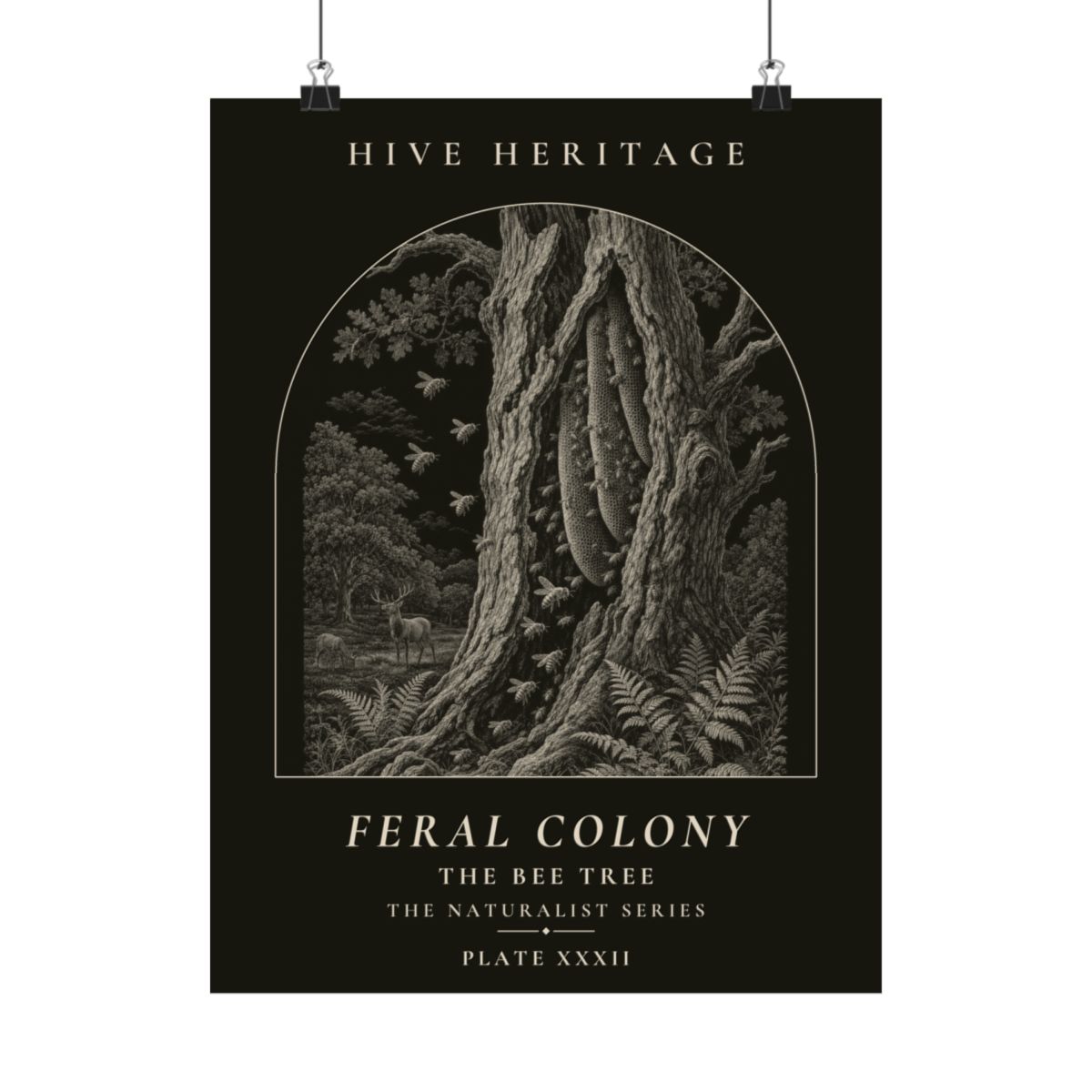
Honey bees lived in hollow trees: cavities of roughly forty litres, set high in an old trunk with a small entrance facing away from the weather, which is exactly what the biologist Thomas Seeley found wild swarms look for when choosing a new home. People have called that hollow a "bee tree" for as long as they have gone looking for honey, and the term sits behind almost everything we now call beekeeping.
When we made the plate called The Bee Tree, this was the story we wanted to tell properly: not a decorative tree with a few bees around it, but the real home the species evolved to use.
A note on the name first. "Bee tree" is not a single invention with a single inventor. It is a descriptive term, used in different places and periods for a tree that holds a colony of honey bees. It is also, separately, a common name given to some garden trees that bees love in late summer. Where a claim below is well documented, I say so. Where the record is thin, I leave it out rather than dress it up.
What makes a tree a bee tree?
Honey bees are cavity nesters. Unlike bumblebees, which often use old rodent holes or tussocks, or wasps that build paper nests, a honey bee colony wants an enclosed space it can fill with wax comb and defend through the winter. In woodland, the obvious candidate is a hollow in a mature trunk or large limb, where heartwood has rotted away or a branch has broken off and the tree has healed around the wound.
The best-known research on this comes from the American biologist Thomas Seeley, who spent years studying wild colonies in the forests of New York State and later set out what swarms look for in a home. His work, described in books such as Honeybee Democracy and The Lives of Bees, found that scout bees favour a cavity of roughly forty litres, with a small entrance, sited well above the ground and facing away from the worst of the weather. Those are findings from one region and one set of woods, so I would not treat them as a rule for every tree in every country. But they explain why a big old tree with a dry hollow is such a good address, and why young, tidy woodland so rarely has any.
Inside, the colony works downwards. Comb hangs from the roof of the cavity, and the bees coat the inner walls with propolis, the resinous material they gather from plants. Honey is stored above the brood, and the cluster keeps itself alive through cold weather by staying together and eating what it has stored. A hive built by a beekeeper is, in the end, an attempt to imitate that cavity in something easier to open.
It is a useful thing to remember when you look at any tall, hollow-trunked tree on a walk. A colony may or may not be in it, and you will not be able to tell from the ground unless you happen to see bees moving in and out of a single small opening. That opening is the giveaway, and it is how people have found bee trees for as long as they have wanted honey.
People and the bee tree
The oldest evidence that people went after wild honey is not about trees at all, but it belongs in this story. In eastern Spain, a rock painting at a site known as the Cuevas de la Araña, near Bicorp, shows a figure on what look like ropes or vines beside a cliff face, apparently reaching into a nest surrounded by bees. It is usually attributed to the Mesolithic, several thousand years ago. Archaeologists debate the details of dating and interpretation, so I would call it a very old picture of honey hunting rather than a settled record of a particular method. What it does show plainly is that reaching a wild nest high up was dangerous, and that people did it anyway.
Trees came into it later, and more deliberately, in parts of eastern and northern Europe. In the forests of what is now Poland and Belarus, and in other forest regions of eastern Europe and Russia, people practised what is often called tree beekeeping or forest beekeeping. Instead of waiting to find a natural hollow, the beekeeper cut a cavity into a living tree, often a pine, well up the trunk. A colony could then move in, and the cavity could be closed with a board and opened when honey was taken. The Polish word for this practice is bartnictwo, and the cavity is often called a barć. The beekeeper is a bartnik.
This was skilled work. The beekeeper climbed with a rope, worked at height, and had to take honey without killing the tree or the colony. In the accounts that survive, the trees were commonly owned and marked, and rights to them could be inherited or regulated, which tells you how valuable a good bee tree was. In 2020, UNESCO added the tree beekeeping culture of Poland and Belarus to its Representative List of the Intangible Cultural Heritage of Humanity, which is a reliable, checkable mark of how seriously the tradition is now regarded. It is not extinct, either. A small number of people in both countries continue it, and there is renewed interest in the old forest practices.
Tree beekeeping is worth a clear distinction from what came after. A managed hollow in a living tree is not a movable hive. You cannot easily inspect the comb, and you cannot move the colony. That limitation is exactly what later hive designs set out to solve. The move from the tree to the skep, the log hive and eventually the frame hive is one of the long arcs of beekeeping history, and the bee tree is where that arc starts.
How do you find a wild bee colony in a tree?
If you wanted honey from a tree you had not yet found, you had to find it. In North America in the nineteenth century, where European honey bees had by then escaped and established wild colonies, a practice known as bee hunting or bee lining was well known. The hunter would attract a few foraging bees to a bait, mark them, and watch the direction they flew when they left. By noting the line, and then moving along it and repeating the process, the hunter could close in on the tree. Henry David Thoreau wrote about bee hunters in his own writing, which is one of the more readable contemporary accounts of the method.
It relies on something bees do very reliably. A forager that has found a rich source heads straight back to its colony, and because the return flight is direct, the direction is a clue. It is a lovely example of natural history turned into a practical skill, and it needed patience more than equipment.
I should say what I am leaving out. There are many popular stories about bee trees, for instance about particular trees being planted, named or blessed by particular people, and about early colonists finding honey in a certain year. Some of these may be true. Very few come with a source I would be happy to point you to, so they are not here. If you have a documented one, we would like to hear it.
Are there still wild bee colonies in Britain today?
Wild honey bee colonies in Britain are a more uncertain subject than they used to be. For a long time the view was that almost every colony was kept by a beekeeper, and that any bees in a tree were escapees from an apiary. More recent surveys and local studies have looked for colonies living without help, and have found that some do survive in cavities, including in trees, for longer than the old view allowed. The extent of it is still being worked out, and I do not think anyone can give you a reliable national number. What can be said is that old trees with cavities matter for far more than bees, and that a hollow that would once have been tidied away is worth leaving where it is if it is safe to do so.
The other meaning of the name is more cheerful. A tree from China and Korea, Tetradium daniellii, is often sold as the bee-bee tree, because it flowers late in summer when other forage is running out and bees are commonly seen working it. Gardeners plant it for exactly that reason. It is a different sort of bee tree from the hollow kind, and it is a good reminder that trees serve bees in two ways: they provide shelter, and they provide food.
Seen that way, the tree in the plate is doing two jobs at once. It is the house and the pantry. A hive is a very clever version of the house. The pantry, in the form of a flowering landscape, is the part we can least easily replace.
Why the tree still matters
Every hive on a stand today carries a trace of the bee tree. The dark interior, the narrow entrance, the comb hanging from the top, the propolis-sealed walls and the way the colony clusters in winter are all inherited from a hollow trunk. When beekeepers talk about giving a colony the conditions it would choose for itself, they are, without saying so, talking about a tree.
That is the natural history I wanted the plate to carry. It is digital engraving-style artwork, made for us in the manner of a naturalist's plate; it is not an antique, and I would never describe it as one. What it does is take a subject with real depth, the oldest home of the honey bee, and give it the quiet, careful treatment that subject deserves.
If the bee tree is the part of beekeeping that draws you, the design is below.
See it in the Naturalist Series: The Bee Tree plate