
Naturalist Series · 1 October 2026
The Bee-Eater and the Honey Bee, Plainly Told
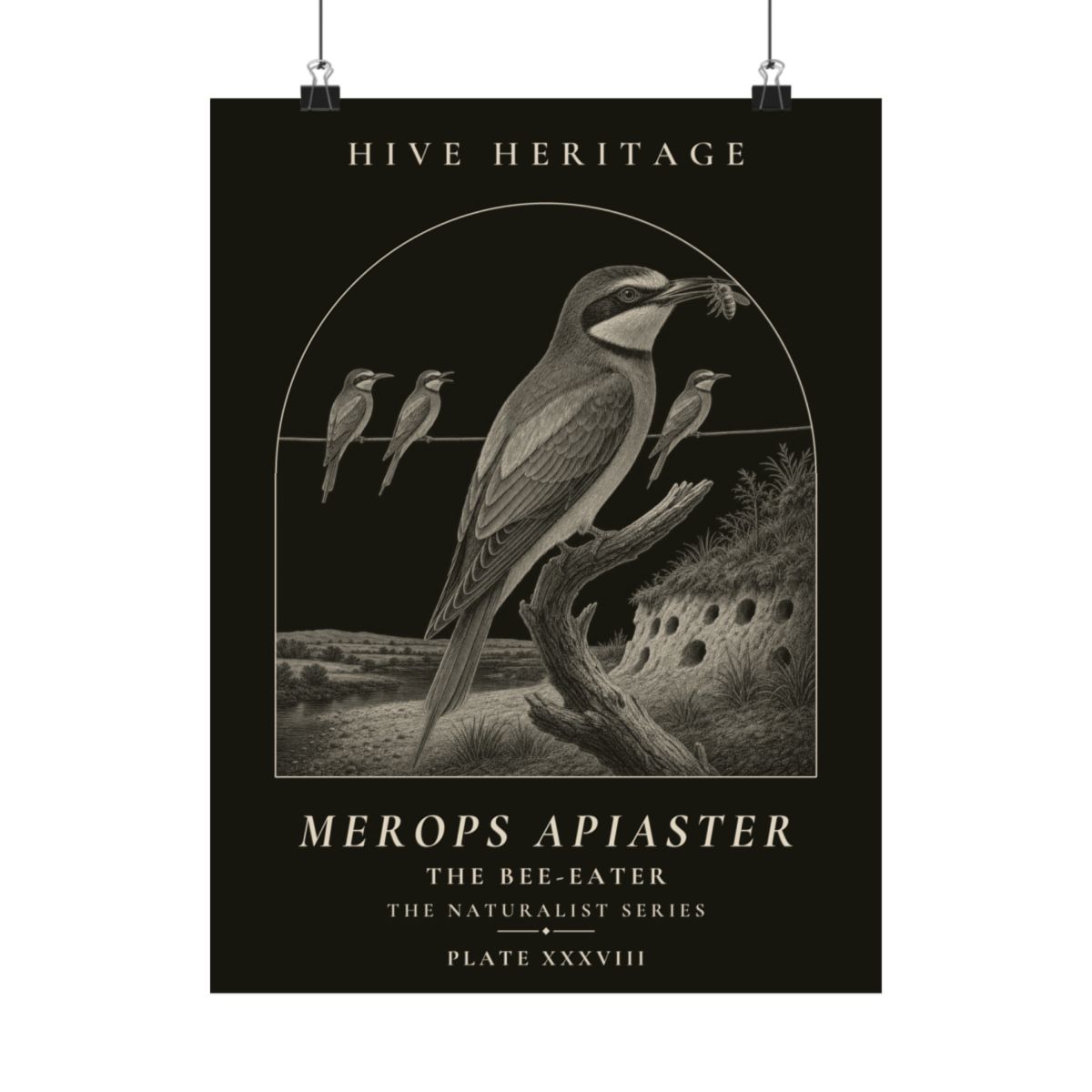
Yes, the bee-eater does eat honey bees, but it takes them one at a time out of the air; it never opens a hive or touches the stores inside. The European bee-eater, Merops apiaster, one of the most colourful birds found anywhere in Europe, hunts bees, wasps and hornets in flight and strikes its catch against a perch to remove the sting before swallowing it.
We drew it for our Naturalist Series because it deserves better than the usual nervous headline. It is a real predator of bees, and the honest account of what it does to a hive is less dramatic than its reputation.
What is a bee-eater?
Bee-eaters are a family of birds, the Meropidae, with a few dozen species spread across Africa, southern Europe, Asia and Australasia. The name is literal. Bees, wasps and hornets make up a large part of what many of them eat, alongside dragonflies, beetles and other flying insects.
The species most likely to concern a European beekeeper is the European bee-eater, Merops apiaster. The second word of its scientific name is simply the Latin for beekeeper, which tells you how long people have connected the bird with hives. The plumage does the rest of the introduction: a chestnut crown and back, a yellow throat edged with a dark line, and underparts of a bright blue-green. It is slim, long-winged and swallow-like in flight, with a slightly curved bill and two elongated central tail feathers that give the silhouette away.
Its call is as distinctive as its colours, a soft, rolling, liquid note, often the first sign that a flock is overhead before anyone has looked up. Bee-eaters travel and nest in groups, and a flock in the air is a fine thing to see and hear.
How does a bee-eater catch and eat a bee?
The hunting method is simple and very effective. The bird sits on an exposed perch, a wire or a bare branch, watches for a flying insect, launches after it, snaps it out of the air and usually returns to the same perch. It is a sit-and-wait hunter rather than a chaser, and it is very good at it.
The interesting part is what happens next. A honey bee is not an easy mouthful, and the bird does not swallow it live. Observers have long described the bee-eater carrying its catch back to the perch and striking it against the wood, then rubbing the insect's body along the perch. The purpose appears to be to squeeze out the venom and deal with the sting before the insect is swallowed. Ornithologists who have studied the family, C. H. Fry among them, have written about this handling in detail. It is a learned, practised routine, and young birds are not born knowing it perfectly.
Like many birds that eat insects with hard parts, bee-eaters bring up the indigestible remains as small pellets. Under a favourite perch, those pellets and the scatter of insect fragments can tell you what a bird has been eating.
Before anyone imagines a hive stripped bare, it helps to be precise about what the bird takes. It takes individual flying insects, one at a time, and it takes them in flight. It does not open a hive, and it does not go inside one. Whatever it removes, it removes from the foragers, drones and queens that happen to be in the air, not from the colony's stores.
Where it lives, and when
The European bee-eater breeds across southern Europe, parts of North Africa and western Asia, and then spends the winter in sub-Saharan Africa. It is a summer visitor to its breeding grounds, arriving in spring and leaving again by late summer, and its journey takes it through many countries on the way.
It nests in colonies, and the nest itself is a piece of engineering. Pairs dig tunnels into sandy or earthy banks and cliffs, using their bills and feet, and lay their eggs in a chamber at the end. A riverbank, a quarry face or a bank at the edge of a field can hold a whole colony, which is why the sight of a busy nesting bank is so memorable. The tunnels are long compared with the bird, often a metre or more.
In Britain the bee-eater is a rare visitor rather than a resident. Individuals and small flocks turn up in spring and summer, usually as birds overshooting their normal range, and on a small number of occasions they have attempted to breed. If you keep bees in Britain, you are far more likely to meet a hornet or a wasp at your entrance than a bee-eater. If one does appear, it is generally a rare treat for local bird watchers, and it is worth reporting to them.
That is one reason we like the bird for the series. It sits at the edge of what a British beekeeper knows, close enough to the hive to matter and far enough away to remain a marvel.
Does the bee-eater harm beekeeping?
This is the part where the story tends to be inflated in either direction. One version says the bee-eater is a menace to apiaries. The opposite version says it is no trouble at all. The truth is that the effect depends on place, season and numbers.
Where bee-eaters are common, especially around the Mediterranean, beekeepers have long known them as a bird that visits apiaries and takes foragers near the hives. That is not a myth, and it is not new. Virgil's Georgics, the Latin poem on farming that devotes a whole book to bees, names the bee-eater among the creatures that trouble a hive. People have been watching this bird around bees for more than two thousand years.
What we cannot honestly give you is a neat figure for the damage. How many bees a bird takes, and whether that matters to a colony's honey crop or its survival, varies with the number of birds, how long they stay and how strong the colony is. A large colony loses foragers all the time to weather, other predators and ordinary wear. Some beekeepers also report concern about queens lost on mating flights, when a queen and the drones leave the hive and are briefly exposed in the air. It is a reasonable worry, and reports from beekeepers are worth taking seriously, but we would not present it as a settled, measured effect.
There is one more point of balance. Bee-eaters are passing through or nesting for a few months, not living at the apiary all year. A migrating flock may be overhead for a few days. A nesting colony is a longer presence, but only where a suitable bank exists.
How bees and beekeepers live with it
The bees themselves have no special defence against a bird taking them on the wing. Their protection is the ordinary one: numbers, and a colony that is able to replace its losses. A healthy colony raises new workers continuously, and that is what absorbs the loss of foragers to any predator.
Beekeepers who share ground with bee-eaters tend to rely on practical habits rather than dramatic measures. Watching an apiary through the season matters. Noticing whether birds are perching nearby, and how long they stay, tells you whether you are dealing with a passing flock or a resident colony. Where a colony of birds nests within easy reach, some beekeepers consider where hives are placed relative to it. None of this needs alarm, and none of it needs harm to the bird. Bee-eaters are a wild species in its own habitat, and in many countries they are protected by law, so the sensible response is to observe, adapt and, if a real problem develops, to ask the local bird or beekeeping association what is normal in your area.
There is a quieter lesson here too. A beekeeper who knows the animals around the hive, the wasps, the birds and the small predators, keeps a better apiary than one who only knows the bees. The bee-eater is simply the most beautiful example of that.
The plate
The Bee-Eater plate in our Naturalist Series shows the bird as it deserves to be seen: sharp, poised and unmistakable. It is digital engraving-style artwork, made in the spirit of the old natural-history plates, and we are careful never to describe it as anything more than that. It is not an antique, and it is not hand-engraved.
If you would like to see the bird as we drew it, and to look at the design on apparel and art, you will find it in the shop below.
See it in the Naturalist Series: The Bee-Eater plate