
Naturalist Series · 29 September 2026
The Bee Boles: Wall Recesses Built for Straw Skeps
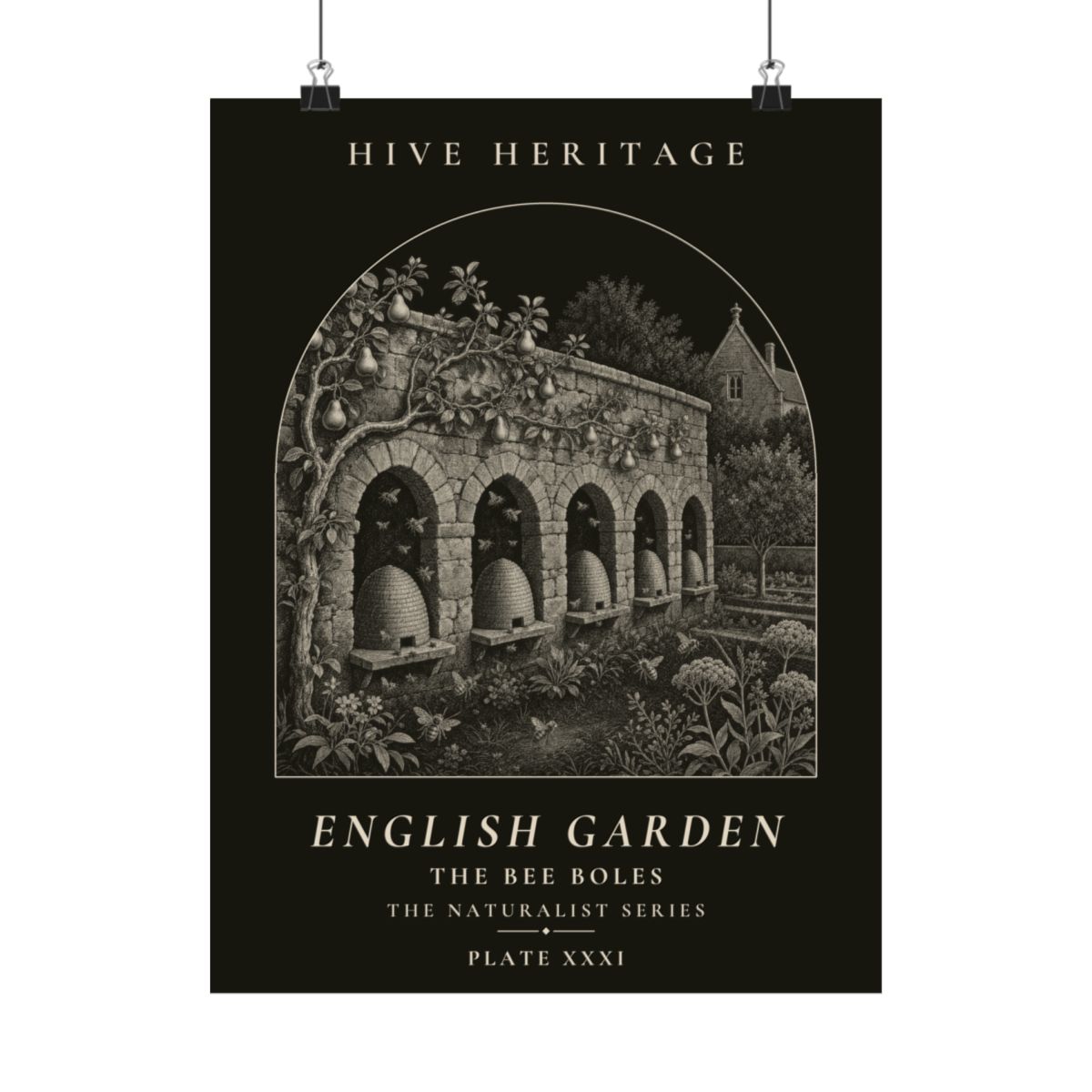
A bee bole is a recess built into a wall, or sometimes a freestanding structure, sized to hold a straw skep, the traditional domed hive coiled from straw and bound with split bramble. Rows of these small arched hollows survive in old garden and orchard walls across Britain and Ireland, one of the few pieces of beekeeping equipment left standing in the landscape for us to find.
We chose them for the Naturalist Series because they sit at an odd crossing point. They are architecture and they are natural history. They tell you how people kept bees before the modern hive existed, and they do it without a single word written down. This is what we can say about them with confidence, and where we have to say "we do not know".
What is a bee bole?
A bee bole is a recess built into a wall, or sometimes a freestanding structure, to hold a skep. The skep is the traditional domed hive, coiled from straw and bound with split bramble or similar material. A skep is light, cheap to make and easy to carry, but it has one serious weakness: straw soaks up rain and rots. A skep left standing in an open garden through a wet winter does not last.
The bole is the answer to that. It gives the skep a dry, sheltered place to stand, out of the worst of the wind and rain. The recess is typically arched or square-topped, with a stone or wooden base for the skep to sit on. Boles are usually found in a row, side by side, in a wall that was built for some other purpose too, such as enclosing a garden or orchard. Where the recesses are set high enough off the ground, they also keep the skeps clear of damp soil.
Some sites have a single bole. Others have several, and a few have boles arranged in tiers, one row above another. A number of them survive with signs of wooden fittings, such as pegs or the remains of a shelf, which suggest the skeps were not always simply left to sit. We should be careful, though. A hollow in a wall is a hollow in a wall, and without other evidence it is not always possible to be sure what any individual recess was for. Some very likely started life as something else, or were altered later.
Why the wall mattered
Think of a skep as a bee's tent. It needs a roof that sheds water and a position that does not turn into a wind tunnel. A masonry wall does a good deal of that work for free. It breaks the wind, it holds a little of the day's warmth, and the recess adds a roof and side walls of its own.
Orientation seems to have mattered too. Recorded boles tend to face towards the sun rather than the prevailing weather, and the sensible reading of that is the obvious one: bees fly earlier and forage more freely on a warm, bright day, and a hive that catches the morning sun is a hive that gets going sooner. That is a pattern in the surviving examples rather than a rule that every builder followed, and it is worth saying so plainly. Where a wall ran east to west, the south face was the natural place for the boles; where it did not, builders made do with the wall they had.
There is another practical reason to put skeps in a row against a wall. It keeps them together and off the ground, and it puts them where the keeper walks anyway. In a working garden, a beekeeper with a handful of skeps did not need an apiary as we now picture one. The wall was the apiary.
The skep, and the trade-off behind it
To understand the bole, you have to understand what beekeeping with a skep involved, because it was very different from what most beekeepers do now. A skep has no removable frames. The bees build their comb from the crown of the dome downwards, and the keeper cannot lift it out piece by piece to look. What lies inside is largely hidden.
Harvesting from a traditional skep usually meant taking the whole contents, and the accepted practice in many places was to kill the colony in the autumn, often with fumes from burning sulphur, so the comb could be taken. Not every skep keeper did this every year, and there were methods of driving bees into a second skep, but the practice of destroying colonies is well documented in the older literature and it is part of the honest history. It is one reason that the arrival of hives built for gentler management was welcomed by later writers on the craft.
The old beekeeping books were aware of the issue of shelter, even when they did not mention boles by name. Writers of the sixteenth and seventeenth centuries, Charles Butler among them in his 1609 book The Feminine Monarchie, gave advice on where hives should stand and how they should be protected. Their concern was practical: dry, sheltered, sunny, and away from anything that would trouble the bees. The bole is one very durable expression of that advice, built in stone or brick rather than left to memory.
How old are they, and who built them?
This is where we have to be careful, because it is the question most often answered with more confidence than the evidence supports.
Surviving boles in Britain are generally thought to date from the seventeenth to the nineteenth centuries, and most appear to belong to the later part of that span. That is an estimate drawn from the walls they sit in and from what is known of skep keeping, not a cast-iron date for every example. Walls are rebuilt, extended and patched. A recess that looks very old may be in a wall that has been repaired several times, and one that looks tidy and modern may be older than it appears. For most boles there is no builder's name and no date. Anyone who tells you exactly who built a particular row and in which year needs to be able to show a document.
What we do know is that they were not the work of a specialist trade. They were built by ordinary masons as part of ordinary walls, on estates, in farm gardens and in the grounds of larger houses, to a plan that the keeper or owner would have specified. That explains why they vary so much in shape and size, and why they turn up in so many places across Britain and Ireland.
The best single source of order in all this is the long-running effort of beekeeping researchers to record them. The International Bee Research Association compiled a register of bee boles, with sites reported by members and the public, and that record is the reason we can say anything general about their distribution and orientation at all. If you find a set that you think is unrecorded, that is the kind of body that would want to hear about it. Boles are rarely protected simply because they are boles, and they are easily lost when a wall comes down.
What are the common myths about bee boles?
A few claims about bee boles get repeated, and they are worth a gentle correction.
The first is that every recess in a garden wall is a bee bole. It is not. Walls have niches for many reasons, and a single hollow with no shelf and no context is a weak candidate. A row of matching recesses, facing the sun, in a garden wall, is a much stronger one.
The second is that boles were the only way skeps were kept. They were not. Skeps were also kept on simple wooden benches and stands, and under a wooden or thatched cover called a bee house or hackle. The hackle was a straw covering laid over the skep to keep the rain off. Those arrangements have mostly vanished because wood and thatch rot, while stone stays. So the boles we can see are probably a biased sample. They survive because they were built to last, not because they were the commonest method.
The third is a romantic one, that the boles somehow protected bees from magic or misfortune. There is a genuine tradition of "telling the bees" about deaths and important events in a household, and it is well recorded in folklore. It is a separate custom, and nothing about a wall recess connects it to that practice. We would rather leave the two apart than tie them together on a hunch.
Why did bee boles stop being used?
The change came with the movable-frame hive. In the early 1850s the American clergyman Lorenzo Langstroth described and patented a hive in which the bees build comb on removable frames, held apart by a gap the bees leave alone, known as bee space. For the first time a keeper could inspect, and take honey from, a colony without destroying it.
These hives are boxes, taller and heavier than a skep and made in parts. They do not fit a small arched recess, and they do not need one, because a wooden hive with a roof of its own carries its shelter with it. As frame hives spread through the later nineteenth century and beyond, the boles lost their purpose. Many were left empty. Some were used for other things, such as storing flowerpots or garden tools, and some were bricked up or demolished with the walls that held them.
That is why the surviving examples are so quietly affecting. Nobody built a bee bole to be looked at. Each one is a small, practical answer to a small, practical problem, and it has outlasted the method it was built for by well over a century.
Where they sit in the story of beekeeping
If you set out the history of keeping bees in Britain, the bole marks a particular chapter: bees kept close to home, in numbers a household could manage, in a basket made from the same straw as the roof. It sits between the bees kept wild in tree cavities and the modern apiary of ordered boxes. It is a reminder that the craft was, for a very long time, something done quietly against a garden wall.
It also shows how much of the past we read from the fabric of a place rather than from books. A keeper who lived and worked with skeps would not have written a description of a bole any more than we would describe a shelf. The record is in the stone, and it is patchy, and we are glad of it all the same.
Our plate of the Bee Boles is a piece of digital engraving-style artwork. It is a modern drawing made in the manner of a natural-history engraving, not an antique or a hand-engraved original, and we would not want anyone to mistake it for one. It shows the row of recesses and the skeps that once filled them, and it belongs with the rest of the Naturalist Series. If this article has made you look twice at an old wall, the plate is a fitting way to keep the subject close.
See it in the Naturalist Series: The Bee Boles plate