
Naturalist Series · 1 October 2026
Summer in the Honey Bee's Year
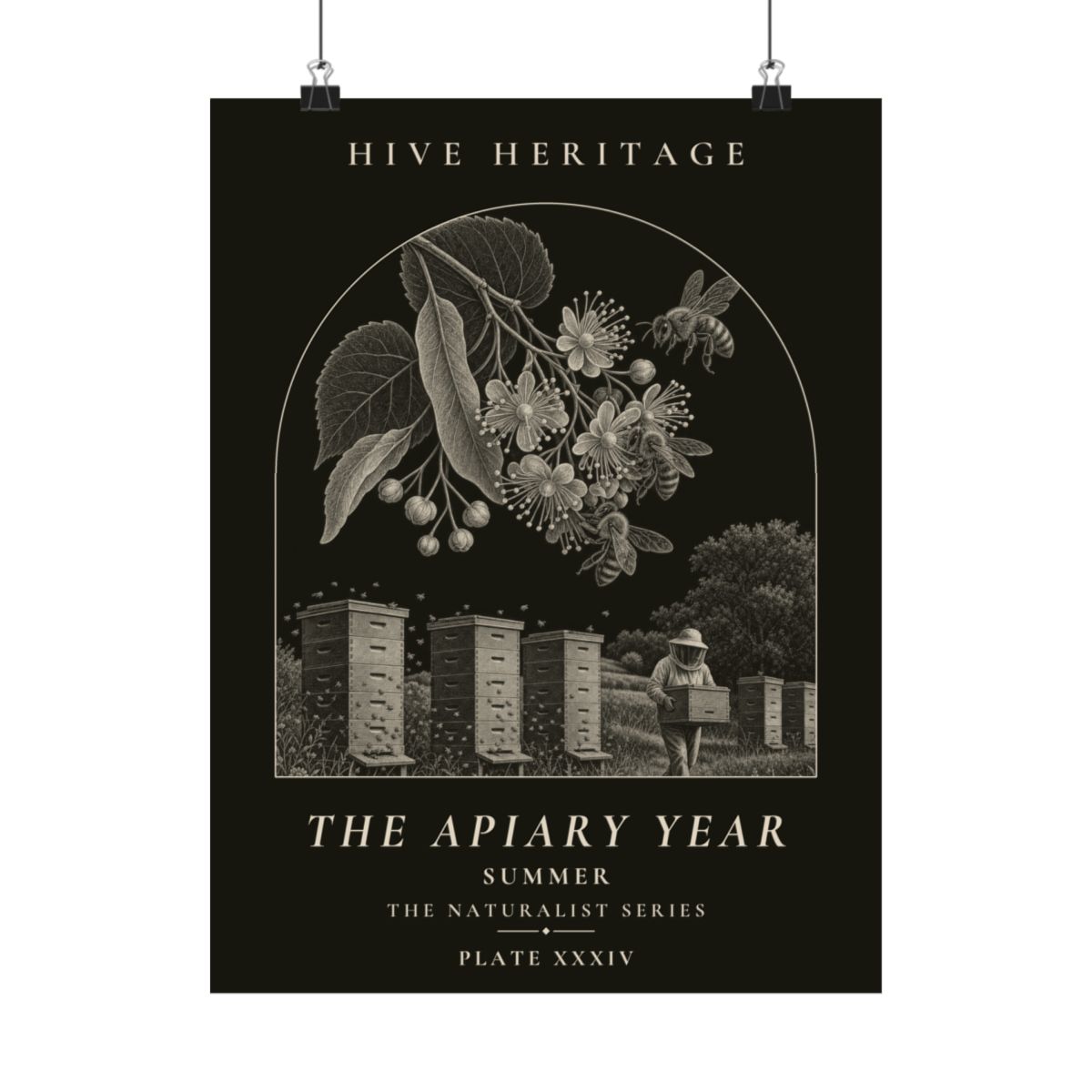
In summer a honey bee colony is at its largest, commonly 40,000 to 60,000 bees, and busiest, with the queen laying up to around 2,000 eggs a day and workers streaming in and out on the nectar flow. Look into a hive on a warm afternoon and you find no stillness at all, but a steady hum of traffic at the entrance.
Summer is the season we had in mind for one of the plates in our Naturalist Series, and it deserves more than a caption. This is what a colony is doing at this point in the year, what the bees are working on, and what the person looking after them does in return. We write about the UK and about temperate North America, because the seasons, the flowers and the beekeeping calendar differ between them, and the differences are part of the story.
How many bees are in a hive in summer?
By midsummer a honey bee colony is at or near its largest. A strong colony is commonly described as holding somewhere between 40,000 and 60,000 bees at its peak, almost all of them female workers. There is one queen. There are also some hundreds of drones, the males, whose only job is to mate with queens from other colonies.
The queen is the engine of all this. At the height of the season a good queen may lay well over a thousand eggs a day, and figures of up to about 2,000 are often quoted. She does not rule anything, despite the name. She lays, and the colony's chemistry and the workers' behaviour decide much of the rest.
The workers' lives in summer are short. A worker bee raised during the busy months typically lives around five to six weeks, which is why the colony has to keep raising new bees just to stay the same size. From egg to emerging adult takes about 21 days for a worker, 24 for a drone and about 16 for a queen. The bees that will see the colony through winter are a different generation, raised later in the year, and they live for months.
The work of a summer worker changes as she ages. In her first days she cleans cells and tends the brood. Later she builds comb and handles incoming nectar, then guards the entrance, and only after about three weeks or so does she usually become a forager. The order is not rigid. If the colony loses a lot of foragers, younger bees can take up foraging earlier. But the general pattern of a bee moving outward from the centre of the nest to the field over her life is well established, and it is one of the loveliest things in natural history.
Keeping the nest at the right temperature is part of the job too. The brood area is held at around 35°C. On hot days workers fan their wings at the entrance and inside to move air, and others collect water and spread it in thin films for evaporative cooling. A bee bringing water home in July is not being casual about it. She is air conditioning the nursery.
What is a nectar flow?
The big task of summer is the nectar flow, the period when plants are producing plenty of nectar and the foragers bring it in faster than the colony uses it. Nectar as it arrives is mostly water. The house bees pass it mouth to mouth, add enzymes, spread it thinly in the cells and fan it until much of the water has gone. Ripened honey is typically around 17 to 18 per cent water, and only then do the bees seal the cells with a wax capping.
Wax itself is a summer product. Young workers secrete tiny flakes of wax from glands on the underside of the abdomen, and the colony draws fresh comb when there is a flow to store. It is expensive work for the bees, which is one reason a beekeeper who gives them drawn comb to fill is helping them a great deal.
Meanwhile pollen comes in too, carried home in the pollen baskets on the hind legs. Pollen is the colony's protein, and nurse bees turn it into the food that raises larvae. Watch foragers landing at a hive entrance and you may see loads in shades of yellow, orange or even grey, depending on which flowers they have visited.
How do foragers tell each other where the good flowers are? Karl von Frisch showed that a returning bee can communicate direction and distance with the waggle dance on the comb. The angle of the dance relative to vertical corresponds to the direction of the food relative to the sun, and the length of the waggle run relates to distance. He shared the Nobel Prize in Physiology or Medicine in 1973, partly for this work. Most foraging happens within a couple of miles of the hive, though bees can and do go further when they must.
What is in flower
The flowers depend on where you keep your bees, which is why a general statement about summer only goes so far.
In the UK, the spring flush of hawthorn, fruit blossom and, in many areas, oilseed rape is over by early summer. Beekeepers talk about the "June gap", a stretch between the spring flow and the main summer flow when there can be less forage available, and the colony, now large and hungry, may struggle in a poor year. Then come white clover, bramble, which is one of the most valuable summer bee plants in hedgerows and rough ground, and in July the lime trees, whose blossom bees work heavily in good weather. Later still, willowherb and Himalayan balsam are worked in many places, and on upland moors the heather comes into flower in August and September.
In temperate North America, the picture is similar but the names change. White clover, alfalfa and sweet clover are important in farmland, basswood (the American relation of our lime tree) flowers in early summer in many eastern regions, and goldenrod and asters carry the colony into late summer and autumn. It is worth remembering that the honey bee is not native to North America. It arrived with European settlers in the early seventeenth century, and its history there is bound up with the history of those colonists.
Across both continents, weather decides what the flowers give. Nectar secretion depends on temperature, moisture and the soil. A hot, dry spell can shut a nectar source down, and a cold wet fortnight can keep the bees indoors when the flowers are at their best. So summer is not an unbroken feast. It is a season of good days that the colony must use well.
What does a beekeeper do in summer?
The early part of summer, especially in the UK, is swarming season. Swarming is how a colony reproduces. The old queen leaves with a large part of the workforce, often on a warm day around the middle of the day, and settles somewhere temporary while scouts search for a new home. Behind them the colony raises new queens. A swarm is a natural event and a fascinating one, but for a beekeeper it means losing a large share of the bees just when the flow arrives.
Because of this, a beekeeper inspects regularly in the swarming season. A common approach is roughly weekly, looking for queen cells and making sure the colony has room to grow. Space matters. If the brood box is crowded, the bees are more inclined to swarm, so the beekeeper adds extra boxes, called supers, on top for storing honey.
Later in the summer the emphasis shifts. Once the main flow ends, the beekeeper removes the honey that is properly ripened and capped, leaving the colony enough stores, and turns attention to the coming winter. Two jobs stand out.
The first is checking the health of the colony. The parasitic mite Varroa destructor breeds inside the sealed brood and builds up through the season, and the viruses it spreads can badly weaken the bees that must survive winter. Most beekeepers monitor mite numbers through summer and plan their treatment for when the honey has been taken off. The details vary by region and by the products permitted where you live, so a beekeeper should follow current local guidance rather than a general rule of thumb.
The second is defence. As forage thins in late summer, wasps become a nuisance and can rob a weak colony. Beekeepers commonly reduce the entrance so that the bees have less to guard. It is one of those small adjustments that quietly decides how a colony gets into autumn.
None of this is a fixed recipe. A beekeeper in Scotland and one in Ontario, or one in Kent and another in Georgia, will time things differently, and a wet year changes the whole plan. Good beekeeping is largely watching, and then doing the small thing the colony needs.
The turn of the season
There is one more thing to notice about summer, and it is the least obvious. The colony reaches its greatest size around the longest days, and then the days begin to shorten. Egg laying tapers off, the colony begins to prepare for the months ahead, and in autumn the drones, no longer useful, are turned out of the hive. The height of summer is already the start of the descent, and the bees seem to know it before we do.
That balance of abundance and anticipation is what the Summer plate in our Naturalist Series is about. It is digital artwork drawn in the style of an engraving, made to reward a slow look, in the way a good natural-history plate should. If this piece has made you want to spend a while with the season, you can find the plate in our shop by following the link below.
See it in the Naturalist Series: The Summer plate