
Naturalist Series · 29 September 2026
Spring in the Honey Bee's Year
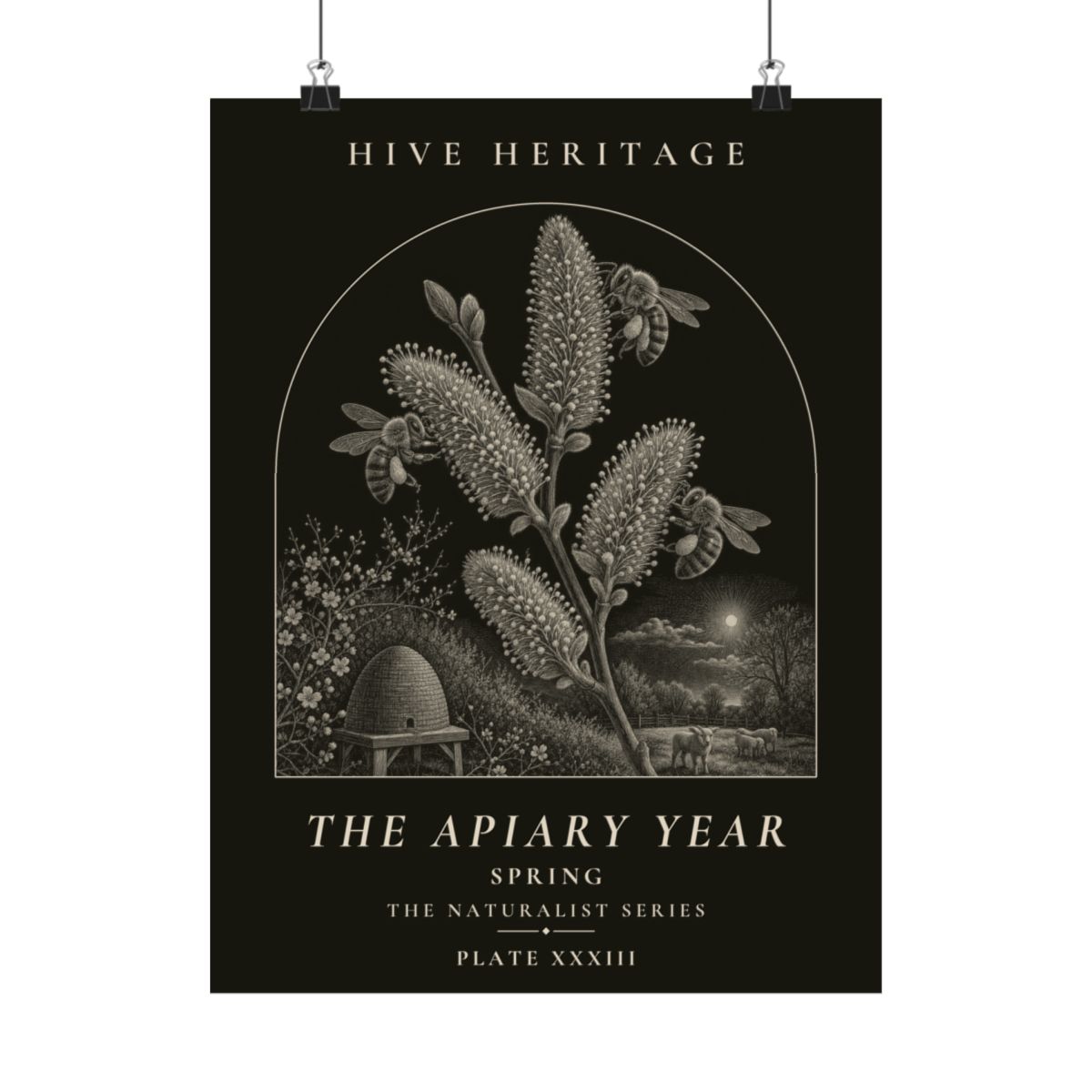
A honey bee colony's year does not begin in spring: it begins in the depths of winter, when the queen resumes laying, often as early as January or February in the UK. The colony is already hard at work weeks before the first flowers open, and spring is simply when that work becomes visible, in the first flights, the first loads of pollen carried home, and a hive that goes from quiet to crowded in a matter of weeks.
This is the story behind the season our spring plate shows. We follow it through the UK and the cooler temperate parts of North America, looking at what the colony is doing, what it is feeding on, and what a beekeeper does to help without getting in the way.
The colony before the first flower
There is a persistent idea that honey bees hibernate and wake up in spring. They do not. Through the cold months the workers form a tight cluster around the queen and shiver their flight muscles to make heat. The bees on the cold outer edge and the bees in the warmer middle change places over time, so nobody stays chilled for long. The cluster feeds on the honey the colony stored the summer before. It does not heat the whole hive, only itself.
The colony does not wait for spring to start again, either. Once the queen resumes laying, which in the UK is often in January or February and a little later in colder regions, the bees have to hold the brood nest at around 34 to 35 degrees Celsius (about 93 to 95 degrees Fahrenheit). That is a great deal warmer than the winter air outside. It costs the colony stores at exactly the point when the stores are running lowest. This is why beekeepers know late winter and early spring as a risky time: a mild spell that encourages the colony to rear brood, followed by a cold snap that stops the bees foraging, can leave a strong colony short of food.
The bees that carry a colony through winter are not the ones that worked in summer. A summer worker lives for something like six weeks, wearing out as she forages. The bees raised in late summer and autumn are physiologically different. They are built to last for months, and their job is to keep the cluster alive until the first new bees of the year can take over. In spring that changeover happens. As new bees emerge, the old winter bees die off, and for a short while the population can hold steady or even dip before it climbs.
The climb is governed by simple arithmetic. A worker takes about 21 days to develop from egg to adult, so eggs laid in February become flying bees in March. Through winter a colony is counted in thousands of bees. By high summer a strong one is counted in tens of thousands. Spring is the stretch in between, and it is the fastest growth the colony makes all year.
Then there is the first fine day. Honey bees are clean about their nest and do not foul it, so through a long cold spell they hold on. On the first mild, still day, often somewhere around 10 to 12 degrees Celsius, the entrance of a hive can suddenly fill with bees taking short flights to relieve themselves. Beekeepers call these cleansing flights. To a passer-by it can look alarming, as if the colony is swarming or being robbed. It is neither. It is a colony stretching its legs, and it is one of the first outward signs that the hive has come through the winter.
What is in flower
A colony rearing brood needs two things from the landscape. Pollen supplies the protein that the nurse bees turn into food for the larvae, and nectar supplies the sugar that fuels flight, heat and, later in the year, honey. Early spring is often generous with one and stingy with the other, which is why the order in which plants flower matters so much.
In the UK, the season often opens with hazel catkins, sometimes as early as January. Hazel is wind pollinated, so it offers bees pollen but no nectar, and on a mild day the bees will collect it anyway. Snowdrops and crocuses follow in the gardens and verges. Then comes willow, and willow matters a great deal: the catkins of goat willow and its relatives provide both pollen and nectar at a time when little else does. Dandelions and blackthorn arrive next, followed by the fruit blossom of orchards and gardens, the flowers of sycamore and field maple, the bright yellow fields of oilseed rape, and in May the hawthorn. Each of these is brief. Apple blossom, for example, is at its best for only a week or two, and a spell of rain or cold in that window can mean the bees simply cannot fly to it.
In the cooler parts of temperate North America the sequence is different but the principle is the same. In the eastern half of the continent the red and silver maples flower very early, well before the leaves, and are an important first source of pollen and nectar for many colonies. Willows follow, and then dandelions, redbud, and the blossom of apple, cherry and other orchard trees. Further into the season come the clovers and other meadow flowers, and in some regions black locust. What flowers, and when, depends heavily on where you are, from the Atlantic coast to the prairies, and no single list covers it.
You can see what is coming in on a bee's legs. Foragers pack pollen into the baskets on their hind legs, and different plants give loads of different colours. A beekeeper watching the entrance on a fine spring afternoon can tell at a glance that the queen is laying, because bees do not bring home pollen in quantity unless there is brood to feed. It is a small, useful piece of natural history, readable from a garden chair.
What the beekeeper does
The best spring beekeeping starts with restraint. The colony has spent months building a warm, sealed environment, and opening the hive on a cold day throws that away. So the first job is to watch from the outside: is there traffic at the entrance, are pollen loads going in, is the colony flying on warm days? If the answer is yes, there is a queen and there is brood.
Stores come next. A colony that has run low on food in early spring is at risk however strong it looks, so beekeepers check the weight of the hive, and if it is light they give emergency food, usually a block of fondant placed directly over the cluster, since a cold, slow colony will take solid sugar more readily than syrup. Good advice is to feed only when needed, and to follow the guidance of a local beekeeping association, because conditions differ from one valley or county to the next.
The first full inspection waits for a warm, still day. Beekeeping associations commonly suggest something like 14 or 15 degrees Celsius or above, which in much of the UK means March or April, and later in colder regions. The beekeeper is looking for a laying queen, or at least eggs, a healthy pattern of brood, enough stores, room to expand and any sign of disease. It is also the time to check for varroa, the parasitic mite that has become a fact of life for honey bee colonies in both the UK and North America. Monitoring and treating it according to current local guidance is part of every beekeeper's year.
As the colony grows, the hive has to grow with it. Beekeepers add space before the colony needs it, and put extra boxes, called supers, on the hive ahead of the main nectar flow. A crowded colony is a colony thinking about swarming.
Swarming is the honey bee's way of reproducing as a colony. In a swarm, the old queen leaves with a large part of the workforce to find a new home, while the bees left behind raise a new queen. In the UK the swarming season runs mainly from May into July, and an old rhyme sums up how beekeepers once valued the timing: a swarm in May is worth a load of hay. Today, from about April onwards, a beekeeper will inspect regularly, often weekly, looking for queen cells, the large peanut-shaped cells in which new queens are raised. Finding them early gives the beekeeper time to make a plan.
Swarms have a reputation for ferocity, and it is mostly undeserved. A swarm has no brood and no stores to defend, and its bees are generally docile. It is a cluster of bees in transit, not an angry mob, though it is still sensible to leave it to someone experienced.
One season, two climates
The UK has a maritime climate. Winters are mild and damp, spring starts early and stutters, and the bees may be flying in February and confined again in March. The colony is always guessing what the weather will do, and so is the beekeeper. After the spring flush there can also be a lean patch, sometimes called the June gap, when the early blossom has gone and the summer forage has not started. A colony that has built up well in spring can go hungry in it, which is one reason beekeepers keep an eye on stores well after the blossom has faded.
Across the cooler parts of temperate North America, in the northern United States and southern Canada, winters are longer and colder, often with snow cover for months. Spring arrives later, but when it comes it comes fast. A colony may fly for the first time on a warm afternoon with snow still on the ground, and within weeks the maples, willows and orchards are all in flower at once. Many beekeepers there start new colonies in spring from packages or nucleus colonies, timed to arrive when there is forage for them. Others are anxiously checking whether their existing colonies survived the winter at all.
The bees themselves behave the same way in both places. They follow the same logic of stores, brood, warmth and blossom. Only the calendar moves.
That is the spring the plate is about: a colony coming back into motion, the first flowers doing their work, and the beekeeper standing back long enough to let it happen. The plate is digital engraving-style artwork, made in the spirit of natural history illustration and not as an antique or a hand-engraved original. If you would like the season on your wall or your wardrobe, the design is linked below.
See it in the Naturalist Series: The Spring plate