
Naturalist Series · 29 September 2026
Sourwood, the Tree Behind Appalachia's Famous Honey
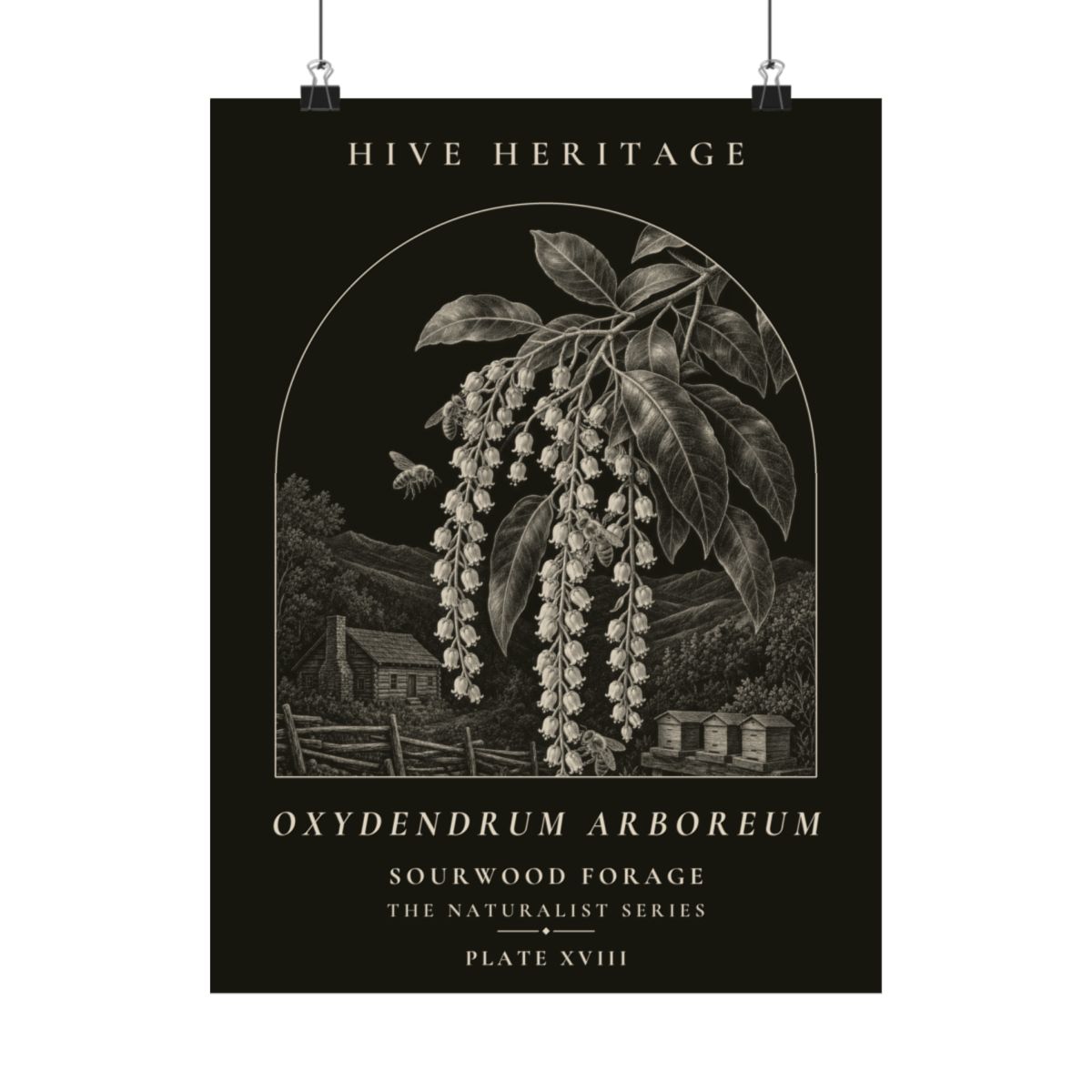
Sourwood is Oxydendrum arboreum, a slim, slightly untidy tree of the eastern American woods whose sprays of small white bell flowers open for a few weeks in high summer, chiefly across the southern Appalachians. It is behind Appalachia's famous honey because it blooms in that narrow window, roughly late June to August, right when other regional forage has finished, giving bees a late source that yields a light, slow-crystallising honey with a spicy, buttery, caramel-like flavour.
Our Sourwood Forage plate in the Naturalist Series is about that tree. This is the longer story behind it, and we have kept to what can be supported: where the record is thin, we say so.
What is sourwood?
Sourwood is Oxydendrum arboreum. The genus holds this one species and nothing else, which makes it something of a loner in botanical terms. The generic name comes from the Greek for sour and tree, and the common name says the same thing in plain English: the leaves have a distinctly tart taste when chewed. In parts of its range it has also been called the sorrel tree, for the same reason, and the lily-of-the-valley tree, for its flowers.
Linnaeus first described it in the eighteenth century under the name Andromeda arborea, and it was later moved to a genus of its own. That early placement tells you something useful. Sourwood belongs to the heath family, the Ericaceae, and so it is a relative of heather, bilberry, blueberry, rhododendron and the strawberry tree. If you know a British moor or a bank of ericaceous garden shrubs, you already know the family resemblance: urn-shaped flowers, a liking for acid soil, and a habit of doing well where other plants sulk.
It is a small to medium tree. In woodland it commonly reaches ten to fifteen metres, and in good conditions it can be taller. The leaves are long, narrow and finely toothed, glossy green through summer. In autumn they turn one of the deepest reds in the eastern forest, which is why sourwood is planted as an ornamental and has found its way into British gardens, where it needs lime free soil to do well. After the flowers come clusters of small grey seed capsules, which often stay on the branches well into winter.
Where does sourwood grow and when does it flower?
Sourwood is native to the eastern United States. Its range runs from roughly Pennsylvania and southern Indiana down through the southern states as far as northern Florida and Louisiana. The heart of the story, though, is the southern Appalachians, the old, worn mountains running through states such as North Carolina, Tennessee, Georgia and Virginia. There it grows on well drained, acid slopes, along ridges, and at the edge of mixed hardwood forest, often as a scattered tree rather than in stands of its own.
That scattering matters to beekeepers, and we will come back to it.
The flowers open in early to high summer. Exact timing shifts with latitude and altitude, so a tree on a warm lower slope will flower earlier than one high in the hills, but the season generally falls between about late June and August. The blooms are small, white and urn shaped, roughly the size of a fingernail, carried in long, one sided sprays that curve over at the tip like a row of fingers. They have a light scent. Because the flowers open from the base of each spray towards the tip, a single tree stays in bloom for a good while rather than all at once.
Timing is the point. Sourwood flowers when many other early forage plants of the region are finished. In the cool, wet weeks of spring, bees in these hills have plenty to work. By midsummer the choice narrows, and a tree that produces nectar then becomes disproportionately valuable to the colonies within reach of it.
What sourwood gives to bees
The plate asks a fair question: nectar, pollen or both? The honest answer is that sourwood's reputation rests on nectar. The tree is a recognised nectar source for honey bees, and the whole honey tradition attached to it is built on that nectar. The open bell of the flower is well suited to it, since a bee has to push right in to reach the sweet liquid at the base.
Bees visiting flowers also handle pollen, of course, and other insects visit sourwood too. But we have not found a reliable, well sourced account of sourwood as a significant pollen crop for colonies, so we are not going to claim one. Nectar is the supported answer. If you are aiming to plant for pollen through the summer, sourwood should not be the only thing on your list.
One thing worth knowing about the honey bee in this story: it is not native to North America. Honey bees were brought across by European settlers in the seventeenth century, and the sourwood honey tradition therefore belongs to a partnership between an introduced bee and a native tree. That does not make it any less real. It makes it a good example of how a landscape and a craft grow into each other over generations.
What does sourwood honey taste like?
Sourwood honey has a long standing place in the food culture of the southern Appalachians, where it is treated as something close to a local flagship. It is typically described as light in colour, from nearly clear to pale amber, and slow to crystallise compared with many honeys. The flavour is usually described in words such as spicy, buttery or caramel like, with a lingering finish that some tasters compare to aniseed or gingerbread. Taste is personal and descriptions vary, so treat those as the way people talk about it, not a laboratory measurement.
Making it is not simple, and this is where the tree's habits come in. Sourwood grows scattered, flowers in a narrow window, and depends on the weather. A wet, cold or windy spell during bloom can cut nectar production sharply, and beekeepers in the region talk about a sourwood flow as something that comes good in some years and disappoints in others. When the hive is busy with other flowers at the same time, the bees will work those too, so whether a jar is truly sourwood depends on the timing of the beekeeper as much as on the tree.
That last point is a useful thing to hold on to whenever you meet a single flower honey of any kind. Bees do not read labels. They fly a wide area and take what is generous. A beekeeper who wants a honey that is mostly sourwood has to place hives near the trees, read the season carefully, and take the honey off at the right moment, before later flows blend into it. The reputation of the honey is really a reputation for that care.
Sourwood has attracted plenty of stories over the years, some of them about who has eaten it and what it is supposedly good for. We have left those out. Nothing we could source supports claims about health, and in any case Hive Heritage does not sell honey. What we can say, and can support, is that this is a distinct regional honey with a recognisable character, made possible by one tree, one bee and a stretch of high summer weather.
Why it belongs in a natural history series
We chose sourwood for the Naturalist Series because it shows something that gets lost when bees are reduced to a single image of a hive and a jar. A honey can be a landscape. A summer in the Appalachian hills, the acid soil, the slope and the heat, and a slender tree with fingers of white flowers, all end up in a jar because a bee visited them.
It is also a reminder that beekeeping is more local than it looks. The same species of bee can make honeys that taste entirely different depending on what is in flower within a few kilometres of the hive. In Britain we know this through heather, borage, oilseed rape, lime and bramble. In the eastern United States, one of the great examples is sourwood.
If you keep bees, or simply like to know what they are doing, it is worth learning which tree or plant carries your own local summer. It is usually smaller and less famous than you expect.
The Sourwood Forage plate is our way of holding that idea in a single image. It is digital artwork made in the style of a naturalist's engraving, not an antique or a hand engraved original, and it is drawn to sit alongside the other plates in the series. Below you will find it in the shop, made to order as apparel and as art.
See it in the Naturalist Series: The Sourwood Forage plate