
Naturalist Series · 29 September 2026
The Red Dwarf Honey Bee and Its Open-Air Nest
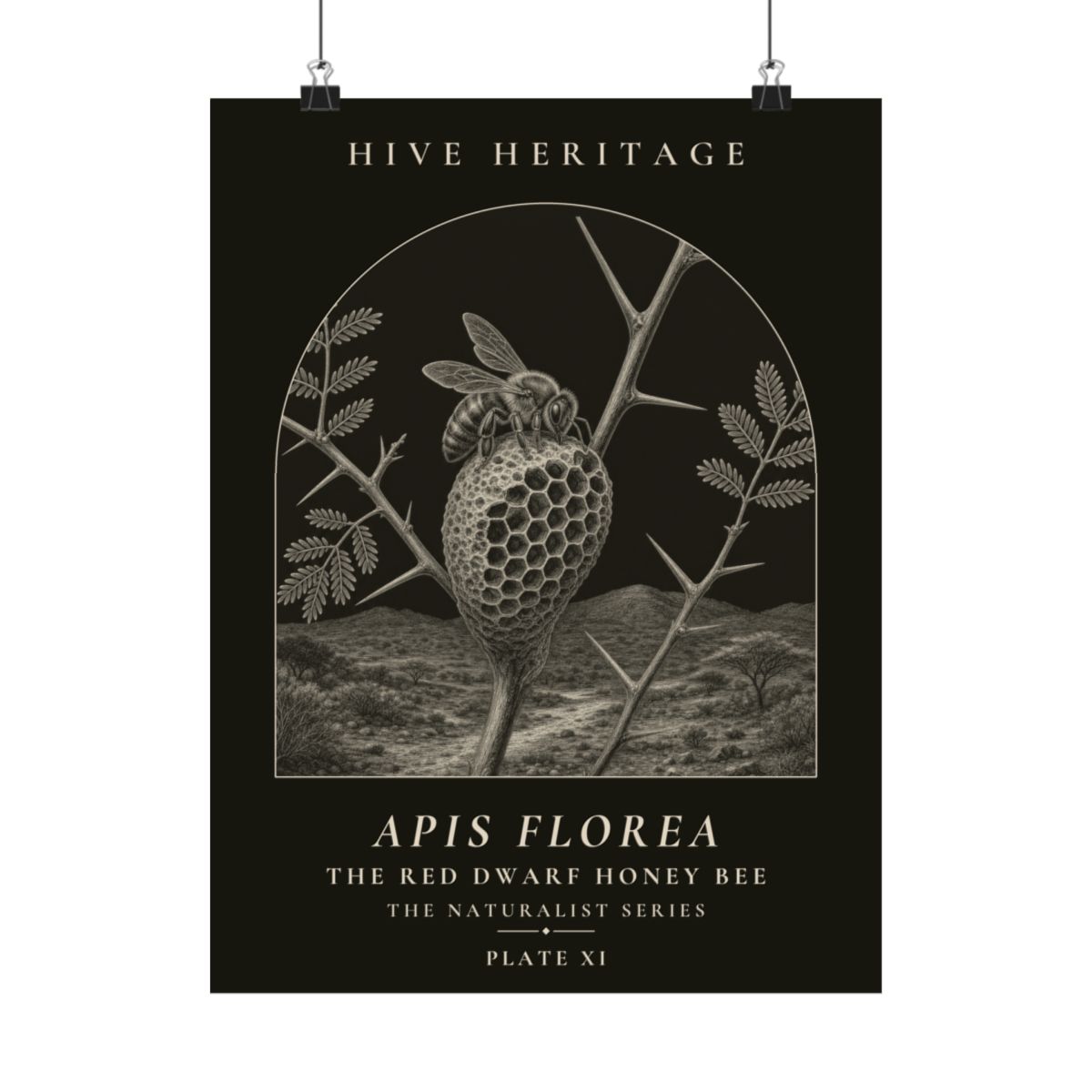
The red dwarf honey bee, Apis florea, builds a single sheet of wax comb hanging out in the open from a twig or branch, not sealed inside a hive box or hollow tree. Native to warm southern Asia, from Iran and Pakistan to Vietnam and southern China, its comb is roughly the size of a hand, with a crown of stored honey at the top, brood cells below, and the whole surface covered by a living coat of bees. Once you have seen that, the western honey bee's dark cavity starts to look like the unusual choice.
This is the bee on our Naturalist Series plate, and it deserves more than a caption. Here is what is reliably known about it.
Where does the red dwarf honey bee live?
The scientific name is Apis florea, and it was described by the Danish naturalist Johan Christian Fabricius in 1787. It belongs to the same genus as the western honey bee, Apis mellifera, but sits in a very different corner of it. Within Apis, the dwarf honey bees form their own small group, and A. florea has one close relative, the black dwarf honey bee, Apis andreniformis. The two look alike at a glance. The red dwarf is the one with a rust-orange band across the upper abdomen, which is where its common name comes from. Behind that, the abdomen is dark with pale banding.
Its home is warm southern Asia. It is recorded across parts of the Arabian Peninsula and Iran, through Pakistan, India and Sri Lanka, and eastward into Myanmar, Thailand, Vietnam, southern China and the Malay world. It is a bee of hot, fairly open country: scrub, orchards, gardens, village edges, the sort of habitat where small trees and shrubs are plentiful and the sun is strong. It does not go into cold, high country.
In recent decades it has also turned up beyond that historic range, in parts of the Middle East and north-east Africa. Researchers have tracked these arrivals, and how far they will spread is still being worked out. That is a moving story, so I will leave it at that rather than guess.
How does the red dwarf honey bee build its nest?
The nest is the thing to understand. A colony builds one comb, usually hanging from a slender branch of a shrub or small tree, often within easy reach of the ground, though the height varies. Sometimes it is a hedge, sometimes a rocky overhang or a building's eave. The comb is small, commonly described as about the size of a hand, or a little more in a strong colony. It is not tucked inside anything. The bees themselves are the roof and the walls.
The comb is built with a clear layout. At the top, the wax swells into a thick crown that wraps around the supporting branch, and this is where honey is stored. Below it come the worker cells, where most of the brood is raised, and the larger drone cells sit toward the lower edge. The whole colony is covered by a layer of workers, several bees deep in places, clustered so tightly that the wax barely shows.
A colony in the open has to solve problems a hollow tree solves for free. Ants are one. Observers of the species, notably in Thailand, have recorded that the bees put sticky bands of resin on the twig above the nest, a barrier ants find hard to cross. Hornets and other predators are another, and here the bee's defence is collective. The curtain of bees over the comb can respond to a threat together, as a single moving surface, rather than one bee at a time. Nobody who has watched it forgets it.
Colonies are also not permanent. Red dwarf honey bees are known to abscond, which means the whole colony leaves the nest and moves on. This can follow disturbance or a change in food supply. It is one reason the species has proved so hard to keep in boxes: a colony that has always lived in the open is ready to leave when it has had enough.
Dancing on the roof
Ask a beekeeper what makes honey bees remarkable and you will often hear about the waggle dance, the figure a returning forager traces to tell her sisters where the food is. Karl von Frisch made that famous for the western honey bee. In that bee the dance happens on a vertical comb, inside a dark hive, so the angle to the sun is translated into an angle from straight up. It is a lovely piece of code.
The red dwarf honey bee does something more direct, and more visible. Its comb has a flat, horizontal platform at the top, where the comb wraps around the branch. Dancers work on that surface, in the open, in daylight. The waggle run points straight at the food. There is no translation from gravity to the sun, because the bee can see the sun and simply points along the line. Distance is signalled by the dance itself. That contrast is one of the reasons the species has long interested researchers who study how bee communication evolved, since a direct, open-air dance is a plausible ancestor of the more abstract one.
Careful readers should note what I am and am not claiming. The direct dance is well documented. Exactly how it relates to the dances of the other honey bees is a scientific question with a proper literature, and I would not present any single tidy answer as settled.
How does the red dwarf honey bee differ from the western honey bee?
The differences are easier to hold in the mind side by side.
- Nest: one exposed comb on a branch, against the western honey bee's several parallel combs inside a cavity.
- Size: the workers are noticeably smaller than the western honey bee's, and the colony is far smaller too.
- Dance: on a horizontal platform, in the open, pointing directly at the target, against a vertical dance in the dark.
- Keeping: the western honey bee has been managed in hives for a very long time. The red dwarf is not kept in boxes in any comparable way.
- Climate: a warm-country bee of southern Asia, where the western honey bee has been carried across most of the world.
The comparison should not be read as a ranking. The western honey bee's cavity and its wintering habits let it live in cold places and produce the large honey stores that beekeeping is built on. The red dwarf's open nest suits a hot region where the flowers are close and the winter is mild. Each design fits where the bee lives.
Living beside people
Because the nest is low and visible, people living within its range have always known these bees. In parts of Asia, wild dwarf honey bee combs are gathered for their honey and wax by people who know where to look. Since a colony makes so little compared with a hive of western honey bees, it is a small harvest, and a nest is also taken at the cost of the colony. Those are practical facts of the harvest, not a recommendation.
The bee also works alongside farmers without anyone managing it. Foraging on a wide range of blossom, it visits flowers in gardens, orchards and fields through its range, and that means it takes part in the pollination that people depend on. How much it contributes to any one crop varies by place and study, and I would rather say that than quote a figure I cannot stand behind.
There is one honest caveat about the bee's future. The colony in the open is exposed to weather, to predators and to human disturbance, and hedgerow and scrub removal takes away nest sites. That is a reasonable concern for any species that nests in shrubs. It is not the same as a documented conservation status for this bee, and this article does not claim one.
What the plate is showing
An engraving-style plate suits this subject well. The red dwarf's story is one of line and structure: a single comb draped from a branch, the crown of stored honey, the packed brood cells, the bees layered on the surface, the rust band on the abdomen. It rewards close looking, which is what natural-history plates were always for.
Our plate is digital artwork made in the engraving style. It is not an antique or a hand-engraved original, and we would not describe it as one. What it does is give you a careful, quiet image of a bee that most people never meet, in the tradition of the natural-history illustration that first made bees a subject of serious study. Its place in the Naturalist Series is as a reminder that the honey bee is not one animal with one way of living. It is a small genus, and this member of it builds its house in the sunlight.
See it in the Naturalist Series: The Red Dwarf Honey Bee plate