Naturalist Series · 29 September 2026
Orange Blossom Forage: Bees, Nectar and Citrus Groves
Orange blossom forage is the short spring nectar flow that honey bees take from the flowers of the sweet orange, Citrus sinensis, chiefly in warm citrus regions such as Spain's Valencia, Florida and California. A fortnight or so of bloom in March, April or May produces the pale, mild, floral honey sold as orange blossom honey.
This article looks at that plant and its relationship with bees, written from what is broadly established about citrus, honey bees and the honey trade. It is not a guide to buying honey, and we make no claims about what any honey does for anyone; Hive Heritage makes apparel and art, not honey. Where a detail varies from one region or grove to the next, we say so rather than smooth it over.
What plant does orange blossom honey come from?
The orange blossom of beekeeping is mostly the flower of the sweet orange, Citrus sinensis. Genetic studies of citrus suggest the sweet orange is an old hybrid, descended from crosses involving the pomelo and the mandarin. Citrus as a group began in the warm regions of southern and south-eastern Asia, and the trees travelled west along trade routes over many centuries. That is a long, layered story and the details are still debated, so we will not pretend to pin it to a single date or a single voyage.
What is easier to say with confidence is where the tree does well today. Oranges want warmth and a long growing season, and they dislike hard frost. That puts the great commercial groves in places such as the Mediterranean basin (Spain, Italy, Greece, North Africa), Florida, California, Brazil and parts of the Middle East and Asia. Spain's east coast around Valencia is the one most often tied to orange blossom honey in the European mind, and Florida has long been a citrus honey region in the United States.
Britain is not on that list. An orange tree can be kept alive here in a pot or under glass, and the grand houses that built orangeries centuries ago did exactly that, sheltering citrus through the cold months. But nobody in this country is taking a crop of orange blossom honey from open ground. This is a forage plant of warmer latitudes, and a British beekeeper who has never worked it is in good company.
The blossom itself is white, waxy and typically five petalled, with a cluster of yellow anthers in the centre. It opens singly or in small groups along the young growth. Sweet orange flowers are strongly scented, and the fragrance is not there for our benefit. It is a signal to pollinators, and a very effective one.
When does orange blossom flower, and what does it give the bees?
In the northern hemisphere, orange trees generally flower in spring. In the Mediterranean that means the weeks around March, April and into May, depending on the year, the variety and how far inland or uphill the grove sits. The season is short. A grove can be in full bloom for a fortnight or so, which means the honey flow is concentrated and the beekeeper has to be ready for it. Southern hemisphere groves flower in their own spring, roughly the opposite half of the year.
The question that matters for a beekeeper is what the flower offers. In the case of citrus, the answer is both nectar and pollen, though the nectar is the star. Orange flowers are good nectar producers, and honey bees work them readily, which is why citrus has such a strong reputation as a honey plant. Bees also collect pollen from the flowers, and it will turn up in the pollen loads carried back to the hive, so the plant is a source of both. But when people talk about orange blossom as forage, they are nearly always talking about nectar, and the honey it makes.
There is a useful complication here for anyone who likes the idea of a single-flower honey. Citrus honeys are known to carry relatively few pollen grains compared with many other honeys. That matters because one of the standard ways of checking what flowers a honey came from is to count and identify the pollen in it, a method known as melissopalynology. With citrus, a low pollen count does not mean the honey is not from citrus. It means the usual test is less straightforward to read, and it is one reason labelling of citrus honey is discussed so carefully by people who work in honey analysis.
It is also worth being clear that spring is crowded. In a Mediterranean grove bees may also be working wild flowers, other fruit trees and roadside plants at the same time. A jar sold as orange blossom honey may be from bees working chiefly citrus, or it may be a blend of spring nectars in which citrus is prominent. Producers and beekeepers who use the name honestly describe what their bees were placed on, and where possible how that was confirmed.
Groves, hives and the honey itself
The relationship between bees and orange groves is old, but the way it works now is fairly modern. In many citrus regions beekeepers move hives to the groves just before bloom, leave them for the flow, and take them away again. This is often called migratory beekeeping, and it has been part of the honey trade in places like Florida and California for a long time. Growers and beekeepers have a shared interest, since bees working the blossom can help fruit set, though the value of that varies. Many sweet orange varieties will set fruit without pollination, and some, like navel oranges, are seedless by nature. Bee visits can still influence the crop in some varieties and conditions, and pollination needs differ across citrus types, so it would be a mistake to say oranges need bees in any simple way.
There is a practical tension as well. Groves are managed land, and the timing of any spraying during bloom matters a great deal to hives placed nearby. Sensible arrangements between grower and beekeeper about when and what is applied are part of working citrus responsibly. We mention it not as a campaign point but because it is a real part of the craft: the flow is short, the trees are worked land, and good beekeeping there depends on communication as much as on colonies.
As for the honey, orange blossom honey is generally described as pale, from very light to light amber, with a soft floral and citrus scent and a mild, fragrant flavour. Like most honeys it crystallises over time, at a rate that depends on its sugar balance and how it is stored. Those are descriptions of character, and honey from different groves and years will differ, so treat them as a general picture rather than a rule.
The name has travelled into language too. In Spanish the orange blossom is azahar, a word that comes from Arabic, and the honey is sold as miel de azahar. The Arabic link is a reminder of how much citrus growing in southern Europe owes to the medieval Mediterranean world. It is worth a small caution, though. The bitter or Seville orange arrived in Iberia earlier than the sweet orange, and both are called orange blossom in casual speech. The distilled orange flower water used in cooking and perfumery is traditionally made from the bitter orange, not the sweet. So the word blossom covers a few closely related trees, and not every reference to orange flowers in a cookbook or a poem points to the tree bees are working for honey.
Orange blossom also has a life well outside the hive. It has long been associated with weddings in Britain and elsewhere, and the flowers are woven into perfumery and food traditions across the Mediterranean. We leave those threads there. The bee's side of the story is enough for one article, and it is the side we care about.
What we keep coming back to is how compressed the whole thing is. A few weeks of bloom. A scent strong enough to carry across a lane. A flower that gives up nectar so freely that people built a named honey around it. And then, until the following spring, nothing but green leaves and slowly swelling fruit. Natural history is often like that: one short, precise moment, and a great deal of patient tradition built around waiting for it.
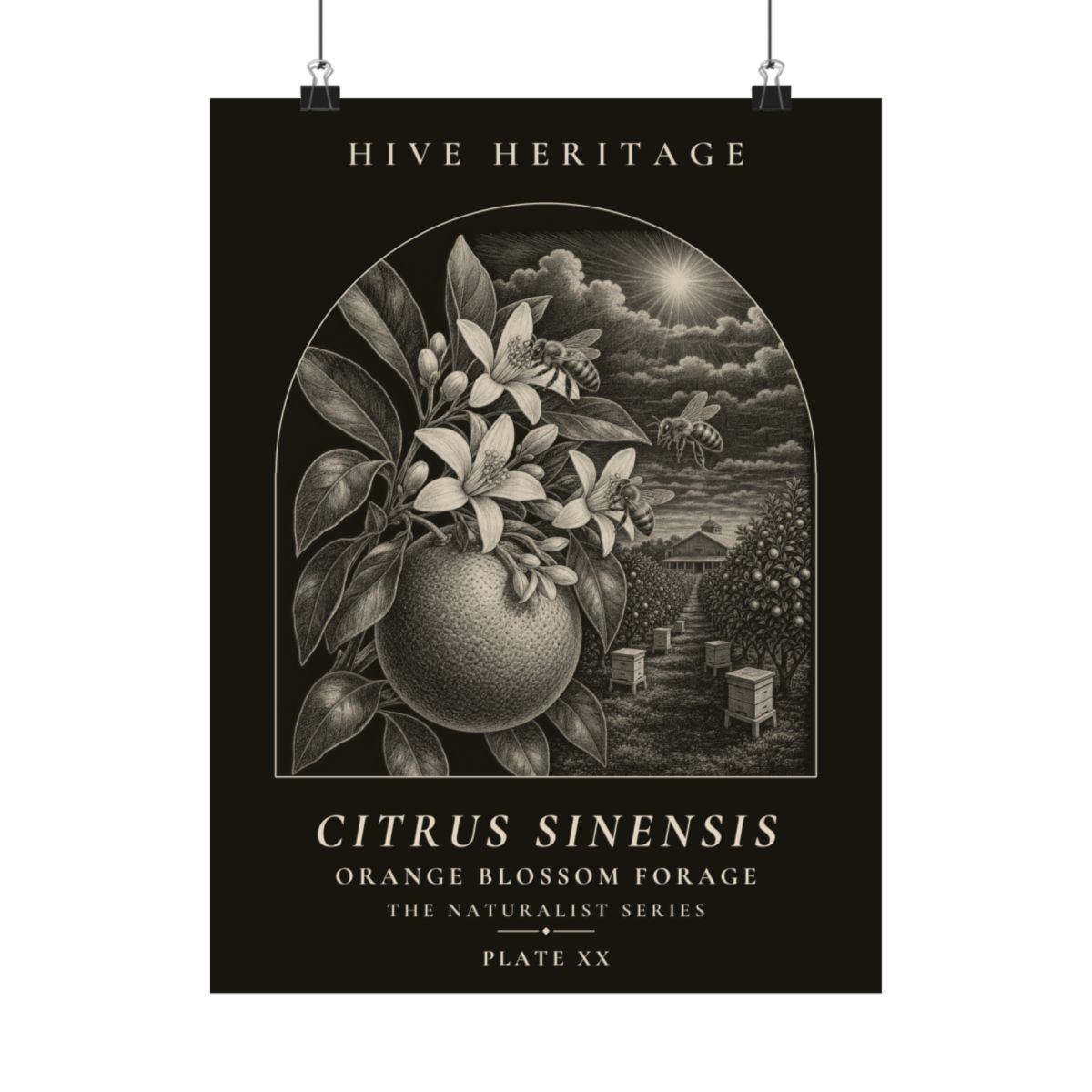
That is the spirit in which we made the Orange Blossom Forage plate. It is digital engraving-style artwork, drawn to sit with the other plates in our Naturalist Series and to reward a slow look, the way a botanical plate does. It is our own design, not an antique or a historical original, and it is there for people who like their bee and plant knowledge worn or hung where they can see it. If the blossom has caught your interest, the design is waiting for you in our shop, just below.
See it in the Naturalist Series: The Orange Blossom Forage plate