
Naturalist Series · 29 September 2026
The Maya Bee: the Stingless Keepers of Yucatán
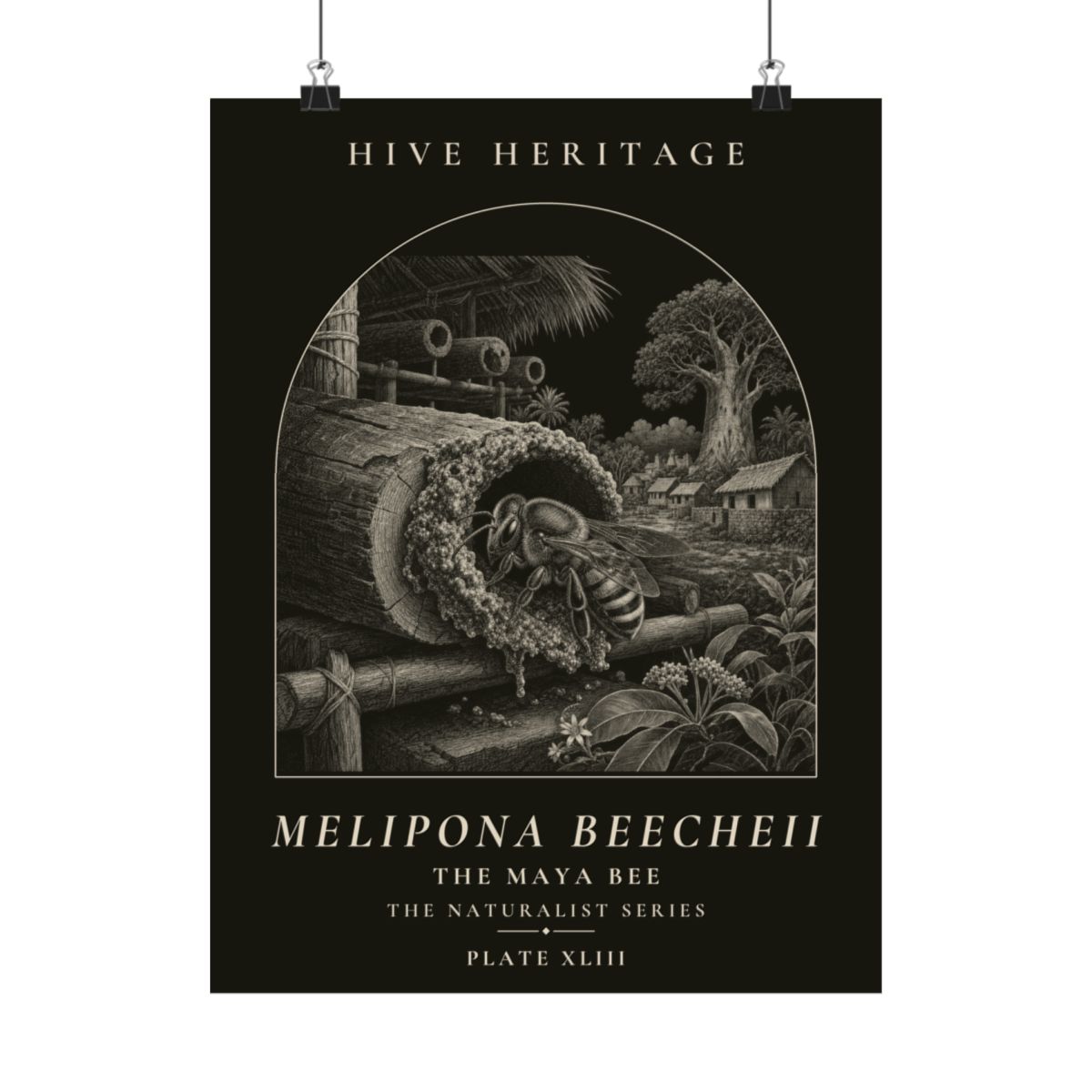
The Maya bee is Melipona beecheii, a stingless bee kept for many centuries in the Yucatán Peninsula by Maya beekeepers, who call it xunan kab, or "lady bee". Its sting is a vestige that cannot pierce skin, and it was traditionally housed not in a hive but in a hollowed log called a jobón, sealed at each end and hung under a shelter.
It is a different picture from the white box, smoker and veil that "beekeeping" usually brings to mind, a picture built almost entirely around one species, the western honey bee, and a few hundred years of European tinkering with its housing. Melipona beecheii is the subject of one of the plates in our Naturalist Series, and like every plate in the series it deserves more than a caption. This is the longer story.
Does the Maya bee sting?
The Maya bee belongs to a group called the stingless bees, the Meliponini, which are found across the tropics of the world. "Stingless" is slightly loose language. These bees descend from stinging ancestors, and the sting has been reduced to a vestige that cannot be used to pierce skin. That is not the same as being defenceless. When a nest is disturbed, stingless bees of various kinds defend it by biting, by swarming around the face and hair, and in some species by smearing sticky resin on an intruder. Melipona species are generally described as fairly gentle, which is one reason they suit keeping, but a colony in a hurry can still make its feelings known.
The colony itself is a modest affair beside a honey bee hive. Where a hive of honey bees can run to tens of thousands of workers in high summer, a Melipona colony is usually counted in hundreds to a few thousand. There is a single queen, and the workers build with cerumen, a mixture of beeswax and plant resin that is darker and stickier than the clean wax we associate with a honey bee comb. The brood is raised in a cluster of cells near the middle of the nest. The honey and the pollen are stored apart from it, in rounded pots of cerumen that look, to anyone used to hexagons, almost like a bunch of tiny dark grapes.
That is a real difference in the bee's engineering, and it matters for the story that follows. A honey bee makes a hanging comb that can be lifted out frame by frame. A stingless bee makes something that has to be opened, worked around and, if you are careful, divided. The style of keeping that grew up around it is therefore quite unlike the one most of us know.
There is one more habit worth naming, because it is where the bee earns its place in the wider natural world and not only in the keeper's yard. Melipona bees are known for buzz pollination. They grip the flower and shake the pollen loose with a burst of vibration from their flight muscles, which is the way certain flowers, with their pollen locked away in tight anthers, need to be worked. Several familiar crops, tomatoes among them, are of this kind, and it is one reason researchers take an interest in these bees beyond their honey.
How did the Maya keep bees?
The Maya word most often given for this bee is xunan kab, usually translated as something like "royal lady" or "lady bee". The keeping of it is called meliponiculture, and in the Yucatán Peninsula it was carried on for many centuries.
The traditional home was a hollow log, called a jobón in Yucatec Maya. A length of hardwood trunk was hollowed out, or a naturally hollow section was chosen, and the two open ends were closed with discs of stone or fired clay, sealed round with mud or wax. A small hole was left for the bees to come and go. The log was then laid on its side, often on a raised support or hung under a thatched shelter where the family could keep an eye on it and the sun could not cook it. It is a plain, sensible arrangement, and it is easy to see why it lasted. A log is close to what the bee would choose for itself, a hollow in a tree, and the keeper simply gives it a version that can be moved and reached.
To take honey, the keeper opens one end, reaches the storage pots and takes a portion, leaving the brood and the rest of the stores in place. The honey that results is quite unlike the thick, sweet stuff from a honey bee hive. It is runnier, because it carries more water, and it is known for a tart, almost fruity edge. The yield is small. A colony gives a fraction of what a honey bee hive would, which tells you at once that this was never keeping for volume. It was keeping for something more particular.
What that something was is a matter on which we should be careful. Honey and wax from these bees were valued in Maya life, and they appear in the accounts of Spanish writers in the sixteenth century among the goods of the region. Bee imagery also appears in Maya art. A bee deity, usually rendered as Ah Muzen Cab, is shown in the Madrid Codex, one of the surviving Maya books, and figures of a descending bee-like god appear in the painted architecture at Tulum. The bees plainly mattered, in daily life and in the way the world was pictured.
Beyond that, we would rather say less than more. You will read broad claims online about precisely how the Maya used the honey in medicine or ritual, and many of them are repeated from one page to another without a source we would trust. Traditional uses are documented by ethnographers and by Maya people themselves, and we are not the people to set them out as fact or to suggest the honey does anything in particular. This is a natural history piece, not a health one, and we leave it there.
Why did Maya beekeeping decline?
For a practice that ran for so long, the decline of Maya meliponiculture has been fairly quick. Researchers working in the Yucatán Peninsula have described a marked fall in the number of people keeping the bee and in the number of colonies kept, across the second half of the twentieth century and beyond. We have chosen not to quote a figure here, because the numbers vary by survey and by place, and we would rather be vague than wrong.
The reasons that are usually offered fit together sensibly. The western honey bee, which is far more productive, arrived and spread, and it offered a keeper much more honey for the same labour. The forest that Melipona depends on, both for nesting hollows and for the range of flowers it feeds from, has been cleared and broken up in places. Storms are named in some accounts as a blow to wild and kept colonies alike. And as the young in many villages moved away to find work, the knowledge that lived in the older keepers, of when to open a log, how to divide it and how to read a colony, was at risk of leaving with them. A tradition kept by hand and by word of mouth is only ever one generation from being lost.
We would add a caution that we apply to every plate in this series. It would be easy to write this as a tidy tale of a noble craft brought down by outside forces, and it would not be honest. Keepers have made their own choices, for good reasons, and the factors above interact in ways that individual studies have not fully separated. What can be said with confidence is that the practice has become much rarer than it was, and that this concerns people who care about the bee.
The people bringing it back
The revival, where it exists, is being carried by people and not by any single organisation. In parts of the Yucatán Peninsula, Maya keepers, including cooperatives of women, have taken up meliponiculture again or have carried on where their families never stopped. Some keep their bees to sell a small quantity of honey. Some keep them mostly to hold on to the practice. Researchers and local groups have run training and have worked on the practical side, such as how to divide a strong colony into two so that the number of nests can grow without taking bees from the wild.
That last point deserves a moment, because it is where the old and the new agree. A log hive can be split, and a keeper who knows the bee can raise the number of colonies steadily and gently. It is slow, and it is the opposite of an industrial answer, which suits the bee. Written descriptions of these efforts tend to stress that they are held together by patient, local know-how, and we think that is right.
We will not claim on the bee's behalf that this work has secured its future. We cannot support that, and we would be doing the bee no favours by saying so. What we can say is that a living tradition, once thought to be fading, has people around it who are keeping it going, and that is a more interesting thing to record than either a triumph or a lament.
Why we drew it
We chose the Maya bee for the Naturalist Series because it changes the picture. It reminds us that beekeeping is a much larger and older subject than the box and the veil, that a bee can be a keeper's companion without ever threatening it, and that some of the most careful craft is the craft that never got industrialised.
The plate is digital artwork, made in the manner of an engraving. It is not an antique, and it is not hand engraved. It is our own drawing of a bee we find quietly remarkable, and we hope it does justice to the small, dark, gentle creature it shows.
If you would like to see it, the plate is just below.
See it in the Naturalist Series: The Maya Bee plate