
Naturalist Series · 29 September 2026
How the Mason Bee Nests, Seals and Pollinates
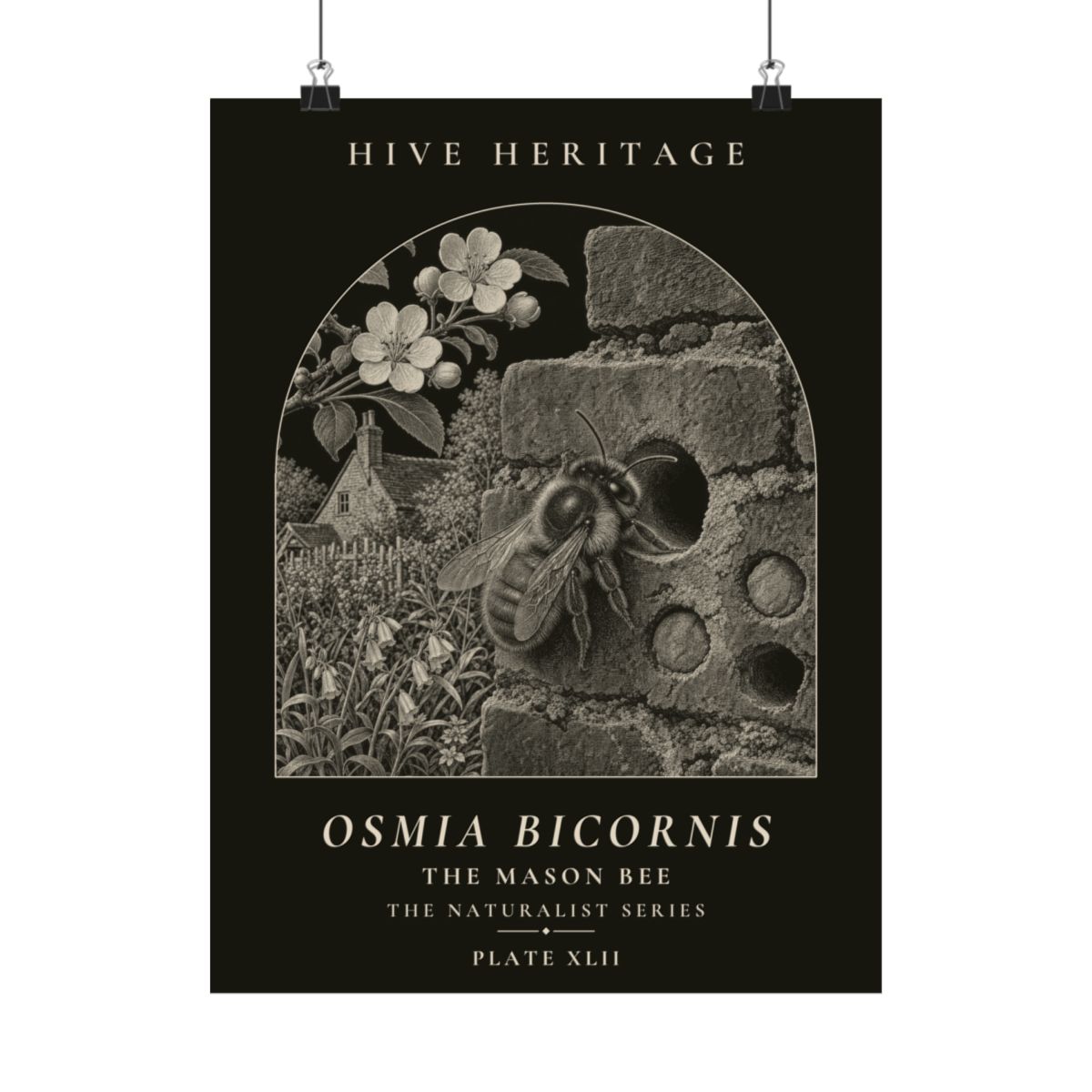
The mason bee nests in a cavity she finds rather than digs, such as a hollow plant stem, an old beetle hole in wood or a gap in a wall, and fills it cell by cell: a mass of pollen and nectar, an egg laid on top, then a wall of mud to seal that cell off, before capping the whole tunnel with a thicker mud plug once it is full. She pollinates fruit blossom so well because, unlike the honeybee, she carries pollen dry in a brush of hairs under her abdomen, and much of it rubs off as she moves from bloom to bloom.
Most people who keep bees know the honeybee well: the colony, the queen, the frames, the stores. The mason bee lives by an entirely different set of rules, and it is worth a beekeeper's time, and anyone's who loves natural history, to see how different. This is the story behind the plate, and we have tried to keep to what can be supported.
What is a mason bee?
The mason bees belong to the genus Osmia, part of the family Megachilidae, which also includes the leafcutter bees. There are hundreds of Osmia species across the world. They are solitary bees, and that word means exactly what it says. There is no queen and there are no workers. Each female mates, finds a nesting place, and provisions her own nest without help. No colony forms, and no honey is made or stored for the winter.
This is the ordinary way to be a bee. In Britain, honeybees are a single species and the bumblebees number only a couple of dozen, while the great majority of the bee species on these islands are solitary. The hive, for all that it fills our idea of what a bee is, is the exception.
The species most often meant by "mason bee" in the UK is the red mason bee, Osmia bicornis. It is a small, stocky bee with a coat of foxy orange-red hair on the rear of the body, and the name bicornis means "two-horned", after the pair of small horns on the female's face. She flies early, generally from spring into early summer, and she is often on the wing when the first fruit trees flower. There are other mason bees in Britain too, some of them fussier about where they nest and what they use to build with, but the red mason bee is the one most gardeners will meet.
Across the Atlantic, the picture is similar but the cast differs. In North America the best known is the blue orchard bee, Osmia lignaria, a native species with a dark, metallic blue-black look. It too flies early in the year, it too nests in holes in wood, and it has long been valued around orchards. There is also a horn-faced mason bee from Japan, Osmia cornifrons, which was deliberately brought to the eastern United States for orchard work. Different continents, different species, the same habit.
How does a mason bee build and seal her nest?
The mason bee does not dig her own tunnel, at least not in the way a mining bee does. She looks for a cavity that already exists: a hollow plant stem, a beetle hole in old timber, a gap in a wall or a crack in mortar. These bees are also readily taken with man-made tubes, which is why bee hotels work. The tunnel needs to be about the right width for her body, and for the red mason bee that is commonly given as roughly eight millimetres.
Once she has chosen, the work is methodical. She gathers pollen and nectar and carries it back to the far end of the tunnel. She builds it into a small mass, lays a single egg on it, and then seals that cell off with a partition of mud. Then she starts the next cell, and the next, working her way outwards towards the entrance. The mud comes from damp, clay-rich soil, and she carries it in her jaws. When the tunnel is full, she closes the entrance with a thicker plug of mud. That habit of building with mud, and of building walls, is what earned her the name "mason".
There is a quiet piece of planning in that order of cells. The females' eggs are generally laid in the innermost cells, which she provisions with more food, and the males' eggs go in the outer cells nearest the entrance. Males, which are smaller, emerge first in spring, and the females follow a little later. Because the outermost occupants leave first, they do not have to push past the others.
Inside the cell, the egg hatches into a larva that feeds on the pollen loaf its mother left. It grows through the summer, then spins a cocoon and pupates. The adult bee forms within that cocoon in the autumn, and it stays there, fully formed, through the winter. In spring, as the weather warms, it chews through its mud partition and emerges. The mother by then is long gone. She lives only a matter of weeks as an adult and never meets her offspring, so everything the young bee needs to do has to be known already.
She does not get the whole thing easy. Nests attract their own parasites and uninvited guests, including small flies, parasitic wasps and mites that feed on the stored pollen or on the developing larvae. It is part of why a cavity nest is not simply a safe box, and why the advice for anyone who provides tubes is to keep them clean and replace them from time to time rather than leaving them to fill with waste and mould.
Why are mason bees such good pollinators?
The honeybee packs pollen into tidy, damp pellets on its hind legs, and it does so by moistening the pollen with nectar. The mason bee carries pollen quite differently. Like others in her family, she has a dense brush of stiff hairs on the underside of her abdomen, and she collects dry pollen there. It is loose, it is carried in bulk, and a good deal of it is shed as she moves from bloom to bloom. For a bee that is carrying pollen to feed her young, this is a working method. For the flowers, it is a rather effective side effect.
That is the mechanism behind the mason bee's reputation as a good pollinator of fruit blossom, in particular apple, pear and cherry. She is active in cool spring weather, when many other insects stay home, and she is not cautious about it: she tends to work the flower thoroughly and move on. Orchards in Europe, North America and Japan have all made deliberate use of Osmia species for that reason, which is a matter of practical record, not of romance.
You will sometimes see it said that one mason bee does the work of a hundred honeybees. We would leave that figure out. It is repeated widely, but a round number like that is not a finding, and the honest position is that mason bees are excellent pollinators of certain crops in the season they fly, while honeybees do other jobs well in other places. The two are not rivals. A garden or orchard is better served by several kinds of bee than by a single champion.
She is also a gentle neighbour. A female can sting, but she seldom does, and the males have no sting at all. She does not defend a hive, because she does not have one, and her nest is a row of cells in a tube rather than a store of honey worth guarding.
Living alongside her
For beekeepers in particular, the mason bee is a useful reminder of how much of the bee world sits outside the hive. If you keep honeybees, you already know that forage matters. The mason bee asks a few more things of a place: early blossom, a cavity of the right size, and, easily overlooked, bare damp earth or clay where she can gather mud. A garden that is tidied so thoroughly that every stem is cut back and every gap filled has quietly removed the places where she nests.
Those who put up a bee hotel can do the bees a good turn by placing it in a sheltered spot facing the morning sun, keeping the tubes clean, and not moving nests about while larvae are developing. We would stop short of promising that any of this will save a species, because that is a claim the evidence has to carry and we have not been given it. What can be said plainly is that a nest that is understood and left in place gives a solitary bee a chance to do what she has always done.
There is something quietly satisfying about the mason bee's craft. A cell, a loaf of pollen, an egg, a wall of mud. Repeat until the tunnel is full, then seal the door. It is the sort of orderly, unhurried building that natural historians have always admired, and it takes place on the side of a wall, without any fuss.
That is the bee our plate is drawn to honour. It is digital artwork made in the manner of an engraving, not an antique or a hand-cut original, and it gives the mason bee the same close attention that an old natural-history illustrator would have given her: the coat, the horned face, the careful lines. If this article has made you look twice at a hole in a wall, the plate is a way of keeping her in view. You will find it in the shop below.
See it in the Naturalist Series: The Mason Bee plate