Naturalist Series · 29 September 2026
What Lavender Gives Bees, and Where the Honey Comes From
Lavender gives a bee nectar above all, its main draw, and only a modest amount of pollen, more of a support act than a protein crop. The honey it makes comes chiefly from southern France, where beekeepers have long moved their hives onto the lavender fields for the few weeks it flowers, and from Spain, where bees often work a related species, Lavandula latifolia.
We chose lavender as one of the plates in our Naturalist Series because it is one of the clearest examples of a plant and a bee working well together. Where the evidence runs thin, we say so.
What is lavender, and where does it grow?
Lavender belongs to the genus Lavandula, part of the mint family, which is why the stems are square and the leaves carry that unmistakable oil. The genus holds a few dozen species, spread from the Mediterranean and North Africa across to south west Asia and into India. It is a plant of dry, sunny, stony ground.
The lavender most people in Britain picture is Lavandula angustifolia, usually called English lavender or true lavender, despite the fact that its native home is the western Mediterranean, in the hills of southern France and neighbouring regions. It has been grown in British gardens for a very long time and thrives here for the same reason it thrives in Provence: it wants sun, sharp drainage and no waterlogging. Heavy, wet winter soil does it far more harm than cold does.
There is a second lavender worth knowing about, because it changes the story of the honey. Lavandin, Lavandula × intermedia, is a hybrid between English lavender and a broader leaved species, Lavandula latifolia. It is larger, more vigorous and produces more oil per plant, which is why it is widely grown for the perfume and scent trade. Many of the great blue fields people photograph in southern France today are likely to include lavandin as well as true lavender, and the two flower at slightly different times. If you buy a jar labelled lavender honey, it is fair to ask which lavender the bees were actually on.
When it flowers
Timing is the whole point of a forage plant. In Britain, English lavender generally comes into flower from around late June and carries on through July and often into August, depending on the variety, the weather and how far north you are. In the south of France the season starts a little earlier and finishes at broadly similar times. Lavandin tends to follow slightly later than true lavender, which stretches the season for anyone with both.
That matters to a beekeeper. In much of Britain, the spring flush of blossom and oilseed rape is over by early summer, and there can be a thin stretch before the later summer forage begins. Beekeepers sometimes call this the June gap, and colonies can go short in it. A generous, reliable summer flower such as lavender helps fill the space. We would not claim it solves the problem on its own, but it is exactly the kind of plant that a thoughtful gardener or smallholder can add to give bees something in the middle of the year.
Nectar, pollen or both?
This is the question the plate is really asking, and the honest answer is that lavender is valued chiefly for its nectar.
The flower is a small tube, opening into two lips. Nectar sits at the base of that tube, and a bee reaches it by pushing its tongue in while its body brushes the anthers, picking up pollen and carrying it to the next flower. Honey bees, bumblebees and a good number of other visiting insects work lavender, which is why it appears on the well known lists of plants recommended for pollinators, including those kept by the Royal Horticultural Society. Bees with longer tongues have an easier time of the deeper flowers, and bumblebees are often the most conspicuous visitors on a garden plant.
Pollen is more modest. Bees do gather it from lavender, and the flowers certainly produce it, but nobody keeping bees would describe lavender as a major pollen crop in the way they might describe willow in spring or bramble and clover in summer. So if you are asking what to plant to feed a colony's protein needs, lavender is a support act. If you are asking what will give bees a dependable summer nectar source, it earns its place.
A practical point for anyone planting for bees: the wild type and simple garden varieties are usually the better choice. Some highly bred forms have been changed so much for looks that they can offer less to an insect. A single flowered, open plant is generally easier for a bee to use than something bred for showiness alone. If you are not sure, watch the plant in flower for a few minutes. The bees will tell you.
Where does lavender honey come from?
Where lavender is grown on a large scale, beekeepers have long treated the flowering as a season in its own right. In southern France, the lavender growing districts have a tradition of moving hives onto the lavender when it comes into bloom, then taking them away again when it finishes. Moving colonies to follow a flower like this is known as migratory beekeeping, and it is an old practice in many parts of the world. It lets a beekeeper make use of a crop that flowers heavily for a few weeks in one place, rather than depending only on what grows around the home apiary.
The honey that comes from it is usually pale, and it is generally described as floral and delicately scented. Spain has its own lavender honey too, and there the bees often work a different species, Lavandula latifolia. As with all single flower honeys, the label carries a caveat. Bees do not respect the boundaries of a field, and a jar sold as one flower is normally mostly that flower, not entirely. That is one reason honest beekeepers describe it as lavender honey by predominance, and why the tradition matters more than any promise of purity.
We are a maker of apparel and art, not a seller of honey, and we make no claims about what any honey does for the body. What we can say is factual and quite enough: lavender is a well loved bee plant, its nectar makes a distinctive honey, and it has shaped the calendar of beekeepers in the places where it grows in numbers.
Does lavender repel bees?
It is worth clearing away a couple of stories that circulate. The first is that lavender repels bees. It does not. The scent that people find calming is exactly what draws bees to it, and a lavender bush in full flower is one of the busiest plants in a garden. If you dislike bees near a path, lavender is not the plant to put there, and that is rather the point of it.
The second is the idea that lavender honey is somehow purple or tastes of soap. Neither is true of a properly made honey. The colour is pale gold to light amber, and the flavour is floral, with the aroma rather than the sweetness doing the talking. The soapy reputation belongs to some scented products, not to the honey.
One more practical note for gardeners. Lavender flowers best after it has been trimmed lightly once the blooms fade, cutting back the flowered stems and a little of the green growth below, but not into old bare wood, which rarely reshoots. A plant kept compact and sound will flower generously for years, and flower is what the bees want from it.
Why this is a plate
Every subject in the Naturalist Series is chosen because it tells a small true story about how bees, plants and people fit together. Lavender does that in a few plain strokes: a dry hillside plant, a summer flowering that bridges a hungry season, a tiny tubular flower that suits a bee's tongue, and a honey tradition that grew up around the way people learned to follow the bloom.
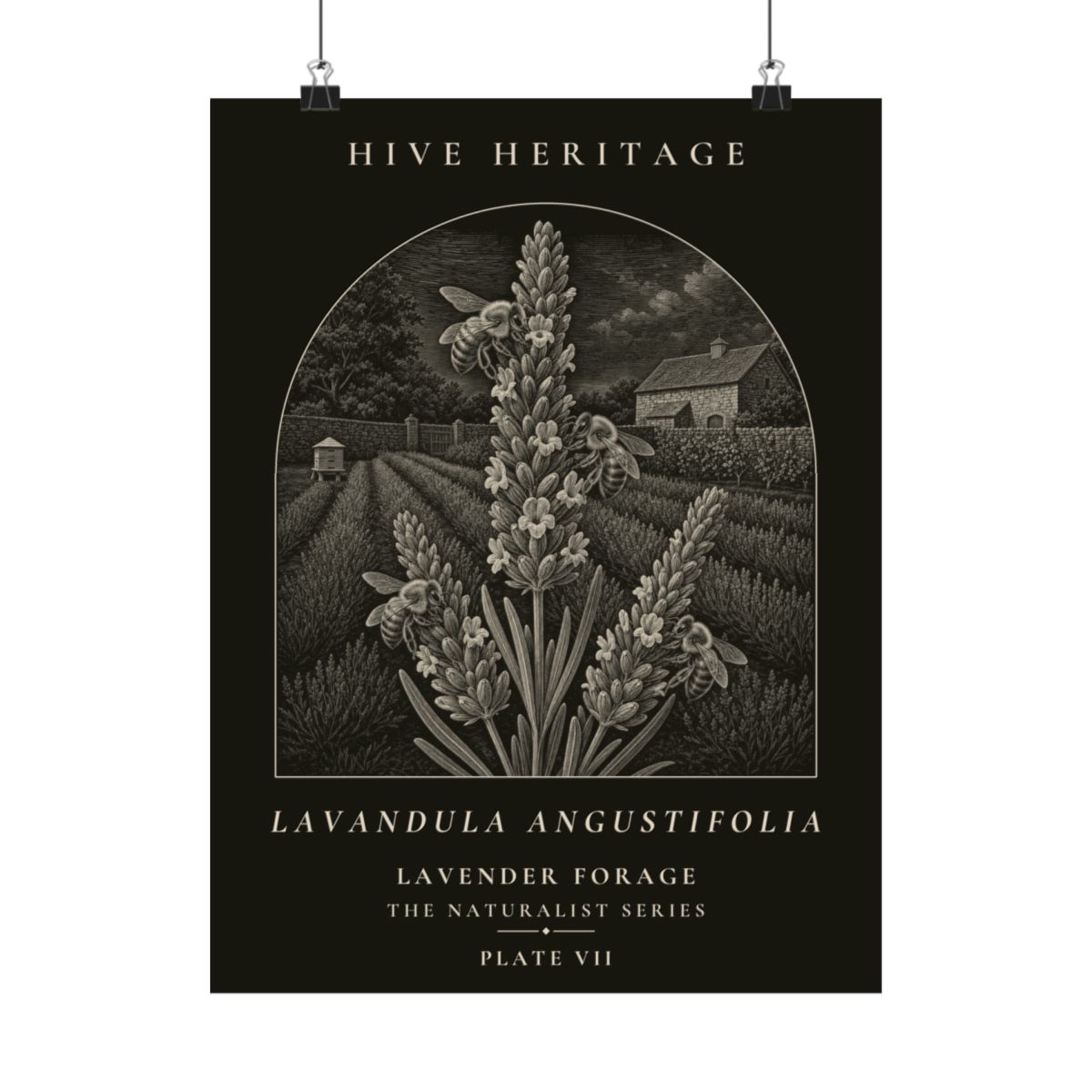
The plate for this subject is digital artwork made in an engraving style. It is our own modern work in the manner of natural history illustration, not an antique or a hand engraved original, and we would not want anyone to think otherwise. It is there for people who like to have the plants and creatures of the beekeeping year around them, drawn with care and left uncluttered. If lavender is your kind of plant, you will find the design linked below.
See it in the Naturalist Series: The Lavender Forage plate