
Naturalist Series · 29 September 2026
The Langstroth Hive and the Discovery of Bee Space
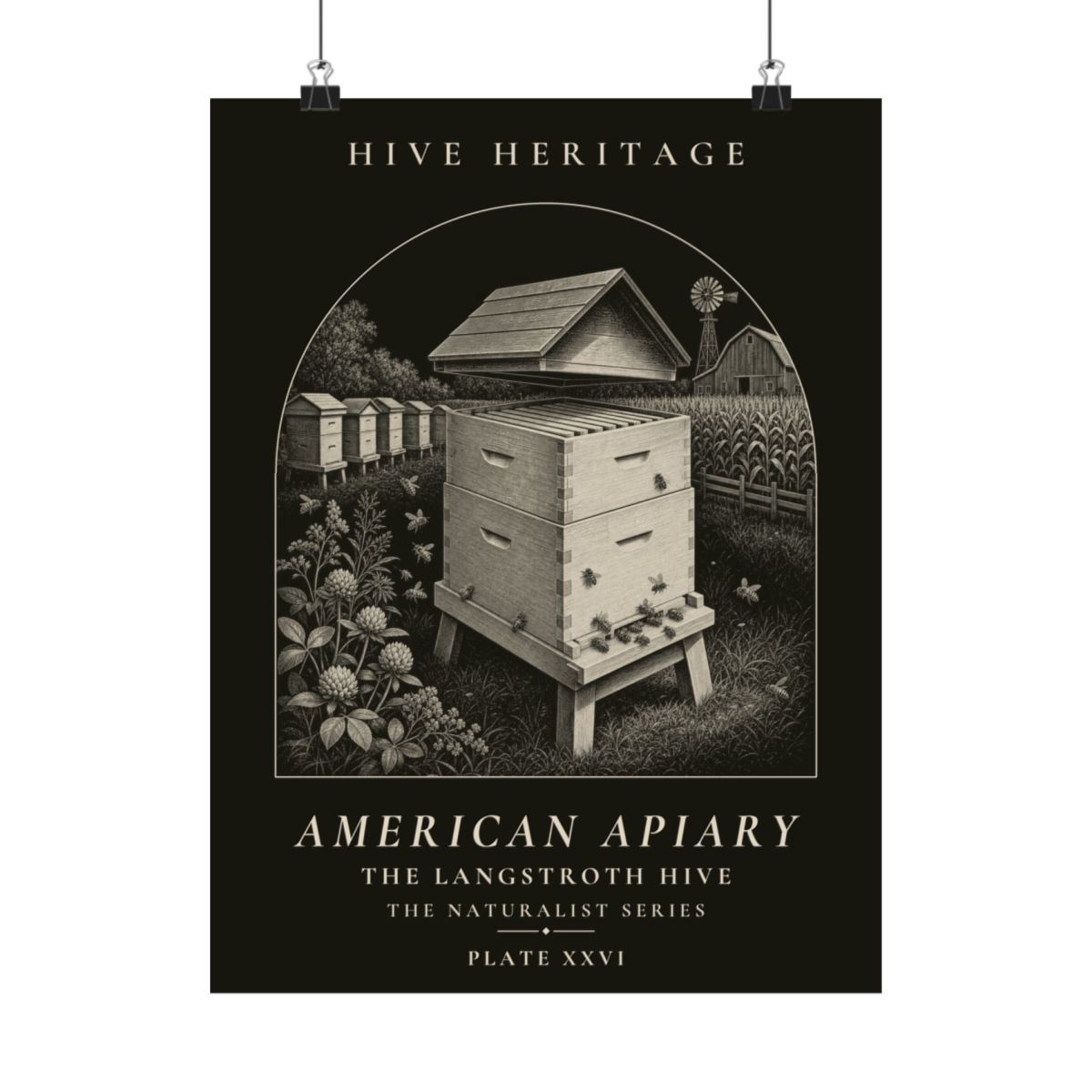
The Langstroth hive is a stack of movable-frame boxes that lets a beekeeper lift out any single frame of comb without cutting into it, a possibility built on Lorenzo Langstroth's 1851 discovery of bee space: the six to nine millimetre gap that bees leave clear rather than seal with propolis or fill with comb.
For most of history, beekeepers had no such access. The honey was in the nest, the nest was one tangled mass of wax, and getting to either meant cutting into it. We made a plate of the hive for the Naturalist Series, and this is the story behind the picture: who built it, and why a gap of a few millimetres matters so much.
What did beekeepers use before the Langstroth hive?
Bees will build in almost anything hollow. A tree cavity, a wall, a basket. For centuries, European beekeepers offered them a straw skep, a domed basket, and left them to it. Bees fixed their comb to the inside of the dome in whatever pattern suited them, and the beekeeper could not look in without damaging it. Harvesting the honey often meant driving the colony out or killing it, traditionally with sulphur fumes, and starting again the next year with a new swarm.
The people who wanted to do better were not short of curiosity. The Swiss naturalist François Huber, who was blind and worked with the help of his assistant, published his observations of bees in the late eighteenth century. He is known for a hive of vertical leaves that opened like the pages of a book, so that the combs could be seen and turned one at a time. It was a remarkable tool for study, though it was never the answer to practical beekeeping on a large scale.
Others moved nearer to a working design. Petro Prokopovych, in Ukraine, is credited with a frame hive from around 1814. In Germany, the Silesian priest Jan Dzierzon introduced a hive with removable bars in 1838. As the story is usually told, the bees still tended to fix their comb to the hive walls, so combs had to be cut free before a bar could be lifted. The idea of a movable comb was in the air. What was missing was a reliable way to make it move without a fight.
Who invented the Langstroth hive and what is bee space?
Lorenzo Lorraine Langstroth was born in Philadelphia in 1810 and trained as a clergyman. He also suffered from bouts of illness that he described in his own writing as head troubles, which interrupted his ministry and teaching, and he took up bees in the late 1830s. He kept them, watched them, and became frustrated at the same problem the skep keepers had: bees glue things down.
Then, in 1851, he made the observation that this hive is remembered for. Bees leave a small passage between combs, wide enough for two bees to pass back to back. It is usually given as somewhere between about six and nine millimetres, or roughly a quarter to three eighths of an inch. Langstroth called it bee space. If a gap is much narrower, the bees seal it with propolis, the sticky resin they gather from plants. If it is much wider, they fill it with comb. Leave it at just the right size and they leave it alone.
That is the whole insight, and it is easy to underrate. Langstroth did not invent the frame. He worked out that if every surface inside a hive is spaced at the bee's own distance, the bees will not bond one part to another. A frame hung inside the box, with bee space around its sides and its ends, can be lifted out cleanly. The colony carries on, and the beekeeper can look at the brood, the stores and the queen, then put everything back.
He was granted a US patent in October 1852 and published his book, A Practical Treatise on the Hive and the Honey-Bee, the following year. The book mattered as much as the hive. It explained how bees live, described how to handle them, and made the case that a colony could be managed rather than sacrificed. Langstroth's later years were not easy. Patent disputes and health problems weighed on him, and his name became better known than his finances suggested. He died in Dayton, Ohio, in 1895.
How does a Langstroth hive work?
A Langstroth hive is a stack of open-bottomed boxes with a roof and a floor. Each box holds a row of rectangular wooden frames, hung side by side from a rebate cut into the top of the box's inner walls, with bee space kept around them. Because access is from above, a beekeeper lifts the roof, separates the boxes and draws out one frame at a time.
Inside, the bees do what bees have always done. They draw wax comb on the frames. The queen lays in the cells, and workers store nectar and pollen around the brood. The hive is a tidy arrangement of that natural pattern, not a different pattern. The parts that give the design its practical strength are these:
- The boxes are interchangeable. The same box can hold a brood nest in one place and a store of honey in another, and can be moved between colonies.
- Frames can be inspected, swapped, and moved between hives. That makes it possible to check a colony's condition without dismantling it.
- The colony grows upward. As the bees fill the space, the beekeeper adds another box on top, and the colony's size is limited by management rather than by the container.
It is worth being careful with claims here. A well-made hive does not make bees healthier or a colony more productive on its own. What it does is give a beekeeper the ability to see and to act. The judgement still belongs to the person, and to the season.
What came after
Once a frame could be lifted out whole, other inventions had somewhere to attach. In Germany in 1857, Johannes Mehring is credited with pressing sheets of beeswax with a cell pattern, which became comb foundation, giving the bees a head start on building straight, even comb. In 1865, Franz von Hruschka, in Italy, is credited with the centrifugal honey extractor, which spins the honey out of the comb and leaves the wax intact. An intact comb can go back into the hive to be refilled, which is a very different economy from crushing it every autumn. Neither idea works without a frame that comes out cleanly.
Others carried the hive and the method forward. Charles Dadant, a French-born beekeeper working in the United States, promoted and revised Langstroth's work, and A. I. Root, in Ohio, published a great deal of beekeeping literature that spread the design and its equipment. By the late nineteenth century the movable-frame hive had become the working standard in much of North America, and it is widely said to be the most common hive design worldwide. We would treat that last claim with a little care, because worldwide counts are hard to make.
In Britain, other designs are far more familiar. The National hive is the everyday choice of many beekeepers here, and the WBC, with its double-walled, cottage-garden look, is the one people picture. Both belong to the same family of ideas. Each is a box with movable frames and a respect for bee space. The measurements differ, and so do the habits of the people who use them, but Langstroth's principle sits underneath.
The natural history is worth holding on to, too. Bee space is not something Langstroth made up. It is a habit of the bees, the way they leave a walkway for their own traffic. His achievement was in seeing it clearly enough to build to it. Good design often starts that way, with a patient look at what a creature does anyway.
The plate we have made for the Naturalist Series is called The Langstroth Hive. It is digital engraving-style artwork, drawn by us in the manner of the old natural-history plates, and not an antique or a hand-engraved original. We wanted it to sit comfortably on the wall of a beekeeper, or of anyone who likes to see a working object drawn with care. The link below takes you to that design in our shop.
See it in the Naturalist Series: The Langstroth Hive plate