
Naturalist Series · 29 September 2026
Koschevnikov's Honey Bee and Its Borneo Forest Home
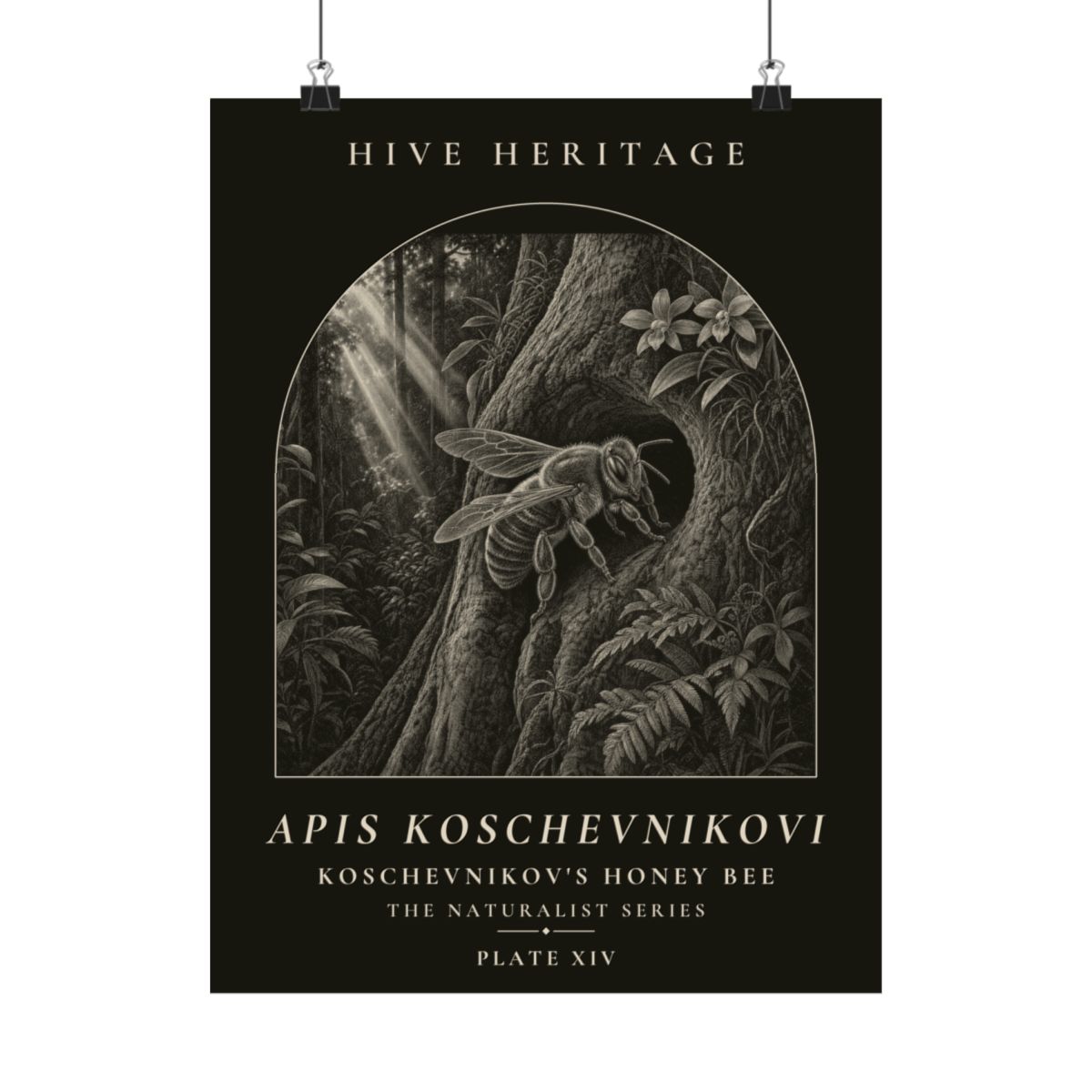
Koschevnikov's honey bee, Apis koschevnikovi, is a reddish-bodied honey bee found only in the lowland and hill forests of Borneo, Sumatra and the Malay Peninsula. First described by the entomologist Günther Enderlein in 1906, it nests inside cavities such as hollow trees, building several parallel combs in the dark much as the western honey bee and its own forest neighbour, the eastern honey bee, do, but it has never been taken into managed hives the way those bees have. We wanted it in the Naturalist Series precisely because it is easy to overlook.
This is what we can say about it with reasonable confidence. Where the evidence is thin, we say so, because a bee this little studied deserves honesty more than a tidy story.
What is Koschevnikov's honey bee and where does it live?
The scientific name is Apis koschevnikovi. It was described by the entomologist Günther Enderlein in 1906, and the name honours the Russian zoologist Grigory Koshevnikov (the spelling varies between Latin and English transliterations, which is why you will see it written more than one way). Some authors call it the red honey bee, or the Malaysian honey bee, and the first nickname explains itself the moment you see a worker: the body is noticeably more reddish than the darker bees of the neighbouring species.
Its home range is the tropical forest of South East Asia. The records come from Borneo (the Malaysian states of Sabah and Sarawak, Brunei and Indonesian Kalimantan), from Sumatra and from the Malay Peninsula. It is a bee of the lowland and hill forest rather than of open country, and it is not found across the continent the way the eastern honey bee is. If you have never seen one, that is not a gap in your education. It simply lives a very long way from most beekeepers.
Workers are of a similar overall size to the eastern honey bee, Apis cerana, and that similarity matters, because the two share much of the same forest. A person walking through it would not easily tell them apart on the wing. Someone who handles both, or looks closely at a specimen, notices the colour first and the finer points of the body after that.
How does Koschevnikov's honey bee nest and how does a colony live?
Honey bees fall into two broad habits. The giant and dwarf honey bees build a single, open comb, hung from a branch or a rock face, with the bees themselves as the only wall. The rest nest inside cavities: a hollow in a tree, a gap in rock, any sheltered dark space that suits them. Koschevnikov's honey bee belongs firmly with the cavity nesters, alongside the western honey bee and the eastern honey bee.
That habit shapes everything about the colony. Inside a cavity the bees build several combs side by side, parallel to one another, with a bee space between them so that workers can pass in the dark. A colony living this way can store far more than the open-comb species, and it can defend a single narrow entrance. It also communicates in the dark. Like other honey bees, these bees dance on the vertical face of the comb to tell nestmates where food is, and the whole system depends on there being a comb to dance on.
Beekeepers will recognise the outline of the year too: a queen laying, workers foraging, brood raised in cells, drones reared in season. What differs is the setting. In a tropical forest the flowering is spread through the year in a different pattern from a temperate meadow, and the shape of the colony's year follows that.
We should be plain about what is not well documented. Koschevnikov's honey bee has been studied far less than either of its cavity nesting relatives, and a good deal of what is written comes from a small number of field studies in Borneo and the Malay Peninsula. Precise figures for colony size, honey stores and nest survival are not something we are willing to quote, because we cannot support them with a source we trust. Anyone who gives you confident numbers for this bee should be asked where they came from.
How does Koschevnikov's honey bee differ from the western honey bee?
Placing the species on the family tree is one of the more interesting parts of its story. On appearance and geography you might guess that Koschevnikov's honey bee is a close cousin of the eastern honey bee, since they share the same forests and look alike. Genetic work has suggested something more surprising: that it sits closer to the western honey bee than to the eastern one. The two Asian bees that look alike are not, on that evidence, each other's nearest relatives. Genetic results of this kind can be revised as more data arrive, so we treat it as the current understanding, not the last word.
The other difference is behavioural, and it is the one that keeps the species apart from its neighbour. In the forests where Koschevnikov's honey bee and the eastern honey bee live side by side, the two do not interbreed. Studies of the drones (the male bees) found that they fly to their mating places at different times of day. The eastern honey bee's drones fly earlier in the afternoon, and those of Koschevnikov's honey bee fly later, towards evening. Queens mate on the wing with drones that have gathered, so a difference in timing is a very effective fence. The two species can share a landscape and still keep their lines separate.
Here is how the comparison looks in short form:
- Range: Koschevnikov's honey bee is confined to parts of South East Asia. The western honey bee is native to Europe, Africa and the Middle East and has been carried almost everywhere by people.
- Colour: Koschevnikov's workers are reddish. Western honey bee workers vary a great deal by race, from dark to yellowish, but the striking red is a hallmark of this Asian species.
- Nest: both build several parallel combs in a cavity, so on this point they are alike.
- Management: the western honey bee has been kept in managed hives for centuries. Koschevnikov's honey bee is, for the most part, a wild forest bee.
There is also a parasite story worth knowing, though it comes with a caveat. The mites of the genus Varroa that plague beekeeping today were once confined to Asian honey bees. Different Varroa species are associated with different hosts, and the species called Varroa rinderi has been recorded on Koschevnikov's honey bee in Borneo. Our understanding of who hosts what has changed several times as researchers looked more carefully, so we would rather point you to the current scientific literature than settle it in a paragraph.
The bee and the people who share its forest
The relationship between this bee and people is a modest one, and that is part of what makes it honest to describe. It is not a bee that has been taken into hives and bred for temperament, or spread across the world for pollination. In its home range, people know honey bees of several kinds: the giant honey bee that hangs its huge combs in tall trees, the eastern honey bee that is kept in simple hives in many places, and stingless bees that are managed by small-scale keepers. Koschevnikov's honey bee is a less familiar presence, and where it is mentioned in the beekeeping literature it is usually as a species that has proved difficult to manage.
That difficulty is instructive. A bee suited to the forest, in a forest with its own rhythm of flowering, does not always accept a box on a farm. Beekeepers who have compared honey bee species point out that the qualities we prize in the western honey bee, such as steady colony growth and a willingness to be housed, are the result of a very long partnership. Koschevnikov's honey bee has had no such partnership, and it behaves like a wild insect. We think that is a fair reason to admire it rather than to regret it.
We will not make conservation claims that we cannot support. We do not have a trustworthy figure for how many colonies exist, or a well-established account of how forest clearance is affecting them, and we are not going to invent either. What can honestly be said is that this is a bee of tropical forest habitat, and that the forests of Borneo and neighbouring islands have been under real pressure from land use change. Anything more specific about this species should come from the researchers who count it.
We also make no claims here about honey or hive products from this bee. Hive Heritage makes apparel and art, not honey, and the natural history is the point.
Why it belongs in the series
The Naturalist Series exists because the honey bee is more than the one species most of us keep. There are bees that build in open air and bees that build in cavities, bees that live in cold climates and bees of the humid tropics, and each one has been shaped by the place it lives. Koschevnikov's honey bee shows that clearly. It looks like its neighbour, it may be closer kin to a bee on the other side of the world, and it keeps its own line through nothing more than the hour of the day its drones take flight.
Our plate of Koschevnikov's honey bee is digital artwork in an engraving style. It is our own drawing, made in the manner of the old natural history plates, and it is not an antique or a hand-engraved original. We wanted a plate that would sit comfortably beside the more familiar bees and remind anyone who looked at it that the genus is larger than they thought. If this article has made you curious about a bee you had never heard of, the plate below is where we would send you next.
See it in the Naturalist Series: The Koschevnikov's Honey Bee plate