
Naturalist Series · 29 September 2026
How Honey Bees Get Through Winter in a Cluster
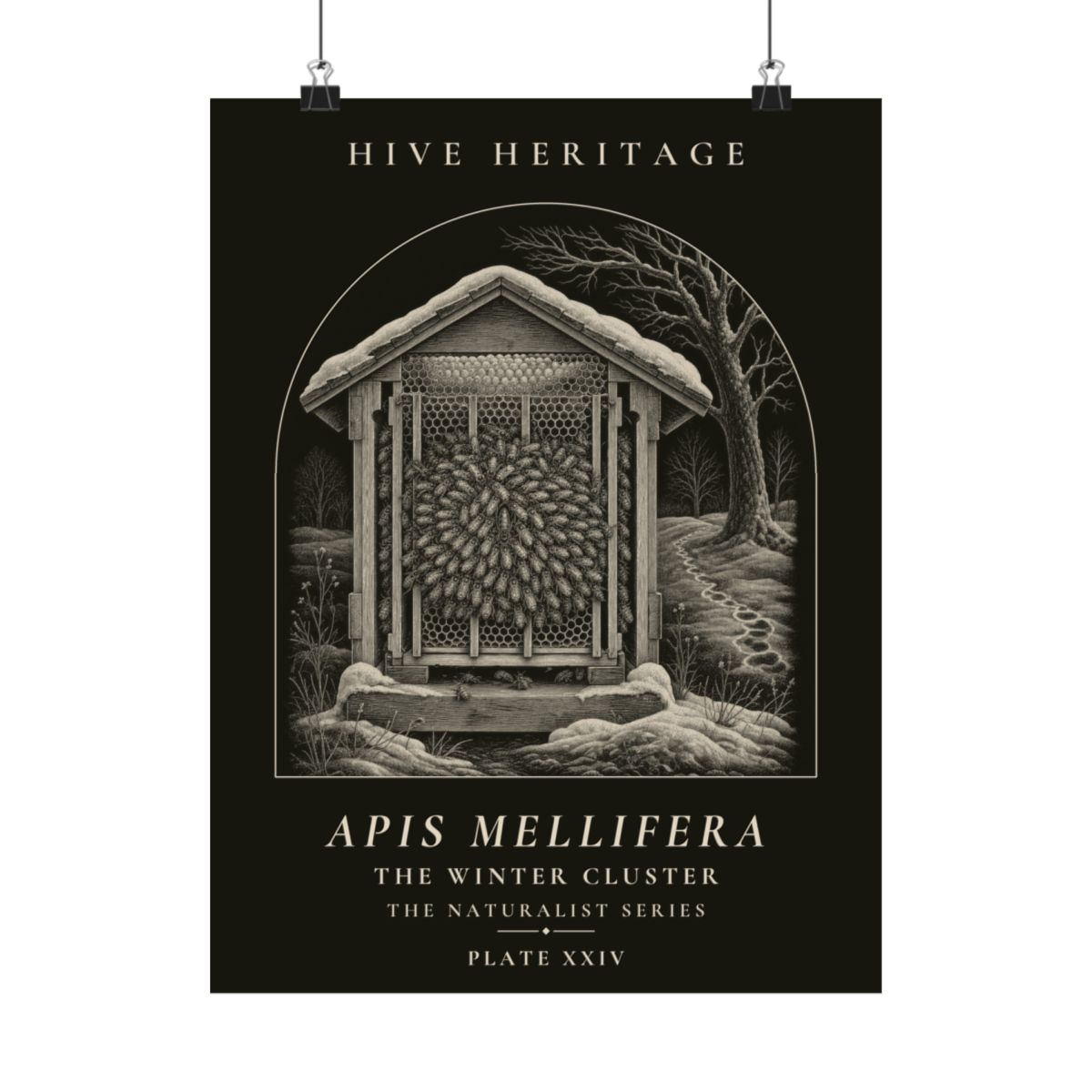
Honey bees do not hibernate. Through the cold months the colony stays awake, draws into a tight cluster on the comb, and keeps itself warm by shivering the same flight muscles a bee uses to fly in summer, burning stored honey as fuel. It is the subject of one of the plates in our Naturalist Series.
We are Hive Heritage, and we make apparel and natural-history art inspired by beekeeping. We are not honey sellers and we are not a research body, so for this piece we have leaned on the published work of bee scientists and on the practice beekeepers have handed down. Where something is still argued over, we say so. Where it is folklore, we call it folklore.
Do honey bees hibernate in winter?
The first thing to set straight is a common belief: that honey bees hibernate. They do not. A hibernating animal lets its body temperature fall and its metabolism slow to almost nothing. A honey bee colony does the opposite. It stays awake, keeps a working core, and spends its stored food to make heat.
Many of our other insects manage winter by shrinking the population down to a few survivors. In the UK, a bumblebee nest dies out by the end of the season, and only the mated young queens go into the ground to wait. A honey bee colony is unusual among social bees of temperate countries in that the colony itself, workers and queen together, carries through the cold months. That is the whole reason the cluster exists.
When the weather cools, the bees begin to draw together on the combs. The exact temperature at which this starts varies with the colony, but the pattern is consistent: the colder it gets, the tighter the group becomes, and it loosens again when the air warms. On a mild day the bees spread across more comb. In a hard frost they contract into a compact mass.
The heat comes from the bees' own bodies. A bee can uncouple its wings from its flight muscles and then contract those muscles anyway, so that nothing moves but the thorax warms. Researchers describe this as shivering, and it is the same muscle that powers flight in summer, put to a different job. The fuel is honey, which is why a colony going into winter needs a proper store on the comb. The bees are, quite literally, burning what they gathered in the warm months.
What does a winter bee cluster look like inside the hive?
It helps to picture the cluster not as a ball with a single temperature but as something with an inside and an outside.
The outer layer, often called the mantle, is made of bees packed closely together, heads pushed in toward the comb, forming an insulating shell. Bees in the mantle are not idle. Their job is to hold the surface of the cluster above the point at which a bee becomes too cold to move. Beekeeping literature commonly puts that surface temperature at somewhere around 9 or 10 degrees Celsius, and describes a bee that drops much below it as falling into a chill coma from which it may not recover.
Inside is a looser core where bees move about more freely, and the temperature there depends on what the colony is doing. When there is no brood, the core can run considerably cooler than most people expect. When the queen is laying and there are larvae to rear, the bees work to hold the brood area close to the warmth they keep it at in summer, in the mid thirties Celsius. That is a large temperature difference to hold against a freezing night, and the bees manage it while cutting the energy bill as far as they can.
One of the most useful findings from studies of clusters is that the members do not stay where they are put. Bees near the cold edge move inward, and bees from the warmer centre move out to take their place, so no individual is left to freeze on the surface for long. Others travel through the cluster to reach honey and carry it toward the centre, passing food along. The cluster is a slow, continuous turning over of individuals, not a fixed sphere.
The cluster also moves as a whole. Bees consume the honey next to them, and over the weeks the mass shifts across the comb and generally upward, following its food. This matters more than it sounds, and we come back to it below.
A note on what the cluster is not. It is not heating the entire hive. Bees heat themselves and the small space around them, not the box, which is part of why a hive can be white with frost at the entrance while a cluster remains alive and functioning a few centimetres away. It is also not a solid mass: the bees are close, but there is air between them, and that is part of how the group holds its temperature while still letting the bees breathe and move.
What are winter bees and how are they different from summer bees?
The bees in a January cluster are not the same sort of bee that was flying in July. A summer worker wears herself out foraging and lives a matter of weeks. The bees that carry a colony through winter are raised in the late summer and autumn, and they are physiologically different. They have larger reserves of fat and protein stored in their bodies, they do little or no foraging, and they live for months rather than weeks. Beekeepers and researchers often call them winter bees, and the term diutinus bee is used in the scientific literature for the same long-lived generation.
That handover is the delicate part of the bee year. If a colony reaches autumn weak, short of food, or short of the time and forage needed to raise a good generation of winter bees, it goes into the cold at a disadvantage. This is one reason beekeepers pay such close attention to the late season, and why so much of the work of the year is really preparation for winter.
Towards the turn of the year, in many colonies the queen begins laying again, usually in a small patch at the centre of the cluster. The area of brood is small at first and grows through late winter as the days lengthen. It is one of the odd things about honey bees that the nursery reopens while the ground is still frozen, and the colony needs its stores to fuel that as well as its own warmth. The cluster is preparing for spring before spring gives any sign of arriving.
What a beekeeper sees, and what they leave alone
A great deal of winter beekeeping is about restraint. Opening a hive in cold weather breaks the cluster's insulation and lets out the heat the bees have spent stores to make, so most beekeepers stay out of the box and read the colony from the outside.
Here is what that reading usually involves:
- Lifting or tilting the hive slightly to judge how heavy it is, which gives a rough idea of how much honey remains. Beekeepers call this hefting.
- Listening. A quiet, steady hum, sometimes heard by pressing an ear or a listening tube to the side of the box, tells a beekeeper the cluster is alive.
- Watching the entrance for bees carrying out dead workers, which is normal housekeeping, and for signs of mice or woodpeckers, which is why entrances are often guarded through the cold months.
- Looking for the brief cleansing flights on a mild, still day, when bees leave to void waste outside because they keep the hive clean. A few bees on the wing in winter sunshine are usually a good sign, not a problem.
The mistake people make is to read a winter hive as failing because it is silent or because there are dead bees on the ground. A cluster has no reason to be noisy, and some loss of old bees over winter is expected.
The real danger, and it is well documented in beekeeping guides, is starvation, and it can strike in a strange way. Because the cluster moves along the comb to reach food, a long hard cold spell can leave it unable to travel. The bees may stay tight on an empty patch of comb while there is honey a hand's width away, simply because the cold will not let them break formation to reach it. Beekeepers sometimes call this isolation starvation. It is one reason a colony's stores are judged not just by total weight but by where the honey sits relative to the cluster. Where stores are running low, many keepers give emergency food such as fondant placed directly above the bees, without opening the cluster more than they must.
Damp is another concern. The bees' own metabolism produces moisture, and if it condenses and drips back onto the cluster, a cold, wet bee is in more trouble than a cold, dry one. This is why keepers think carefully about ventilation, rather than wrapping a hive up as though it were a person in a coat. The colony wants to stay warm at its centre, not sealed in a humid box.
Things we have chosen to leave out
Bee folklore around winter is rich, and much of it is charming but unsupported. We have left out the idea that the queen is always found dead centre of the cluster, because her position shifts with the brood. We have also left out any specific figure for how many bees a cluster needs to survive, or how much honey a colony will use, because those numbers vary with climate, colony and season, and a single number would be more confident than the evidence allows. And we make no claims about what any of this means for bee populations at large. The natural history is remarkable enough as it stands.
If you would like to read further, the winter chapters of Thomas Seeley's book The Lives of Bees are a serious and readable account of how colonies get through the cold, drawing on decades of field and laboratory work. Any good beginner's beekeeping manual will also cover the practical side of winter management for your own region.
The plate
Our Winter Cluster plate is digital engraving-style artwork. It is not an antique, and it is not a hand-engraved original. It is a contemporary piece made in the tradition of natural-history illustration, drawn with the fine line and quiet restraint that suit the subject. What it tries to show is the thing this article has been describing: a colony gathered close, doing its unseen work in the middle of the coldest season, with the whole of the next year depending on it.
If that appeals to you, the plate is in our shop, and you will find the link below.
See it in the Naturalist Series: The Winter Cluster plate