Naturalist Series · 26 September 2026
What the Honey Bee Waggle Dance Actually Tells Us
Would you believe a bee if it told you where to find a meadow? For a long time, most people did not. The idea that an insect could describe a place to its sisters, using nothing but movement on a dark wall of wax, sounded closer to a fable than to science.
It turned out to be true, and the story of how that was shown is as interesting as the dance itself. It is the story behind the plate we call The Waggle Dance, and it is worth telling properly.
What the bee is doing
A honey bee forager that has found a good source of nectar or pollen returns to the hive and, if the find is worth advertising, may dance. Inside the hive it is dark, and the combs hang vertically, so the dance happens on that upright surface, among a crowd of bees that are busy with their own work.
The dance has a pattern. The bee runs forward in a straight line while shaking her body from side to side. That is the waggle run. She then circles back to her starting point, first to one side, then, on the next circuit, to the other. Repeat it enough times and the track she leaves is a figure of eight, with the waggle run as the straight line through the middle.
The waggle run is the part that carries the message. Two things about it matter.
- Direction. The angle of the waggle run, measured against straight up on the comb, matches the angle between the sun and the food source as the bee saw it on the flight. Waggle straight up, and the food lies toward the sun. Waggle to the right of vertical, and the food lies to the right of the sun.
- Distance. The longer the waggle run lasts, the farther away the food. A short run means close by, a long run means a long flight.
So the bee translates a flight across open ground, with the sun as her reference, into a movement on a vertical wall in the dark. Gravity stands in for the sun. It is a clever piece of translation, and it is done by an animal with a brain smaller than a sesame seed.
The man who worked it out
The Austrian zoologist Karl von Frisch spent decades watching bees. He first described a simpler dance, a round dance, performed by bees whose food was near the hive. Later, in the 1940s, he worked out that a different pattern, the waggle dance, is used when food is farther away, and that its direction and duration relate to the location of the source. He set out the full account in his book on the dance language and orientation of bees, and in 1973 he shared the Nobel Prize in Physiology or Medicine with Konrad Lorenz and Nikolaas Tinbergen for work on animal behaviour.
His method was patient rather than grand. He marked individual bees with paint so that he could tell one forager from another. He set out dishes of sugar solution at chosen places, watched which bees found them, and then watched what those bees did on their return. Then he looked at where new bees turned up. Recruits arrived at the feeders the dancers had visited, not at random places around the hive.
That is how you test a claim about communication: you change the message and see if the outcome changes with it.
The argument that followed
Good science does not stay unchallenged, and von Frisch was challenged. In the 1960s the American biologist Adrian Wenner and colleagues argued that recruits might find food mainly by smell, following the scent the dancer carried on her body and the odour of the flowers she had visited, rather than by reading a dance. It was a serious objection, because scent clearly does matter to bees. The disagreement ran for years.
What settled it, for most researchers, was a set of later experiments. In one, Axel Michelsen and colleagues built a mechanical model bee that could be made to perform the dance, including the waggle and the sound that goes with it. Real bees followed the model and, at least some of the time, flew in the direction it indicated. In the early 2000s, a team led by Joseph Riley used harmonic radar, a tracking technique that lets researchers follow individual bees across a landscape, to record the flights of bees that had followed a dance. Recruits flew toward the location that the dance described. Scent has a part to play, but the dance carries real spatial information, and bees use it.
Note the shape of that history. An elegant idea, a rival explanation, then better tools to test between them. It is a fair account of how natural history moves forward.
What is going on in the dark
The dance is not a neat performance by a lone bee. It is a noisy, crowded event, and the bees that follow it are doing skilled work of their own.
Followers cluster around the dancer and keep close contact, touching her with their antennae as she moves. The dancer also produces a vibration, a buzzing sound in pulses during the waggle run, which the followers can detect through the comb. The dance is also imprecise. A single dancer repeats her run many times, and the angles vary a little from one to the next. Followers do not get a perfect bearing from one circuit. What seems to happen is that the information builds up across the repeats and across many dancers, so that bees converge on a place rather than on a single point.
Two further details are worth knowing, because they are what turns a party trick into a working system.
- The sun moves, and the dancer knows it. A bee that dances for a long time is dancing about a place she visited earlier, while the sun has shifted across the sky in the meantime. Von Frisch observed that the dancing bees adjust the angle of their waggle runs to keep pointing to the same spot on the ground. The bees appear to compensate for the sun's movement.
- Different bees, different dialects. The relationship between the length of a waggle run and the distance flown is not identical across all honey bee species and races, which is why researchers often talk about dialects of the dance.
The dance is not only used for food, either. Honey bee colonies looking for a new home use it too. When a swarm hangs in a cluster outside the old nest, scout bees search the countryside for cavities, and they dance on the surface of the swarm to advertise the sites they have found. Thomas Seeley, who has studied this at length, describes how scouts for the best sites end up recruiting more dancers, until the swarm reaches something close to agreement on one place. It is a decision made by a crowd of insects, and it is easier to watch than to believe.
What a beekeeper sees at the hive
If you keep bees, you will probably not see the dance on your first few inspections. The dance floor, as it is sometimes called, is usually on the comb near the entrance, where returning foragers unload, and much of the action is on the parts of the comb hidden under a crowd of bees. Frames that are well covered will hide it. A glass-sided observation hive makes it far easier, which is why so many of the classic studies used one.
When you do catch it, you know. Among the ordinary movement of a busy comb, one bee is walking a purposeful line, wagging her abdomen from side to side, and a small ring of bees is turned toward her. She then loops round and does it again. It looks like something between a walk and a shiver, and once you have seen it, you cannot stop seeing it.
A beekeeper can also read the wider picture from the hive. A colony that has plenty of forage sends foragers out and returns them with loaded pollen baskets. A colony in a lean spell is quieter. The dance is one clue in that picture, not a diagnostic tool, and I would not claim that you can read a colony's health from a single glimpse of it. What it does give you is a reminder that the hive is not a mass of insects following a routine. It is a group of animals sharing information about the world outside, and acting on it.
Why it matters to us
The waggle dance is remarkable for what it shows about the honey bee. It is one of the best known examples of symbolic communication in an invertebrate: the movement does not simply resemble the flight, it stands for it, and other bees read it and act on it. That is a large claim, and it holds up because of decades of careful testing, from paint-marked bees at a feeding table to radar tracking across open fields.
It is also, quite simply, a beautiful thing to look at. A single bee, in the dark, with her sisters pressed around her, describing a hedgerow.
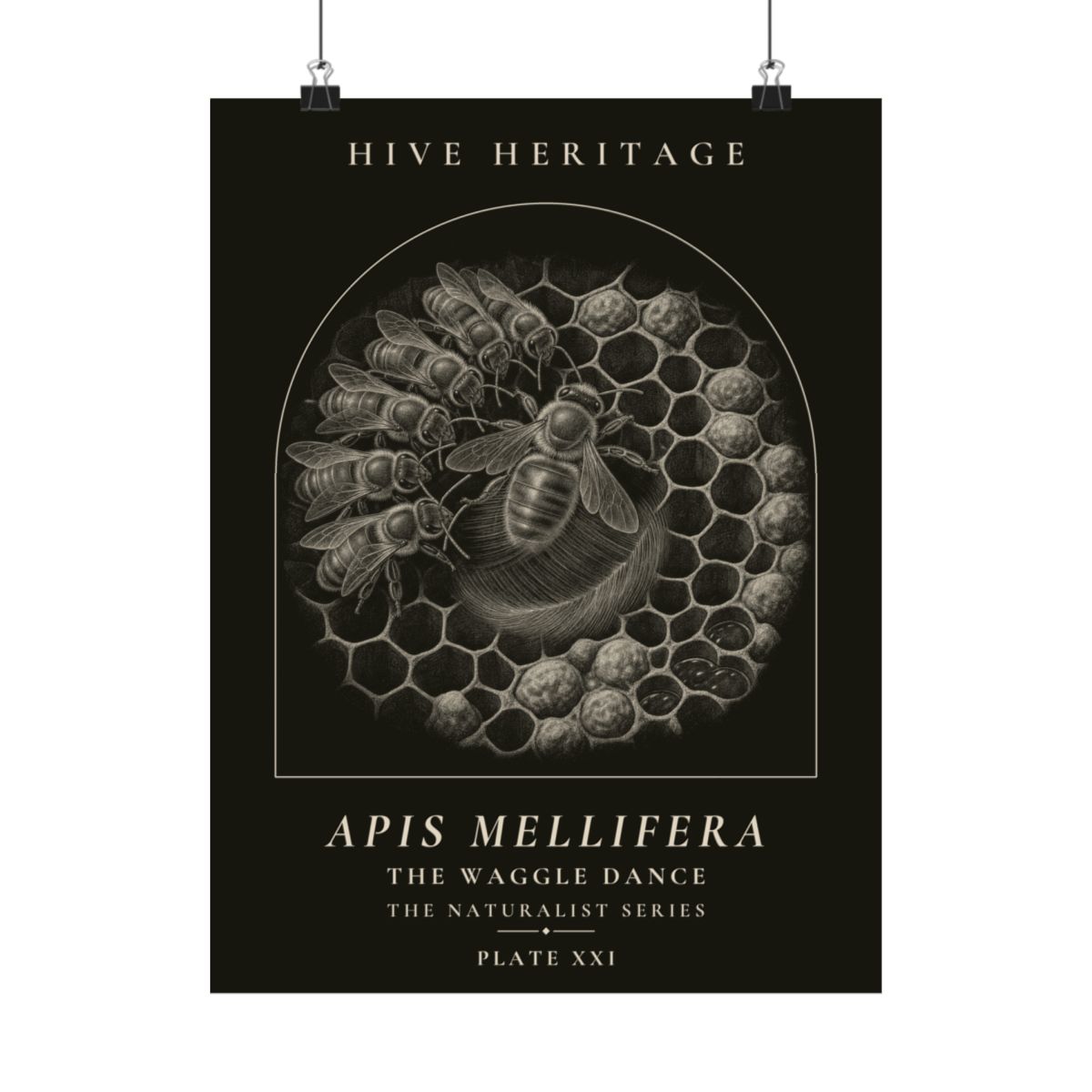
That is what we wanted the plate to hold. The Waggle Dance is digital engraving-style artwork, made in the spirit of the old natural history plates but not an antique and not a historical original. It shows the figure of eight, the followers and the comb, drawn with the patience the subject deserves. If this article has made you want to look at it, the design is waiting in our shop.
See it in the Naturalist Series: The Waggle Dance plate