
Naturalist Series · 29 September 2026
How a Honey Bee Colony Swarms, and Why It Does
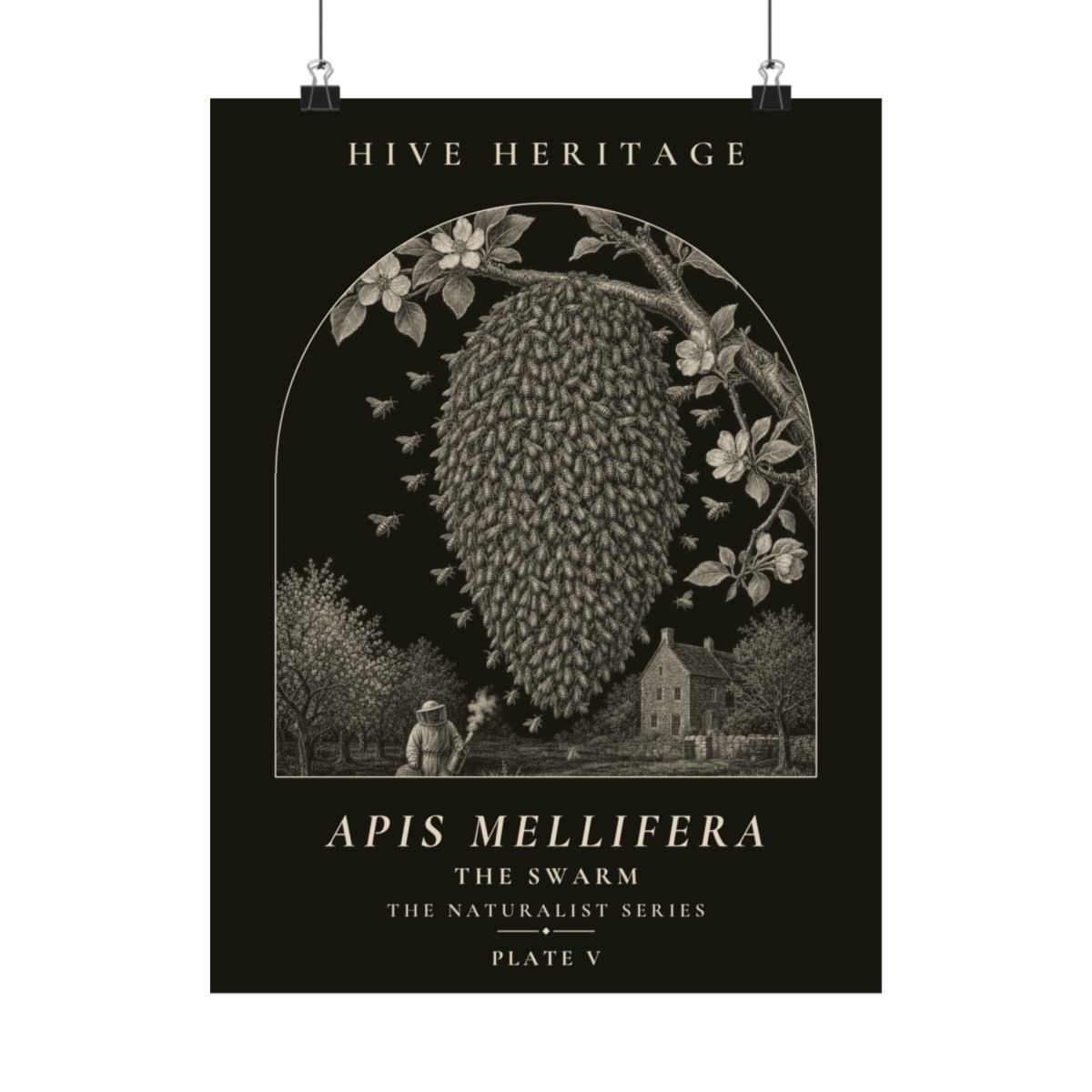
A honey bee colony swarms to reproduce: the old queen leaves with roughly half or more of the workforce to found a new colony, while the bees left behind raise a new queen and carry on in the original nest. It happens because the growing colony becomes too crowded for one queen's scent to reach every worker, and by the time the swarm takes flight the colony has already sealed queen cells to secure its own future.
It looks like chaos when a swarm arrives, thousands of bees turning overhead before they hang together from a branch like a dark, living fruit, but it is one of the most orderly things a honey bee colony does. We made the plate called The Swarm to show that moment properly, and this article is the natural history behind it: the weeks of preparation, how the cluster chooses its new home, and what beekeepers have learned from watching.
Why does a honey bee colony swarm?
The first thing to say is that a swarm is how a honey bee colony reproduces. A single bee cannot live on her own for long, so the colony is the real individual in the story, and swarming is the way one colony becomes two. The old queen leaves with a large part of the workforce, often around half of the workers or more, and the bees who stay behind carry on in the original nest with a new queen.
The swarm that leaves first is called the prime swarm, and it goes with the old, mated queen. If the parent colony is strong, further swarms can follow days later. These afterswarms, sometimes called cast swarms, leave with a virgin queen rather than the mated one, and they tend to be smaller.
In Britain the season runs mainly from late spring into early summer. An old English rhyme, passed down in several versions, puts a value on the timing: a swarm in May is worth a load of hay, in June a silver spoon, and in July not worth a fly. It is a rule of thumb from farmers and cottage beekeepers, not a measured result, but it captures something true. A swarm that leaves early has a long season to build comb and gather stores before winter. One that leaves late has very little time.
What happens in a hive before a swarm leaves?
A swarm does not happen on impulse. The preparations are visible inside the hive for a couple of weeks beforehand, and beekeepers learned to read them.
In spring a colony grows quickly. The queen lays more eggs, the brood nest expands, and the nest fills with bees. As the space becomes crowded, workers begin building queen cups on the comb, small wax cups shaped a little like acorn cups. Beekeepers who have studied swarming describe several things that contribute: crowding in the brood nest, a large population of young bees, and a queen whose scent is spread thinly among so many workers. It is a combination of conditions, not one switch.
Once the queen lays into these cups, the workers feed the developing larvae a diet that makes a queen rather than a worker. The timing matters. A queen develops from egg to emerged adult in about sixteen days, and the cells are sealed with wax at around the eighth day after the egg was laid. The prime swarm commonly leaves around the time the first queen cells are sealed, which means the colony has already secured its own future before half of it walks out the door.
The old queen has to change too. She is normally a heavy egg layer, too plump to fly far. In the days before departure the workers feed her less and she lays less, and she slims down enough to manage the flight. Scouts begin to look for a new home while the swarm is still in the parent nest, and on the morning itself many of the bees fill their stomachs with honey. That is their food for the journey, and it is part of why a settled swarm is often described as gentle: these bees are carrying supplies, not defending brood or stores. Even so, a swarm is wild bees in an unfamiliar situation, and the sensible thing for anyone who finds one is to keep back and ask a local beekeeper to collect it, not to approach it.
When the swarm lifts, it is not tidy. Bees pour out of the entrance and circle, the queen among them, and the cloud drifts to a nearby resting place. That first cluster may hang for a few hours or for a couple of days. The bees at that stage are homeless and waiting, and the real decision is being made by a few hundred of them.
How the cluster chooses a home
The best account of this comes from the American biologist Thomas Seeley, who spent years watching swarms, including experiments on a small island off the coast of Maine, and described the work in his book Honeybee Democracy in 2010. What he and his colleagues found is a remarkable piece of collective decision making.
The scouts are older workers, and they set out from the cluster to look at possible nest sites: hollow trees, cavities in walls, anywhere with enough enclosed space. A scout who finds a good site comes back and dances on the surface of the cluster. The waggle dance, the same one foragers use for flowers, tells other bees the direction and distance. The better the site she found, the longer and more vigorous her dancing.
Seeley's work found that the bees favour cavities of about forty litres, a good deal of space, with a small entrance and a position well off the ground. Sites that are too small, too damp or too exposed attract less enthusiasm. Scouts who see a dancer's site will fly to inspect it for themselves, and if they agree they return and dance too. Over the course of hours or days, support for the best site builds while dances for weaker sites fade.
The bees do not vote by counting every dancer. Instead, when enough scouts are present at one site at once, the group has reached what Seeley describes as a quorum. At that point the scouts return to the cluster and begin preparing the swarm to fly. Later research by Seeley and colleagues described a further signal in which scouts headbutt dancers advertising rival sites, which helps to end the debate. The swarm then warms its flight muscles, scouts make a high piping sound to help the cluster get ready, and the whole mass lifts off together and heads for the chosen cavity.
What I find quietly remarkable is what this says about the whole enterprise. No bee is in charge of the decision. The queen does not choose, and neither does any one scout. The choice is made by many small acts of comparison, which is a lovely thing to know when you look at a swarm hanging from a branch.
What people have learned from watching
Beekeepers have been watching swarms for as long as they have kept bees. For centuries the hive of choice in Britain was the straw skep, and when a swarm settled, the keeper's task was to shake or brush it into a skep and carry it home. It was a way of getting new colonies for free, and the sight of a swarm was often welcome.
Our understanding of what was happening inside was slow to develop. In 1609 the English clergyman and beekeeper Charles Butler published The Feminine Monarchie, one of the first books in English to treat bees as a subject worth serious observation. Butler correctly worked out that the ruling bee was female. It was a considerable step, and the observations of swarming in his book were careful for their time, though later work corrected and extended much of it.
There is also the old custom of tanging, banging pans or ringing bells when a swarm flew. The idea was usually that the noise would make the bees settle, or that it announced a claim of ownership over the swarm. I have found little reliable evidence that the sound does anything to the bees, so I would call it a custom worth knowing about, not a technique that works.
The next great change was the moveable frame hive in the nineteenth century, associated with Lorenzo Langstroth, whose hive design was patented in 1852. With frames a beekeeper could look at the brood nest without destroying the colony, and could see queen cells as they appeared. Swarming turned from an event that happened to a beekeeper into one that could be anticipated. Regular inspections during the swarm season, giving the bees more space, and separating the old queen from the brood in a controlled way, often called an artificial swarm, are all methods that grew from the same understanding: the colony is going to divide, so the beekeeper decides how.
None of these methods is a cure, and it is worth being honest about that. Beekeepers still lose swarms, and a colony that has decided to go is hard to talk out of it. What the last four centuries of watching have given us is not control over the bees but a better reading of them. We know what queen cups mean, we know why the old queen slims down, and we know the swarm on the branch is deliberating, not lost.
That is the story we wanted The Swarm to carry. The plate is digital artwork made in an engraving style, and it belongs to the Hive Heritage Naturalist Series, where each design takes one part of the colony's life and looks at it closely. If this article has made you see the cluster on the branch differently, the plate is in the shop, where you can see the design and how it has been made.
See it in the Naturalist Series: The Swarm plate