
Naturalist Series · 29 September 2026
The Honey Bee Queen and What She Really Does
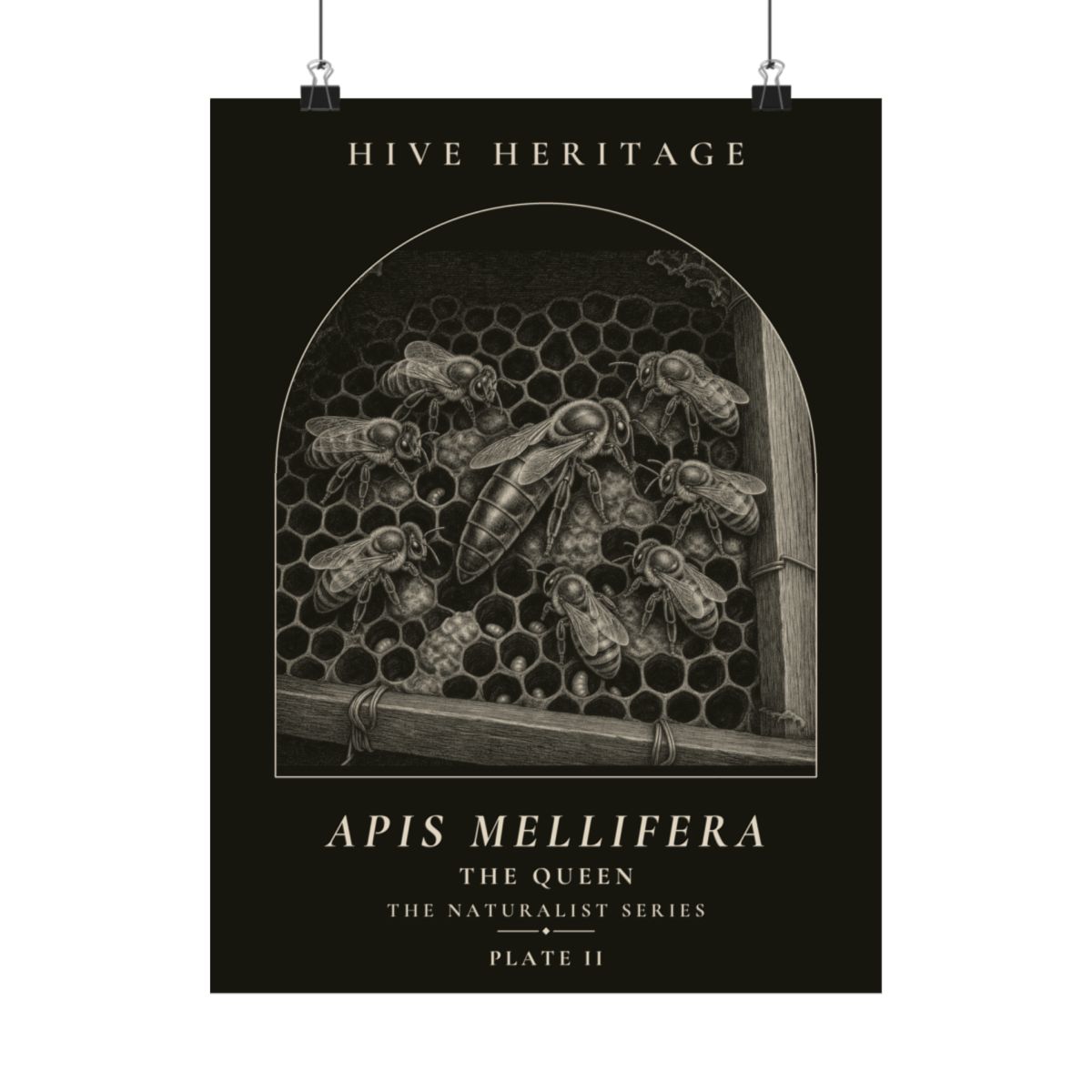
The honey bee queen is the colony's mother, not its monarch: she is the only bee that lays fertilised eggs, up to around two thousand a day at the height of summer, while decisions about foraging, swarming and defence are made by the workers, not by her.
We gave her a plate of her own in the Naturalist Series because so much of that title is misleading. It took naturalists several centuries to work out what she actually does, and the truth is quieter and more interesting than the picture of a monarch on a throne.
Does the queen bee rule the hive?
For a long time the leader of the hive was assumed to be a king. Shakespeare, writing around 1599 in Henry V, has a speech about bees that says they "have a king and officers of sorts". It was a fair summary of what most educated people believed. The correction came from the Dutch naturalist Jan Swammerdam, who dissected the large bee in the seventeenth century and found ovaries, not the organs of a male. His work was published after his death, and it settled the question of sex. The queen is a female, and she is the mother of the colony.
What she is not is a ruler. She gives no orders and holds no council. Decisions in a honey bee colony, such as where to forage, when to raise new queens and where a swarm should settle, emerge from the behaviour of thousands of workers responding to one another and to the season. The queen is closer to the colony's reproductive organ than to its government, and the workers tend her rather than obey her. They feed her, groom her and clear away her waste, and they can, and do, replace her when she stops performing.
Her role rests on a quirk of honey bee genetics. A fertilised egg becomes a female, either a worker or a queen. An unfertilised egg becomes a male, a drone. So the queen chooses, egg by egg, whether to fertilise it as it passes down from her stored sperm. Every worker in the hive is her daughter, and every drone is her son, carrying only her genes.
Workers are female too, but under normal conditions their ovaries stay undeveloped, and the queen's pheromones are part of the reason. Beekeepers have known for a long time that a colony senses its queen through scent as much as sight. The blend of chemicals she produces, often called queen mandibular pheromone, is passed around the nest as workers lick and antenna her and then touch other bees. It signals that a laying queen is present, and it helps to keep worker ovaries dormant and the colony settled. Remove her, and within a short time the mood of the hive changes. Workers become restless and the usual hum takes on a different note.
How long does it take a queen bee to develop?
A queen and a worker begin as the same kind of egg. What separates them is what the larva is fed and how much room she is given.
Worker larvae receive royal jelly, a secretion from the nurse bees' glands, for only the first few days, after which their diet changes to a mixture including pollen and honey. A larva chosen to become a queen keeps receiving royal jelly, in generous quantity, throughout her development. Her cell is also different. Worker cells are small and hexagonal, sitting flat in the comb. A queen cell is a large, downward hanging structure often compared to a peanut shell, built by the workers at the edge or face of the comb.
The timing is neat. A queen takes about sixteen days from egg to emergence. A worker takes about twenty one, and a drone about twenty four. That head start matters: when a colony raises a new queen, she is the first to emerge and gets to act before any rivals are ready.
Beekeepers recognise three reasons for queen cells. A colony preparing to swarm builds them, typically in spring and early summer. A colony quietly planning to replace an ageing or failing queen builds a few, which beekeepers call supersedure. And a colony that has suddenly lost its queen builds emergency cells around young worker larvae, only those young enough to be steered into a different life. Which of the three you are looking at changes what a careful beekeeper does next, and reading the cells is a skill that takes seasons to learn.
Once she emerges, a virgin queen may make a thin, high pulsing sound, known as piping, and queens still sealed in their cells can answer with a duller sound, sometimes called quacking. Observers have described these sounds for centuries. In a colony with several queen cells, the first virgin to emerge may seek out the others and sting them in their cells, or, if two meet, fight. Only one usually survives, unless the colony is swarming, when the situation is more complicated and one or more virgins may leave with afterswarms.
How many eggs does a queen bee lay in a day?
A few days after she emerges, and if the weather allows, the young queen leaves the hive for the first time. Mating happens in flight, high above the ground, at places where drones gather in numbers. The blind Swiss naturalist François Huber, working in the late eighteenth century with the help of his assistant, established that honey bees mate in the air and not in the hive, an observation that overturned earlier ideas. Such drone congregation areas are still studied today, and they seem to recur in the same landscapes year after year.
She mates with many drones, commonly a dozen or more, and reported numbers vary between studies. Each drone dies after mating. She returns to the hive carrying sperm, which is stored in a small organ called the spermatheca, and it is enough to last her for years. In most cases she does not mate again. That single short episode shapes the whole future of the colony, because the variety of fathers gives her daughters a range of traits, and a colony with that variety copes better with the demands of a season.
After that she becomes an egg layer. In good conditions, a queen can lay up to about two thousand eggs a day at the peak of the season. That is, roughly, her own weight in eggs or more, and she cannot manage it alone. Nurse bees feed her constantly with royal jelly, which is how she finds the energy. Workers also inspect each cell before she lays into it, and she measures cells with her front legs before choosing whether to fertilise the egg. Small cells receive fertilised eggs, and the larger drone cells receive unfertilised ones.
Her working life is long by insect standards. A queen can live for several years, and beekeepers often consider a queen to be at her best in her first and second seasons, with the third being less reliable. Colonies often replace her before that, on their own timetable, not ours.
The queen through the beekeeping year
The colony's year is really the queen's year, seen from the outside.
In late winter, as the days lengthen, she starts laying again in the middle of the cluster, in a small patch of brood kept warm by the workers. In the UK this can begin as early as January or February, depending on the weather and the forage, and the colony grows slowly at first. By spring the brood nest widens, and the population climbs. In May and June a strong colony can reach its peak, and this is also when swarming is most likely.
A swarm is the colony's way of reproducing itself as a whole. Before a prime swarm leaves, the workers feed the old queen less and she slims down enough to fly. She departs with a large share of the workers, while a new queen, raised from one of the queen cells, is left behind to take over the parent hive. A swarm hanging from a branch in early summer holds the old queen in its centre, with the workers clustered around her while scouts look for a new home. Someone who sees this for the first time rarely forgets it.
Through summer she lays steadily, and as forage declines in late summer and autumn, laying slows. By winter the colony contracts into a tight cluster, and in the coldest weeks the queen may stop laying altogether or nearly so. The workers around her keep the cluster warm enough to survive on their stored honey until she begins again.
If a queen fails, through age, injury or being lost during a mating flight, the colony has one small window to correct the problem. With young enough larvae, it can raise an emergency queen. Without them, some workers may begin to lay unfertilised eggs, which can only ever become drones, and the colony gradually declines. This is why experienced beekeepers check for eggs, the plain evidence that a queen is present and laying, more often than they check for the queen herself.
Beekeepers also mark queens, a small dot of paint on the thorax, so that she is easier to find. The colour follows an international convention tied to the last digit of the year. For years ending in 1 or 6 the colour is white, so a queen marked this year will carry a white dot. Yellow, red, green and blue follow in turn, and a quick look at the dot tells a beekeeper roughly which year she was raised, which matters when deciding whether she is due for replacement.
There is a good deal that even now is not fully known about how colonies decide to replace a queen, and how much the workers assess her against the changing state of the hive. What is well established is that the queen is best understood as one part of a working whole. Without her the colony cannot renew itself, and without her daughters she cannot survive a single week.
That, we think, is the real story behind the crown-and-court picture that people carry in their heads. It is a story of a mother at the centre of a very large and very organised family, watched, fed and eventually replaced by the daughters she made. Our Naturalist Series plate, The Queen, is a piece of digital engraving-style artwork, drawn in the spirit of the old natural history plates but made now, not found in an old book. It gives her the quiet, careful attention she deserves. If you have kept bees, or simply stood and watched a hive entrance on a warm afternoon, you may find it worth a look, and the link below will take you to that design.
See it in the Naturalist Series: The Queen plate