
Naturalist Series · 1 October 2026
How a Honey Bee Colony Spends Autumn
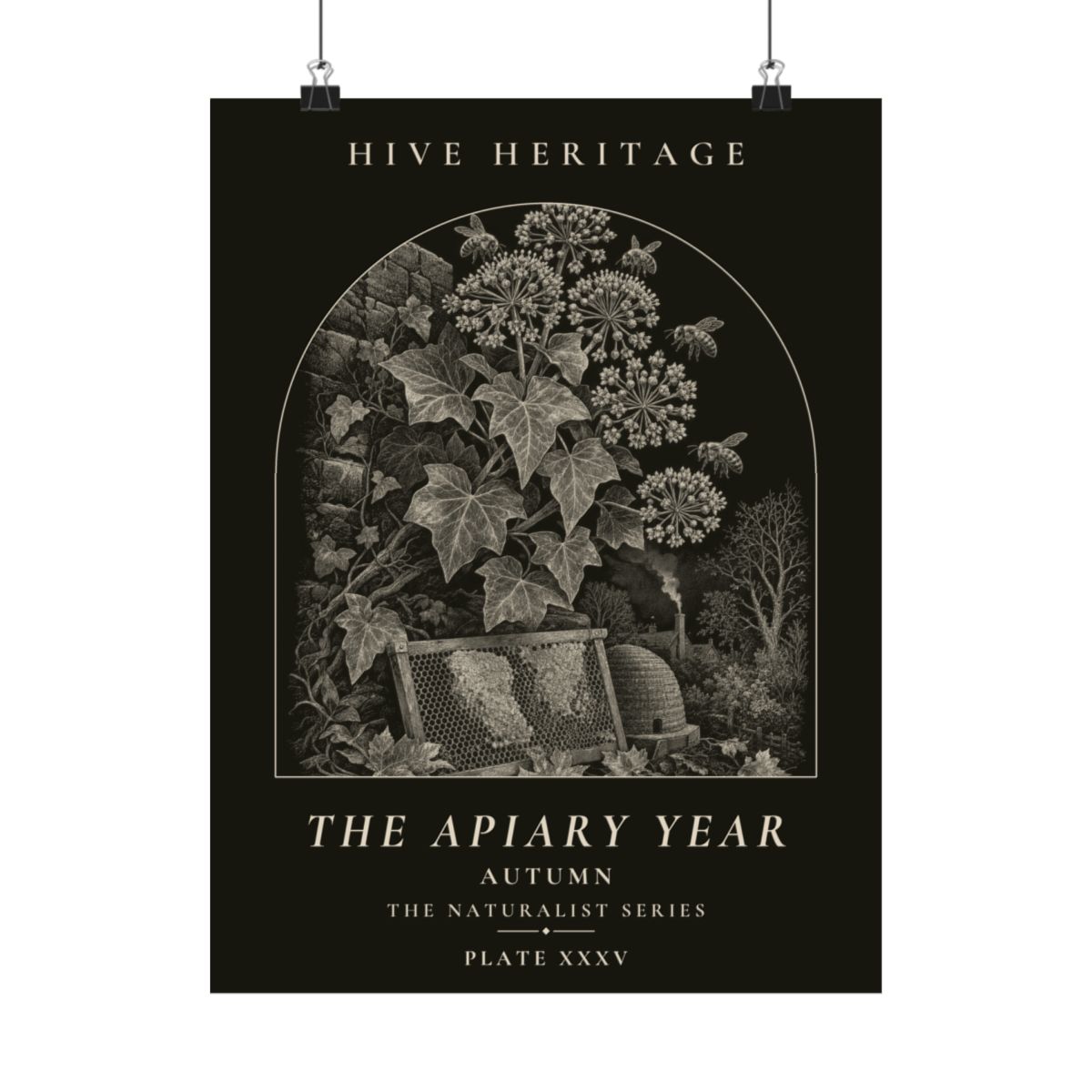
A honey bee colony spends autumn shrinking on purpose. As the nectar dries up, the workers evict the drones from the hive, the queen lays fewer eggs, and the colony rears a smaller, longer-lived generation known as winter bees, carrying extra fat reserves so they can keep the queen warm through to spring rather than spend themselves foraging.
We make natural-history art inspired by beekeeping, so this season matters to us more than most. It is the quietest chapter in the bee's year and, we think, the most interesting: nearly all of it is careful preparation, from the last flowers still open to what a beekeeper needs to do before the cold sets in. We have written it with the UK in mind first, and temperate North America alongside, since the pattern is the same even where the weather and flowers differ.
Why do bees kick the drones out in autumn?
The first sign of autumn inside a hive is a change in who is allowed to stay. Drones, the male bees, have one job, which is to mate with queens from other colonies. They do not forage, they do not sting, and they eat a good deal of the colony's stores. Once the nectar flow drops away, the workers stop tolerating them. Drones are pushed out of the entrance, sometimes dragged by a wing, and they cannot get back in. It looks harsh, and it is. It is also ordinary bee economics: a colony heading into winter cannot carry passengers.
At the same time the queen lays fewer eggs. In summer a good queen can be laying at a remarkable rate, and the colony can number tens of thousands of bees. Through late summer and autumn that laying slows, the brood nest shrinks, and the population begins to fall. In many colonies, particularly in colder places, laying pauses for a spell in winter and starts again around the turn of the year, though the exact timing varies with the weather, the forage and the bees themselves.
The bees being raised now are not the same as the bees raised in June. A summer worker wears herself out. She commonly lives around five or six weeks, and most of that is spent flying. The workers reared in late summer and autumn are often called winter bees, or diutinus bees in the scientific literature. They carry more body fat and more of a storage protein called vitellogenin, and they do not spend their lives foraging in the way a summer bee does. As a result they can live for months, often right through to the spring, and they are the ones that keep the queen alive and the cluster warm until the first new brood emerges.
This is why a healthy autumn matters so much. The colony that goes into winter is not the colony that made the honey. It is a smaller, younger, longer-lived generation, raised for a different job.
What is still in flower
The forage does not vanish in autumn, but it thins and changes. In the UK the best late source is ivy, Hedera helix. It flowers from about September into November, well after almost everything else has finished, and its round green-yellow flower heads are often crowded with bees, wasps, hoverflies and other insects on any mild day. Ivy supplies both nectar and pollen, and the pollen in particular is valuable for the last brood of the year. One quirk beekeepers know well is that ivy nectar sets hard very quickly, sometimes inside the comb, which is one reason people who want to extract honey take it off the hive before ivy comes into flower. A solitary bee, the ivy bee, has its whole adult season timed to ivy bloom, which is a nice example of how tightly some insects follow one plant.
In upland parts of Britain, heather, Calluna vulgaris, flowers in late summer and into early autumn, and some beekeepers still take hives up onto the moors for it. Garden plants matter too. Michaelmas daisies and other asters, sedums and late-flowering Mahonia can all give a lifeline on a warm afternoon, and a mild autumn stretches all of this out.
In temperate North America the late-season picture is different. Goldenrod and asters are the great autumn flowers across much of the east and Midwest, and beekeepers there often depend on them to build up stores. Goldenrod honey has a strong, distinctive smell while it is being ripened, and a colony working it is very busy. It is worth remembering, too, that the European honey bee, Apis mellifera, is not native to North America. It was brought across by European settlers in the seventeenth century, and it now forages on a mixture of native and introduced plants. The bees are working on flowers that in many cases they and their ancestors never met.
Whichever side of the Atlantic, the point is the same. Autumn forage is a top-up, not a harvest. Whatever the bees gather now goes almost entirely into their own winter larder.
What does a beekeeper do in autumn?
The beekeeper's autumn is a list of small, practical jobs, and the order matters. Broadly, it goes like this.
First, the honey is taken off. The boxes the bees have filled for the beekeeper, usually called supers, are removed, and from that moment the bees are living on what remains in the brood box. That is why the next jobs come quickly.
Second, the beekeeper deals with varroa. The parasitic mite Varroa destructor lives on honey bees and breeds in the brood cells, and the mite population climbs through the summer as the colony grows. Heavy mite loads harm the very winter bees the colony is counting on, and they also spread viruses, deformed wing virus among them. Official guidance in Britain, including the material published by the National Bee Unit, is built around monitoring mite numbers and treating at the right time, which is generally soon after the honey has come off and before the winter bees are properly established. The specifics of which treatment and when depend on the product, the temperature and the hive, so a beekeeper follows the current guidance rather than a rule of thumb from a blog post, this one included.
Third, feeding. The bees must go into winter with enough food, and a lightly stocked hive will starve however healthy its bees. Many UK guides put the winter requirement for a full colony at somewhere in the region of twenty kilograms of stores, though figures vary with the hive and the region, and it is common to feed thick sugar syrup in early autumn to make up any shortfall. Beekeepers judge this by lifting the hive, a practice called hefting, or by weighing it, and they learn to feel the difference between a hive that will last and one that will not.
Fourth, defence. As nectar becomes scarce, wasps and even other bees start looking for easy pickings, and a weak colony can be robbed out. Beekeepers reduce the entrance so that fewer bees have to guard it. Mouse guards go on too, because a warm, dry hive full of food is exactly what a mouse wants for the winter. In some places, green woodpeckers learn that a hive is a source of food in cold weather, and beekeepers fit netting or similar protection to stop them making holes in the boxes.
The climate changes the emphasis. In the UK, damp is often a greater enemy than cold. A hive that is airy, dry and well ventilated usually copes better than one that is sealed up tightly. Across the colder parts of temperate North America, where winters are longer and more severe, beekeepers commonly add insulation or wraps, set up windbreaks, and sometimes combine weaker colonies with stronger ones so that no hive goes into winter too small to keep warm. Both approaches are aimed at the same thing, a colony that can look after itself until spring.
And then, for the most part, the beekeeper leaves them alone. Opening a hive in cold weather lets out heat the bees have worked hard to keep. Much of good autumn beekeeping is knowing when to stop.
How do honey bees survive winter?
Honey bees do not hibernate. As the temperature falls, roughly towards ten degrees Celsius and below, the workers gather into a tight ball called the winter cluster, with the queen inside. Thomas Seeley, whose book The Lives of Bees is one of the best accounts of how colonies live through the year, describes how the bees shiver their flight muscles to generate heat without moving their wings. The cluster tightens as it gets colder and loosens as it warms. Bees on the cold outer edge move inwards and bees from the warm middle move out, so that no one stays exposed for long.
The cluster does not sit still. It slowly moves across the comb, eating its way through the honey stored above and around it, so a colony can starve with food in the hive if the cold has held it away from the frames that still have stores. On a mild winter day bees may leave the hive for a short cleansing flight, because they avoid fouling the inside of the hive, and a beekeeper who sees that on a bright, cool afternoon has a good sign that the colony is alive.
That is the real story of autumn. A few thousand well-fed bees, a queen at the centre, and a quiet ball of heat sitting on a store of honey, waiting for the ivy to be forgotten and the first willow catkins to appear.
We drew the Autumn plate in the Naturalist Series with that quiet in mind. It is digital artwork in an engraving style, made by us, not an antique or a hand-engraved original, and it is our way of holding this season in a single image. If the season you have just read about is one you would like to have in front of you, the plate is the place to look.
See it in the Naturalist Series: The Autumn plate