
Naturalist Series · 29 September 2026
How the Bee Yard Was Sited and Laid Out
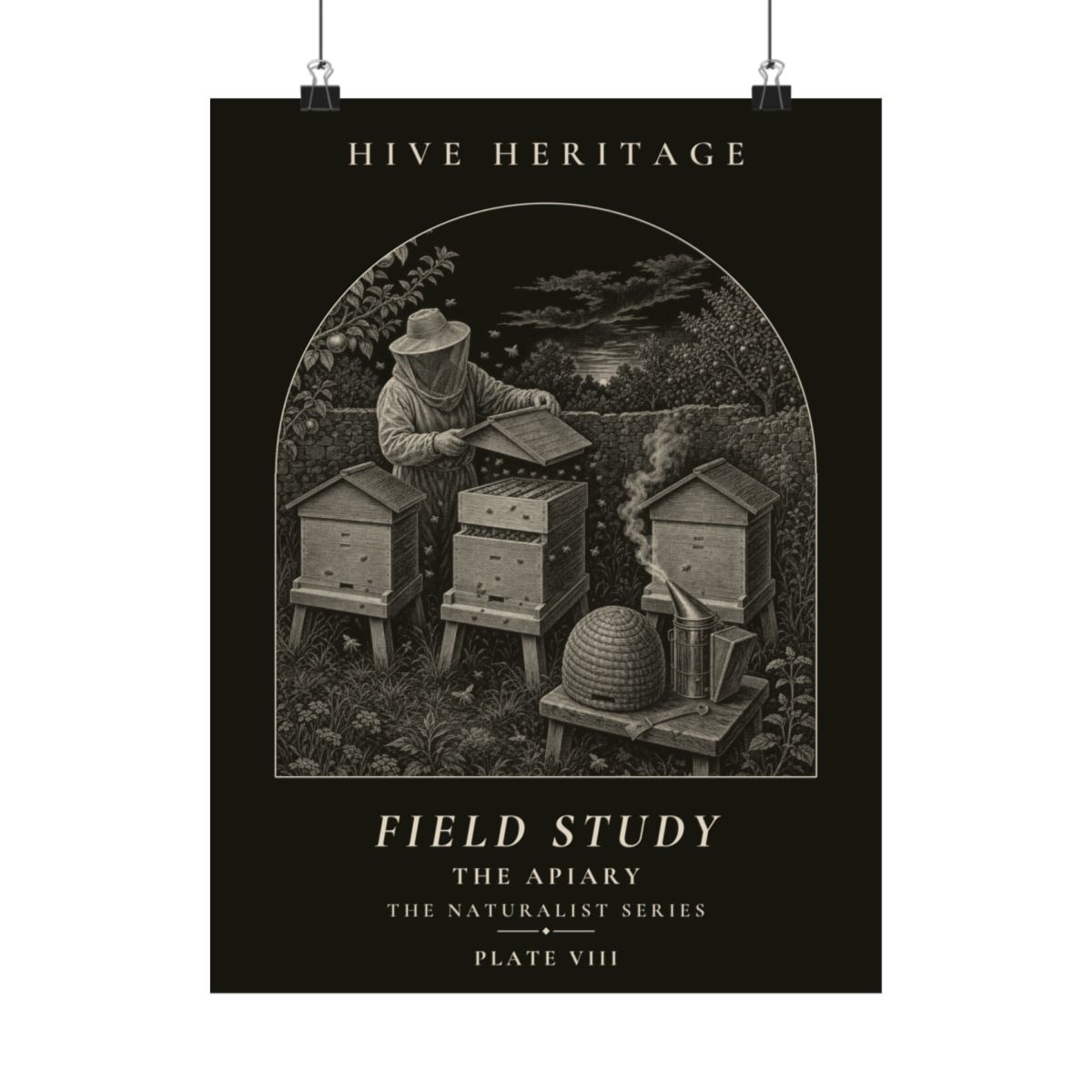
An apiary is sited for sun, shelter, water and forage, and laid out to give the keeper room to work every hive without disturbing the rest. Beekeepers have followed that logic for centuries, from Roman writers advising a wind-sheltered spot with water close by, to modern guidance on facing entrances towards the morning sun and standing hives apart on raised stands.
We are Hive Heritage, and our Naturalist Series plate of the apiary is the reason for this piece. A picture of a bee yard looks calm and orderly. The history behind it is more interesting than the picture lets on.
What does 'apiary' mean?
"Apiary" comes from the Latin apiarium, a place for bees, from apis, the bee. Some beekeepers, particularly in North America, say "bee yard" for the same thing, and the two words are used interchangeably. An apiary can be a single hive at the bottom of a garden or a dozen colonies on a farm edge. What makes it an apiary is not the number but the intention: a spot chosen and arranged for keeping bees.
That word "chosen" matters. Bees are perfectly capable of finding their own home. A wild colony will settle in a hollow tree, a gap in a roof or a cavity in a wall without any help from us. Keeping bees means offering them somewhere better than luck would provide, and it means putting that somewhere where the keeper can reach it. Almost all the history of the apiary is a negotiation between those two wishes.
Where should a bee yard be sited?
Some of the earliest surviving guidance on siting bees comes from the Roman world. Virgil's Georgics, a poem about farming, devotes its fourth book to bees, and it is surprisingly practical under the verse. He advises that the bees' station should be sheltered from the wind, since the wind stops foragers carrying their loads home. He wants water close by, a spring or a shallow pool, with branches or stones laid in it so that a bee can land and drink without drowning. He wants shade nearby too, from a tree, so that the colony is not baked in summer.
Roman farming writers such as Varro and Columella also wrote on the subject, and the same themes recur. Read them alongside a modern beginner's guide and the overlap is striking. Shelter, water, shade, and a position where the hive can be tended: none of that has been overturned.
We should be honest about what we can and cannot say. There are pictures of beekeeping from ancient Egypt, including a relief from the Old Kingdom that shows hives and the handling of honey, and clay hives that look like horizontal tubes stacked in rows. That tells us that keeping bees in a purposeful arrangement is very old indeed. It does not tell us much about how any particular keeper felt about the site. We prefer to say less than to invent a tidy story.
Skeps, hackles and the wall that held them
In Britain, the image most people carry of an old apiary is the straw skep: a domed basket of coiled straw, bound together with strips of split bramble, with the bees building their comb inside. A skep is light enough to lift with one hand, which is part of why it lasted so long. It is also not weatherproof by itself. Damp is the enemy of a colony, and straw left in the rain will not stay sound for long.
So the apiary had to do the work the skep could not. Skeps were commonly set on a bench or a stone shelf, raised off the wet ground, and given a cap of thatched straw, sometimes called a hackle, to shed the rain. Rows of skeps under a shelter, or on a bench along a sunny wall, are what many older paintings and engravings of bee gardens show.
Then there are bee boles. A bee bole is a recess built into a wall, sized to hold a skep, so that the wall itself becomes the shelter. Examples survive in garden and farm walls across Britain, often in a row of several alcoves, and many of the surviving ones are thought to date from the seventeenth to the nineteenth centuries. Their positions tell you what the builders valued. Boles are typically found in walls that face towards the sun, out of the worst of the weather, which fits with the advice that has run right through the subject: bees fly earlier and work longer where the morning sun reaches the entrance.
If you ever come across a wall with a row of small, regular alcoves and no obvious use for them, it may be worth a second look. Some were used for other purposes over the years, so it is not always certain, but a bole is one of the few places where the apiary has left a permanent mark on the landscape.
A harder truth belongs here too. With skeps, the honey was often taken at the end of the season by killing the colony, traditionally with sulphur fumes, so that the comb could be removed whole. The movable frame hive changed that, and it is one reason the modern apiary looks so different.
How did the movable frame hive change the apiary's layout?
In the nineteenth century, the American clergyman Lorenzo Langstroth described and patented a hive with removable frames, in 1852. His insight was a matter of measurement. Bees leave a gap of roughly a centimetre or a little less between combs, a passage they keep clear, which is now usually called bee space. Leave a gap much smaller than that and they seal it with propolis. Leave much more and they fill it with comb. Build the frames to respect that gap and each one lifts out without tearing anything.
That single idea reshaped the yard. Once a keeper could open a hive, inspect it and close it again with the colony intact, the layout had to allow for the keeper too. Hives were set on stands, apart from one another, with room behind to stand and lift. The tidy rows familiar from photographs and from our plate are a product of that working need.
The old rules of siting carried across unchanged in spirit. Modern guidance tends to say much the same things the Romans did, with a few refinements:
- Face the entrance towards the morning sun where you can, and keep the hive out of a damp hollow where cold air and frost settle.
- Shelter the site from the prevailing wind with a hedge, a fence or a wall.
- Where a path or a neighbour's garden lies close by, a hedge or fence in front of the hives makes the bees climb as they leave, so they cross the boundary above head height.
- Provide a reliable source of water nearby, so foragers do not have to search for one.
- Leave working space around each hive, and stand the hive off the ground so it stays dry.
One point is subtler. Bees returning from foraging do not always find their own entrance perfectly. In a long straight row of identical hives, some bees drift into the wrong colony. Keepers have known this for a long time, and it is one reason apiaries are often arranged with hives at slightly different angles or set out in short groups, with differing markings near the entrance, rather than in one unbroken line. It is a small example of the layout responding to how bees actually behave.
The bee yard as part of a landscape
An apiary does not stand alone. A foraging bee can travel a few kilometres from the hive, and what flowers within that range shapes the whole season. Old bee gardens were often placed beside orchards, in walled kitchen gardens or on the edge of common land for exactly that reason. In parts of Britain, keepers also carried skeps up to heather moorland late in summer so the colonies could work the bloom there, a practice that survives in a modern form today.
That makes the apiary a small piece of shared land management, and it is part of what we find worth celebrating in the subject. A bee yard is a place that only makes sense in relation to hedges, orchards, water and weather. We would not claim a particular apiary helps any particular species or landscape, because that depends entirely on the place. What can be said with confidence is that keepers, for centuries, have paid close attention to the ground the bees fly over, and drawn their layouts from it.
Our plate of the apiary is digital artwork made in the manner of an engraving. It is not an antique, and we would never present it as one. What we have tried to do is give the arrangement its due: the sheltered position, the tended order, the sense that someone chose this spot with care. If you keep bees, or simply love the way a bee yard sits in a garden, you can find that design in the Hive Heritage shop.
See it in the Naturalist Series: The Apiary plate