Naturalist Series · 29 September 2026
Goldenrod and the Bees That Work Its Late Flowers
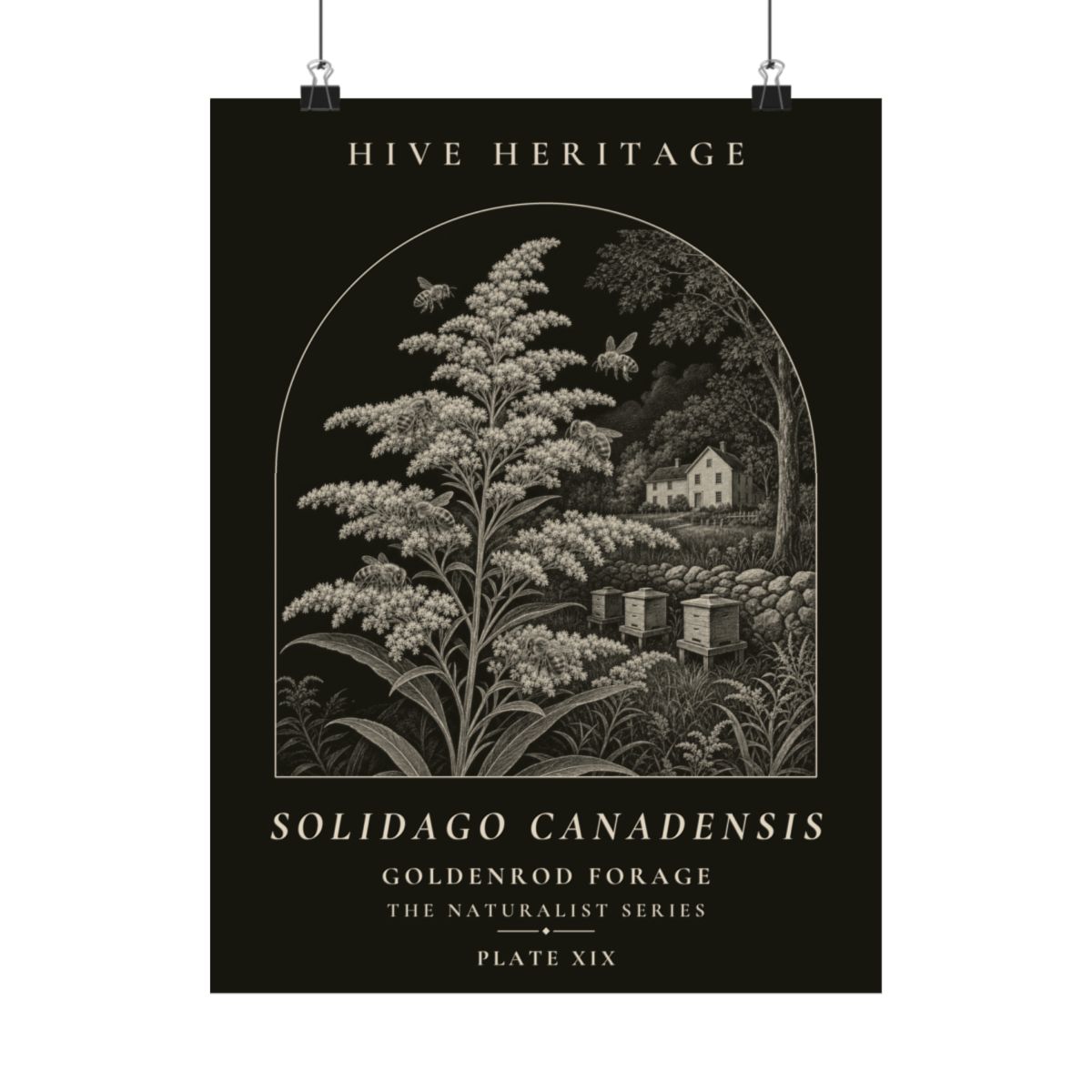
Goldenrod is one of the last big nectar and pollen sources of the bee year, flowering from August into October just when meadow flowers are finishing and before ivy opens. Honey bees, bumblebees, solitary bees and hoverflies all work its yellow spikes for both: the nectar becomes honey, and the pollen is what a colony needs to rear the young bees that carry it through winter.
We make apparel and natural-history art, and we do not sell honey. What follows is the natural history behind our Naturalist Series plate: what the plant is, where it grows and what it gives a bee. Where a popular story cannot be supported, we say so.
What is goldenrod?
Goldenrod is the common name for the genus Solidago, part of the daisy family. There are somewhere around a hundred species, depending on who is counting and how they split them, and the great majority are native to North America. A handful grow in Europe and Asia, and a few reach South America. The variety is one reason the name can mean quite different things in a Yorkshire garden and on an American prairie.
Britain has one native species, Solidago virgaurea, sometimes called European goldenrod. It is a modest, upright plant of heaths, dry grassland, woodland edges, cliffs and rocky ground, with loose spikes of yellow flowers that appear from mid to late summer and carry on into early autumn. It is not a plant you see in great sheets. You come across it in ones and twos, and it rewards the walker who is paying attention.
The goldenrod most people in Britain actually see is a different plant altogether. Canadian goldenrod, Solidago canadensis, came from North America as a garden plant and has since naturalised across much of the country. It spreads by underground stems as well as seed, and it builds dense stands on waste ground, road verges and rail banks, flowering from August into October. Its plumes are heavier and more arching than the native plant's, and it is often the one being described when someone says goldenrod is taking over a field. Gardeners and land managers have their own views on that, and they are not ours to settle here. For the bees, the point is simply that in late summer it is in flower when not much else is.
Each yellow flower head is really a small cluster of even smaller florets, the same arrangement you see in a daisy or a dandelion, only far more compact. That structure matters for insects. A short-tongued visitor can land on a plume and reach nectar and pollen across dozens of florets without flying anywhere. It is an efficient thing to work, and you can see it in the way bees move along a spike, barely lifting off.
What does goldenrod give a bee?
The short answer to the question we set ourselves is both. Goldenrod offers nectar and pollen, and honey bees collect each of them from it. Bumblebees, solitary bees, hoverflies and many other insects visit it too. In North America in particular, the flowers are known as an important late source for honey bees, and goldenrod is often named alongside asters, which flower at much the same time and share the same roadsides and meadows.
Nectar is the sugar the bees turn into honey. Pollen is their protein and fat, and it is what the colony needs to rear young bees. Late in the year that second job matters as much as the first. The bees that carry a colony through the winter are raised in the autumn, and a colony with pollen still coming in during those weeks is better placed to raise them. Beekeepers pay attention to what is flowering for exactly this reason, and goldenrod sits in that window.
Two cautions, because natural history is tidier in a caption than it is outdoors. First, nectar is never guaranteed. How much a flower secretes depends on the weather, the soil and the season, and beekeepers who work goldenrod talk about good years and disappointing ones. Second, which plant a bee is on tells you little about what ends up in the hive. A colony forages over a wide area and takes whatever is giving most, so honey from goldenrod country is commonly a blend, with aster and other late flowers in the mix.
It is worth saying something about the British picture too. Here, ivy is generally the great autumn plant for bees, and it flowers later than most. Goldenrod sits in front of it, in the stretch of late summer and early autumn when the meadow and bramble flowers are over and the ivy has not yet opened. We would not claim it as a major honey source for the country as a whole. What we can say is that it is one of the plants filling that gap, and that it is easy to watch: stand near a flowering clump on a warm day and count the different insects. You will lose count.
What does goldenrod honey taste like?
Goldenrod honey has a reputation among beekeepers, and it is worth describing the reputation honestly. Those who have harvested it, chiefly in eastern North America where the plant is abundant, commonly describe a deep golden to amber honey with a strong, distinctive flavour. Many mention the smell while the nectar is being ripened in the hive as heavy and pungent, and some say it is not to everyone's liking. Others prize it precisely for that character. Taste is personal, and we would not tell you which camp to join.
Beekeepers also report that it tends to crystallise quickly, sometimes while still in the comb. This is a practical concern more than a quality one. Honey that sets in the frame is harder to extract, so people who expect a goldenrod flow tend to plan their timing. We are describing what beekeepers say about handling it, not offering a rule, and different regions and years will behave differently.
There is a longer-running debate about whether late goldenrod honey should be left on the hive for the bees' own winter stores or taken by the beekeeper. Keepers hold differing views, shaped by climate, colony strength and local habit. We are not going to pick a side in a discussion that properly belongs to people who look after bees for a living. If you keep bees and want guidance for your own area, a local association is the right place to ask.
Something we deliberately leave out is any claim about what the honey does for the person who eats it. Goldenrod carries a long folk history in herbal medicine, and even its scientific name, Solidago, comes from a Latin root meaning to make whole. The older English name woundwort points the same way. Those are facts about naming and tradition. They are not evidence that the plant or its honey does anything for anyone, and this is a natural-history page, not a health page.
Three myths about goldenrod
The most persistent one is that goldenrod causes hay fever. It is a natural thing to assume. The plant is loud and yellow, and it flowers just as many people start sneezing. But goldenrod pollen is heavy and sticky, made to be carried on the bodies of insects rather than blown about on the wind. The plants that release clouds of light pollen at that time of year are the wind-pollinated ones, and ragweed is the usual culprit in North America. Goldenrod is caught up in the blame because it is conspicuous and ragweed is not. If you would like the plainer version: a plant that advertises itself to bees so obviously is, for that very reason, unlikely to be scattering pollen on the breeze.
The second is that it is simply a weed. That depends heavily on where you are standing. In its home range, goldenrod is a member of the meadow community that evolved with the insects that use it. Canadian goldenrod in Britain is a different matter, an introduced plant that can crowd out other vegetation where it takes hold. Both can be true, and we would rather say so than flatten it into a slogan.
The third is a curiosity rather than a myth. In his last years, the inventor Thomas Edison worked on goldenrod as a possible home-grown source of rubber, and he is recorded as having experimented with breeding a taller, richer plant for the purpose. It never became an industry. We mention it because it shows how much attention this humble roadside flower has drawn, and how little of that attention was ever about bees.
Reading the plate
Bees do not know the calendar, but they know when the flowers are open. A plate called Goldenrod Forage is about that: a plant in its late-summer prime, and the work it does when the year is turning. Our Naturalist Series plates are digital artwork made in the manner of engraving. They are our own work and not antique or hand-engraved originals, and we would never present them as such. What they share with the old natural-history tradition is the patient attention, the idea that a plant is worth looking at closely and drawing carefully.
If this piece has made you look at a yellow roadside spike a little differently, the plate that accompanies it is our small way of holding on to that. The link below takes you to it.
See it in the Naturalist Series: The Goldenrod Forage plate