
Naturalist Series · 29 September 2026
The Giant Honey Bee: Apis dorsata and Its Open-Air Nest
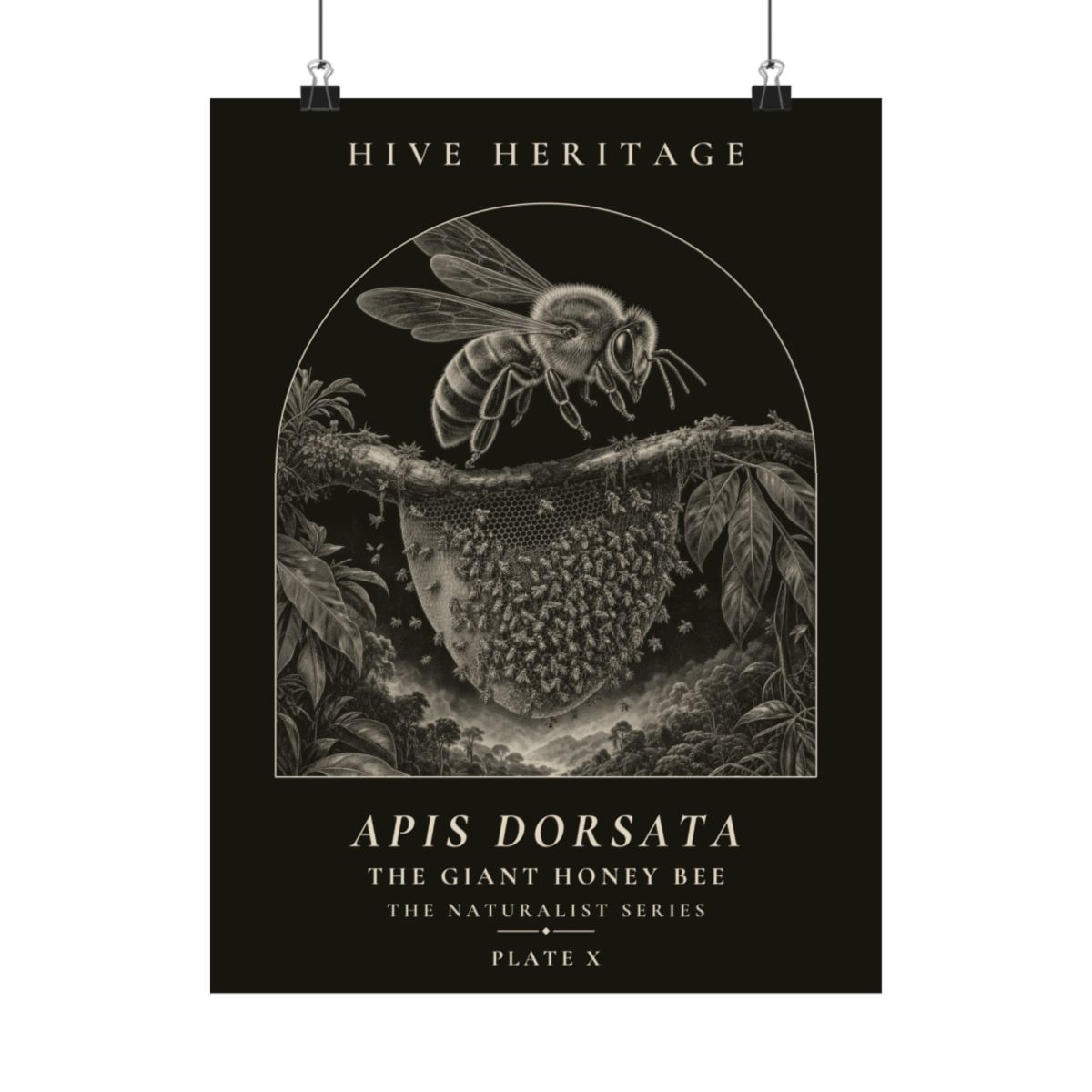
The giant honey bee, Apis dorsata, is the largest of the honey bees and lives across South and Southeast Asia, from India and Sri Lanka to Indonesia and the Philippines. Rather than nesting in a cavity like the honey bee kept in British hives, it hangs a single sheet of wax comb, often more than a metre across, from an exposed tree branch, cliff ledge or building, with a worker bee roughly two centimetres long and the whole comb covered edge to edge by a living curtain of bees.
We chose it as one of the plates in our Naturalist Series because it shows how much room there is inside a single genus. Below is what we could establish about it, and where the evidence is thin we have said so rather than filled the gap.
Where does the giant honey bee live, and how big is it?
The scientific name is Apis dorsata. It was described in the late eighteenth century, and the species name is Latin for "of the back", a reference to markings on the bee's body. The genus Apis is the group of true honey bees, and it is smaller than most people assume. Biologists usually sort its members into three informal groups: the dwarf honey bees, the giant honey bees and the cavity-nesting honey bees. The western honey bee, the one kept in hives across Britain and most of the world, belongs to that last group. So does the Asian hive bee, Apis cerana.
The giant honey bee lives in South and Southeast Asia. Its range runs through India and Sri Lanka, across the mainland of Southeast Asia, and out into the islands of Indonesia and the Philippines. Populations in different places are sometimes described as separate subspecies, and the exact classification has been argued over. A closely related bee that nests on high Himalayan cliffs was long treated as a form of Apis dorsata and is now often given its own species name, Apis laboriosa. If you read older or newer sources and find the two used differently, that is the reason. We have kept this article to Apis dorsata in the usual sense and mentioned the Himalayan bee only so the difference in names does not confuse you.
The name fits the size. A worker is roughly two centimetres long, noticeably bigger than the western honey bee's worker. It is the largest of the honey bees in general build, and the comb it makes is correspondingly large. Yet it is still recognisably a honey bee, with the same social structure: a queen, thousands of workers and a smaller number of drones.
How does the giant honey bee build its nest?
The most striking thing about the giant honey bee is where it builds. It does not use a cavity. It hangs one enormous comb from an exposed support: a high tree branch, the underside of a rock ledge or cliff, sometimes a tall building. Colonies are often placed high up, well out of the reach of easy disturbance. The comb can be a metre or more across, and it is a single sheet, not a set of parallel ones.
The bees themselves are the roof and the walls. Workers cluster over the comb in several layers, forming a living curtain. The outer layers face out toward the world, and the bees beneath them are protected by that thick surface of bodies. Within the comb there is an arrangement that beekeepers will find familiar in outline. Honey is stored in the upper part, which is often thickened and used as the food store. Brood, the developing young, is raised below. Pollen is kept in between. A further detail that surprises people is that the cells for workers and drones are essentially the same size. The western honey bee builds two sizes of cell, and the giant honey bee builds one.
An exposed nest raises an obvious question: how do you defend it? One of the best-documented answers is a behaviour called shimmering. When a threat approaches, such as a wasp or hornet, bees on the surface of the curtain flip their abdomens upward in turn, and the movement passes across the face of the colony in a wave. From a distance it looks like a ripple running over the nest. Researchers who have filmed and analysed it describe it as a defensive signal, and it can spread across the surface of the curtain within a moment. We would not want to say more about its purpose than the studies support, but it is a real and well-filmed behaviour, and it is one of the reasons this bee is so often photographed.
Colonies of the giant honey bee are also known for moving. Instead of staying in one place all year, many colonies migrate seasonally, leaving a nest site and settling somewhere else, often when the flowers they depend on change. Some return to the same tree or cliff in later seasons. In some places a great many colonies gather on one tree or one rock face, and old, favoured sites can carry a dense collection of nests at once. We will not quote a number for how many, because the figures differ between places and reports, and we would rather be vague than wrong.
One more habit is worth mentioning. Observers in Nepal recorded giant honey bees foraging on bright moonlit nights, which is unusual for honey bees. It fits with a bee that works in open country under a large sky.
How is the giant honey bee different from a beekeeper's honey bee?
The contrast with Apis mellifera, the western honey bee, is the reason this species is such a good subject for a natural-history plate. Put simply, they solve the same problem in opposite ways.
The western honey bee nests in enclosed cavities and builds several parallel combs inside them. That arrangement is exactly what a beekeeper borrows, and it is why frames and boxes work. A cavity gives shelter and lets the colony control its own surroundings. The giant honey bee gives up the shelter and builds in the open on one comb, relying on the density of its bees, its defensive behaviour and its height to keep the colony safe.
Biologists generally think open nesting is the older habit within the genus, and that the cavity-nesting species developed later. The dwarf honey bees also nest in the open on a single comb, though a much smaller one. So the giant honey bee is a reminder of what honey bee nests may once have looked like, and the western honey bee is the specialist.
There are practical consequences. A bee that builds one exposed comb cannot be housed in a box the way the western honey bee can. Attempts to keep giant honey bees in hives have not produced a bee that stays. When conditions change, colonies leave, and this is bound up with the same migratory habit described above. The species has never been domesticated in the way the western honey bee has, and we would not describe it as anything other than a wild bee.
The dance language is another point of difference worth knowing. Honey bees communicate the direction and distance of food by dancing. In the western honey bee this generally happens on vertical combs inside a dark hive, where the dancer's angle to gravity stands for the angle to the sun. The giant honey bee dances on its open comb, on the surface of the curtain, in view of the sky. Researchers who study the honey bee dance have used this species to understand how the signal works when the dancer can see the sun itself. It is a good example of how a wild relative helps answer questions the hive bee raises.
The giant honey bee and people
People have taken honey and wax from wild colonies for a very long time, and the giant honey bee is one of the bees they have hunted. In parts of Asia, wild honey gathering from open nests remains a seasonal practice with its own skills, tools and inherited knowledge. The nests can be high in trees or on cliffs, and the work is hazardous. A colony that feels threatened will defend itself hard, and you would not approach a nest of this size without the training that such gatherers have. The plate is best enjoyed at a distance too.
Some communities have also developed ways of encouraging the bees to nest where they can be reached more safely. In parts of Indonesia, including Sumatra, gatherers have put up sloping boards on tall trees as places for wild colonies to build. We describe it only in outline, since the details vary between regions and we would not want to attribute more than we can support to any one place.
The bee matters to more than honey gatherers. As a large, wide-ranging forager it visits many kinds of flower, and it is counted among the pollinators of both wild plants and crops in the regions where it lives. That is a statement about what it does, not a claim about how any particular population is faring, and we make no conservation claim about it here. If you want to know how the species is doing in a given place, the best answer will come from the researchers and local organisations who study it.
We are a small brand inspired by beekeeping, and we started with the bee that beekeepers know. The giant honey bee is a useful corrective to that. It is a honey bee that never needed a box, and it shows that the familiar hive is one answer among several. It also shows something that every good natural-history book tries to do, which is to make an animal you thought you understood look new again.
The Giant Honey Bee plate in the Naturalist Series is digital artwork in the style of an engraving. It is not an antique and not a hand-engraved original, and we would not want it mistaken for one. What it does aim for is accuracy of attention: the size of the worker, the sheet of comb, the layered curtain of bees. If this article has made you look twice at a bee, the plate is a way of keeping that look on the wall or on a garment, and you can find it in our shop below.
See it in the Naturalist Series: The Giant Honey Bee plate