
Naturalist Series · 29 September 2026
Festooning: The Living Chains Inside a Honey Bee Hive
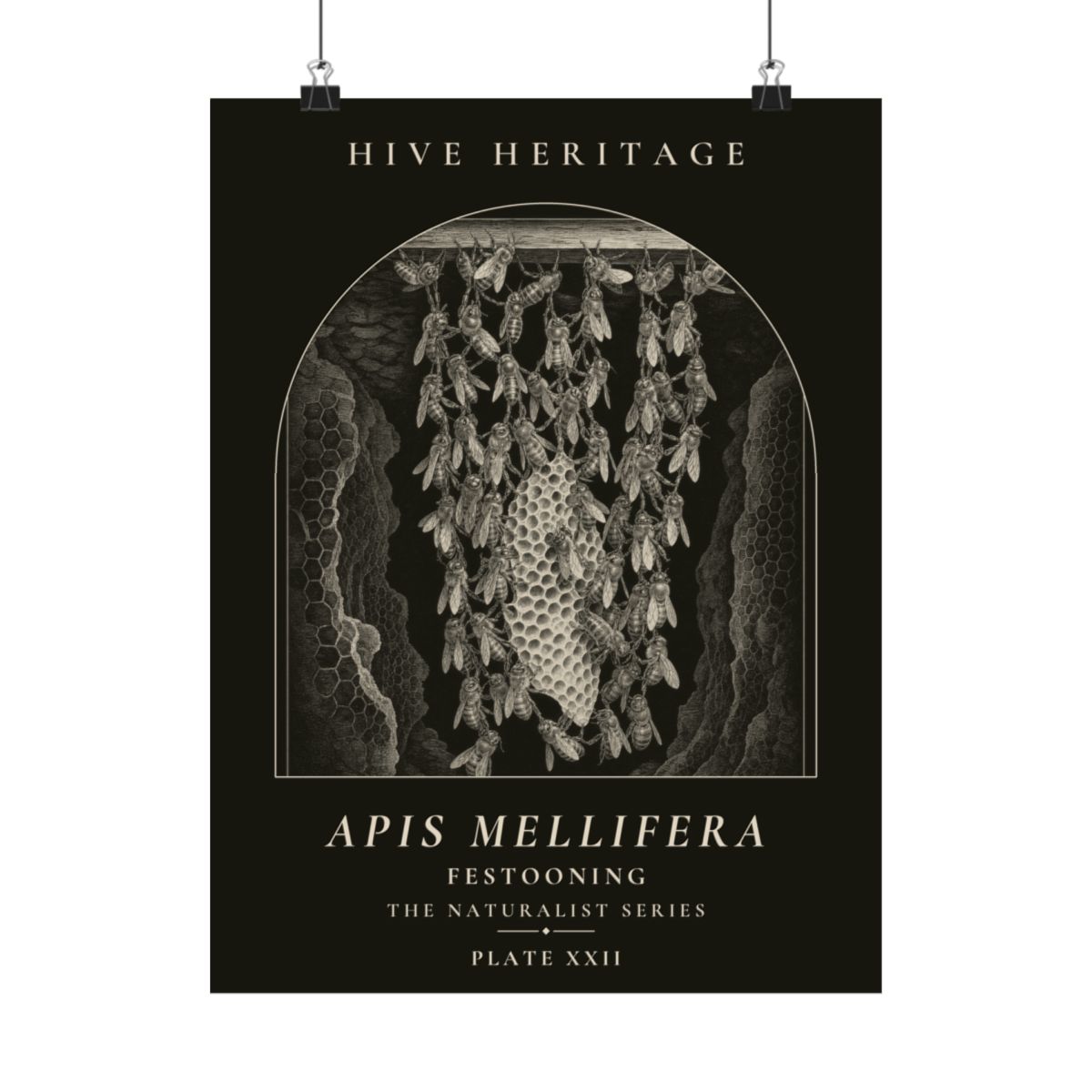
Festooning is the chain or hanging curtain of worker bees that forms when a colony is making wax and building new comb, with each bee gripping the legs of the one above and held in turn by the one below. It is one of the most striking sights in a working hive, and one of the least explained to people who have only met bees through a jar of honey.
We chose it for a plate in our Naturalist Series because it is a piece of bee behaviour that repays slow looking. This article goes further than a caption can, setting out what has been established about festooning, where the evidence runs out, and what you might actually see if you keep bees.
What is festooning in bees?
A festoon is a chain or hanging curtain of worker bees. Each bee holds on with her legs to the bee above and, in turn, is held by the bee below. The chains often hang from the top bar of a frame, from the roof of a cavity, or from the edge of a comb that is still being built. Seen from a little distance, the whole mass can look like a single textured fabric, gently moving as the bees shift and adjust.
The behaviour is closely tied to making beeswax. Honey bees are unusual among the bees most people know in that a worker produces wax from her own body. On the underside of the abdomen she has wax glands, arranged in four pairs. Wax is secreted as tiny, clear flakes, called scales, which appear in the small pockets under the abdominal plates. A single scale is only a few millimetres across, and to the naked eye it can look like a fleck of dandruff or a shaving of glass.
Wax production is not something a bee does at any age. In the standard reference work on the subject, Mark Winston's The Biology of the Honey Bee, wax secretion is described as peaking in workers in the middle part of their adult lives, after the period of nursing brood and before foraging takes over. Younger and older bees can produce wax when the colony needs it, but the typical wax worker is a bee in that middle phase of work inside the hive.
So when you see a festoon, you are very often looking at bees that are producing wax, or ready to. The chain is the visible posture of a colony that is about to build, or is building, new comb.
Why do bees festoon?
The first thing to say is that the story of beeswax has a long history of correction. For a long time people assumed bees gathered wax from flowers, in the way they gather pollen. The Swiss naturalist François Huber, working in the late eighteenth century with the help of his assistant, is generally credited with showing that the wax comes from the bees' own bodies, and with observing the clustering of wax-producing bees that we now call festooning. His work is a reminder of how much of this can be established by careful watching alone.
Since then, researchers have offered several explanations for why the bees hang in chains rather than simply secreting wax where they stand. These are best treated as overlapping ideas, not settled rival theories.
Warmth. Beeswax is worked into comb most easily when it is warm and pliable. Bees keep the brood nest at a steady temperature, roughly in the mid thirties Celsius, and comb-building bees are tightly clustered, which holds heat around them. A dense chain of bodies is a good way to keep a building site warm. The bees are not idle in a festoon. Their muscles and metabolism generate heat, and the cluster limits how quickly it escapes.
Access. A festoon puts many wax-producing bees close to the work face, and close to each other. Scales can be passed along to the bees that shape the comb. Observers of comb building have long noted that the bee that makes a scale is not always the bee that places it, and that scales are handled, chewed and worked into the growing comb by several individuals. The mouthparts are used to soften the scale, and it is mixed with secretions before it is added to the cell wall. The chain gives all this activity a physical structure.
Position and space. Comb in a natural nest is built downwards from a roof or a bar, and the festoon is where the new wall of wax will go. Some researchers have suggested that the bodies of the bees in the chain help mark out the space, and that the colony's own dimensions, including the gap bees leave between combs, are worked out through the arrangement of the bees themselves. That is an idea worth taking seriously, but we would be careful not to present it as proven in every detail. Direct evidence for how bees "measure" is harder to come by than the neatness of the finished comb might suggest.
What is better supported is the link between building and conditions. Studies of when colonies begin drawing new comb, notably the work of Stephen Pratt on how colonies time their construction, point to a colony responding to signals from the state of the nest, such as available space and incoming nectar, rather than to a fixed calendar. That fits what beekeepers report: festoons and fresh white comb tend to appear when there is forage coming in and somewhere to put the wax.
There is also the cost. Wax is not free. To make it, bees consume a large amount of honey or nectar, and estimates of the ratio differ from study to study. All that can be said with confidence is that comb is expensive for a colony, which is one reason the behaviour is tied so closely to good foraging conditions.
What a beekeeper sees at the hive
If you keep bees, the places to look are the ones where new comb is going up. In a hive with foundation, that is often the frames nearest the brood nest or the ones just added to a box when the colony is expanding. In foundationless frames, where bees start from a guide strip or a bare top bar, festoons are usually very clear indeed, because the whole comb is built from nothing.
You may notice a few things.
- The chain hangs in a fairly regular line, following the shape the new comb will take.
- The bees in it are close together and warm to the eye, if not the touch, and they move slowly compared with foragers on a comb face.
- Pale, almost white wax appears beneath or between the chains and darkens over time as it is used.
- If a chain is disturbed, it breaks apart and reforms quickly. It is a behaviour, not a fixture.
A beekeeper should handle a festooning frame gently. Bees on freshly built comb, especially very new comb hanging from a bar, are working on a structure that has little strength yet. New wax is soft, and heavy shaking or hard bumps can crack or drop it.
There is a piece of folklore to leave at the door. You will sometimes hear that festooning is a sign that a colony is about to swarm. We cannot support that as a rule. Swarms do produce a great deal of comb quickly once they settle in a new cavity, and wax-producing bees hang in chains there too, but seeing a festoon in a hive is not, by itself, good evidence of swarm preparation. It tells you that the bees are building. Reading swarm intentions takes other signs, such as queen cells and the state of the brood nest.
It is also worth telling festooning apart from other clustering. Bees may hang in a mass on the outside of a hive on a hot evening, often described as bearding, and a swarm gathers in a hanging cluster on a branch. The likeness is real, but the purposes are different. Bearding is largely about keeping the nest cool and less crowded. A festoon is about the work of building.
Why it belongs in a natural history series
The reason festooning is so satisfying to draw is that it makes the collective visible. Honey bees are sometimes described as though the hive were a single creature, but a festoon shows the plain mechanics: individual bees, each holding on, each doing a small part, together forming something that no one of them could. The comb that results is one of the most economical structures in nature, made by animals that carry their building material inside their own bodies.
We have tried to respect that. Every article in this series sticks to what can be supported, and where an idea is still argued over, we say so. Our plates are digital artwork in an engraving style, made for us. They are not antique prints and not hand-engraved originals, and we would rather say that plainly than borrow a history that is not ours.
The Festooning plate shows those living chains in that engraved style. If this article has made you want to look a little longer at what bees are doing on the comb, it is the design to go and see, in our shop, linked below.
See it in the Naturalist Series: The Festooning plate