Naturalist Series · 29 September 2026
Why the Bees Turn Out the Drones in Autumn
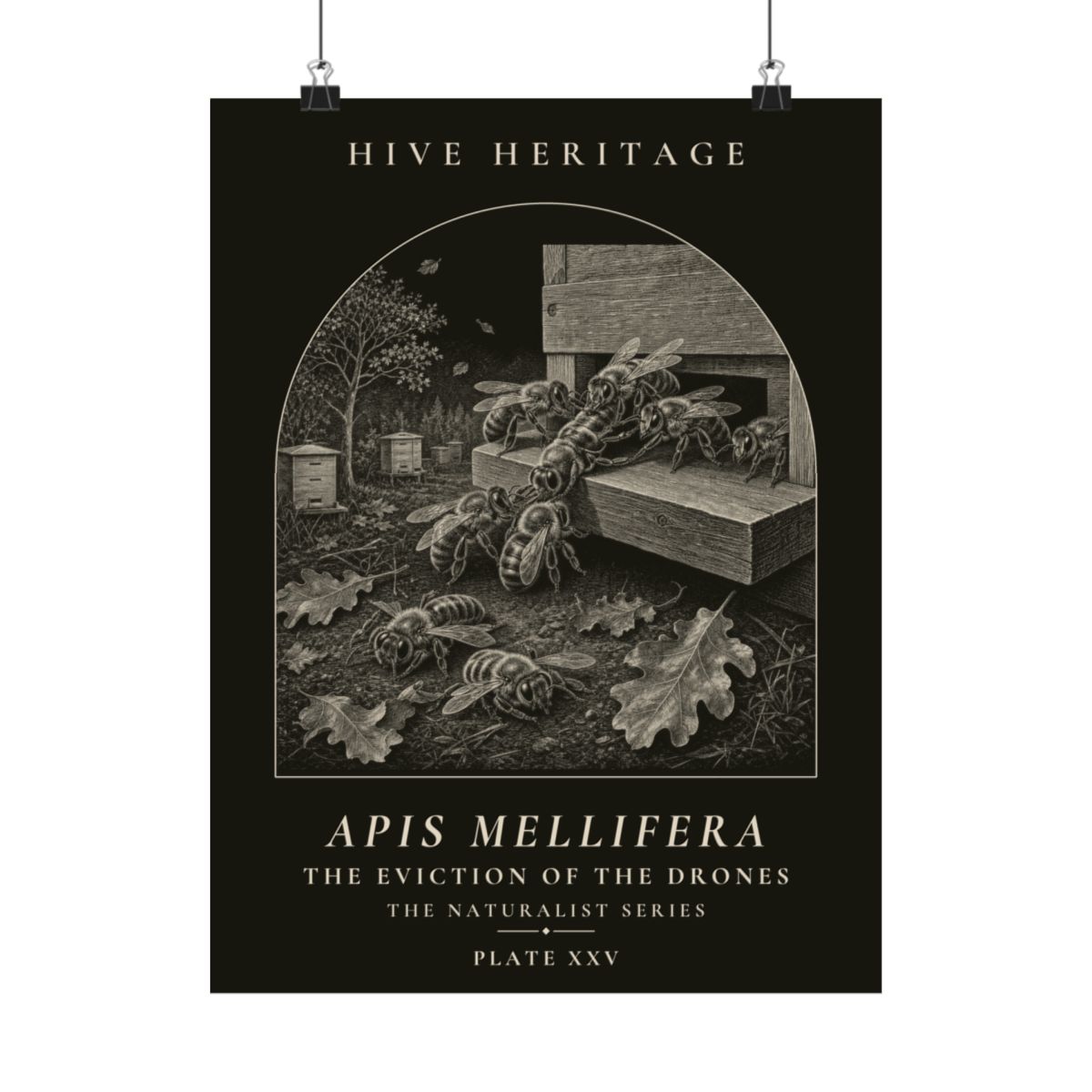
Worker bees turn the drones out in autumn because the males have stopped earning their keep. A drone cannot forage, has no wax glands and does no work in the hive, yet a strong colony may have fed a few hundred to over a thousand of them through the summer; once the mating season is over and the last nectar flows are finishing, that cost no longer buys the colony anything, and the workers stop feeding the drones and drive them out.
It is one of the most striking events in the beekeeping year, and one of the most misunderstood: on a mild day at the turn of the season you can watch broad, heavy-bodied drones seized by smaller workers, hauled to the entrance and pushed out, some dragged by a wing or leg, turned away if they try to come back, until by evening a few sit cold and motionless in the grass below the landing board. We made a plate about it. Here is what we can say about it with confidence.
What is a drone bee?
A honey bee colony is mostly female. The workers, thousands of them, do nearly everything: they clean, nurse, build comb, guard, forage and ripen nectar. There is one laying queen. The drones are the third kind of bee in the hive, and there are usually far fewer of them than there are workers.
A drone is easy to recognise once you have seen one. He is stockier than a worker, with a blunt, rounded abdomen and very large eyes that meet across the top of his head. He has no sting, because the sting is a modified egg-laying organ and he is male. He has no pollen baskets on his legs and no wax glands, and he does not forage. He is also noisier in flight, with a deeper, louder hum than a worker's.
His origins are unusual. A queen can lay either fertilised or unfertilised eggs. Fertilised eggs become females, workers or queens. Unfertilised eggs become drones. A drone therefore has a mother but no father, and carries only one set of chromosomes where a worker carries two. This was worked out in the nineteenth century, and the Silesian priest and beekeeper Johann Dzierzon is credited with proposing it in the 1840s. It is still one of the first things a new beekeeper finds astonishing.
Drones are also raised in their own cells. The comb builders make larger cells for them, and the capped drone brood has a domed, bullet-shaped cap that stands proud of the flat cappings over worker brood. A drone takes around twenty-four days to develop from egg to adult, a few days longer than a worker.
Lazy, or doing the one job that matters?
Shakespeare gave us the "lazy yawning drone" in Henry V, and the idea has clung to the male bee ever since. It is worth setting against what the drone is actually for.
He has one task, and it is not done inside the hive. A young drone spends his first days being fed by the workers and then feeding himself from the stores. When he is sexually mature, roughly two weeks after emerging, he begins to fly in the warmest part of the day. Drones from many colonies gather in particular places, usually called drone congregation areas, where they fly in numbers, high above the ground. A virgin queen, on her mating flights, goes to those places. She mates in the air with a number of drones, and the colonies she comes from and goes to are shaped by which males she meets.
The mating is fatal for the drone. The act damages him so badly that he dies. Those drones that never mate, and that is the great majority of them, live out their season and are then removed by the colony. So the drone is not idle. He is an expensive investment that pays off for the colony's genes rarely and at a distance, in the air, far from the hive.
He is expensive because he eats. Drones are fed by the workers when young, and they consume stores throughout their lives, without bringing any back. A colony that raises them in the hundreds, and commonly a few hundred to over a thousand in a strong colony in season, is spending real resource on them. That spending is worth it in spring and summer, when forage is plentiful and queens are on the wing. It stops being worth it when the season turns.
How do bees evict the drones?
The timing depends on the weather and on what the bees can find. In Britain it often falls in late summer or early autumn, as the main nectar flows finish, but there is no calendar date for it. A poor, wet summer or a sudden dearth can bring it forward. A late flow, such as ivy in a good autumn, can put it back.
What beekeepers observe is consistent. The workers stop feeding the drones and begin to keep them from the stores. The drones are harried on the combs and pushed towards the edges of the nest, where they cluster in cooler spots. Then workers take hold of them and carry or drag them to the entrance and out. Guard bees at the entrance turn back those that try to return. Drones that have been pushed out cannot feed themselves properly from flowers, are poorly equipped to cope with the cold, and do not survive for long outside. Beekeepers commonly find them in front of the hive, or in the grass beneath it, after a chilly night.
A drone can be seen going in through the wrong door, too. Drones drift, and they are often accepted by colonies other than their own during the mating season. But once the eviction begins, the general attitude of the workers toward males changes, and that hospitality is withdrawn.
It helps to think of the colony as a household that has to get through the winter on what it has stored. The workers of autumn are already different from those of midsummer, and the colony is shrinking its numbers and tightening its accounts. The drones, who cost stores and return nothing in the months ahead, are the obvious saving. The colony does not do this out of anger. It does it because a colony that carries dead weight through a winter with no forage is a colony that may not last.
We should be careful about how much we claim beyond this. What the workers sense, and how the decision spreads through thousands of bees with no leader to make it, is not something we can fully explain, and we will not pretend to. Researchers have studied how nutrition and colony condition affect drone rearing and retention, but the plain observation is enough for the beekeeper: when the stores and the season say enough, the drones go.
What does it mean if a hive still has drones in winter?
For a beekeeper, the eviction is a small, honest report from the hive. If the drones are being turned out on time, it is a sign that the colony is behaving as a normal queenright colony behaves, and that it is preparing for winter. It is not a fault to be corrected and it is not a sign of a colony in trouble. Many an experienced beekeeper has been reassured by the sight of drones on the ground in front of a hive in September.
The opposite is also informative. Drones still in the hive in the depths of winter are unusual, and beekeepers treat them as something to investigate. A colony that has lost its queen and failed to replace her, or one with a queen that is failing, or one in which workers have started to lay, may keep its drones long after the neighbours have thrown theirs out. Workers can lay unfertilised eggs, and unfertilised eggs can only become drones, so a colony with laying workers produces males alone, and the colony cannot recover on its own. A hive that is still tolerating males when it should not be is a hive worth a careful look on the next mild day.
Drones matter in another way to the beekeeper. Varroa mites, the parasite that has shaped modern beekeeping, are known to favour drone brood, whose longer capped stage suits the mite's own breeding cycle. Some beekeepers use this knowledge in management, by encouraging the colony to build drone comb and then removing it. That is a practical matter for people who keep bees, and we mention it only to show how closely the drone is tied up with the hive's yearly rhythm, and with the beekeeper's.
The last lesson is a gentler one. It is easy to feel sorry for the drones, and to feel that the workers are harsh. But the eviction is not a failure, and it is not an oddity of cruel insects. It is one of the ways that a colony of tens of thousands manages to remain a single, sensible household through the year. The males are there when they are needed, in spring and summer, and they go when the household must shrink to survive the cold. Then, in the following spring, the queen begins to lay drone eggs again, and the cycle starts once more.
The plate
This scene is one of the plates in our Naturalist Series, and it is the one that shows the moment described above: the workers at the entrance, the drones being turned out, the season closing in. It is digital engraving-style artwork, made in the manner of the natural-history plates we admire. It is not an antique, and it is not a hand-engraved original, and we would never want anyone to think it was. It is a modern piece made for people who watch bees and enjoy looking closely at them.
If you keep bees, you will probably recognise the scene at once. If you do not, we hope the account above shows why a beekeeper does not look away from that entrance in September. You can find the plate through the link below.
See it in the Naturalist Series: The Eviction of the Drones plate