Naturalist Series · 1 October 2026
The Death's-Head Hawkmoth and the Honey Bee
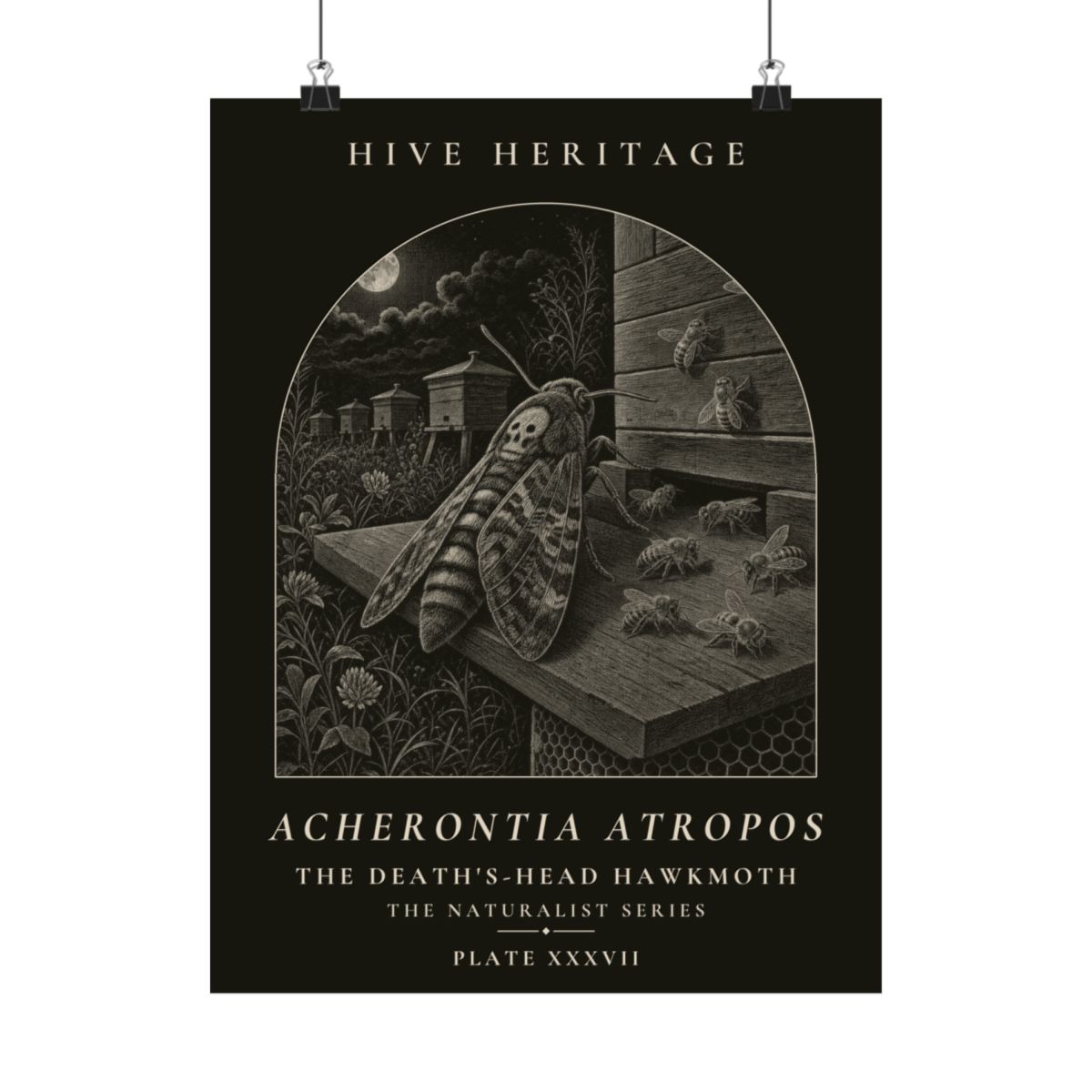
Few insects have collected as much folklore as the Death's-Head Hawkmoth. It is big, it has a pale mark on its thorax that looks remarkably like a skull, and when it is picked up it squeaks. Add a habit of walking into beehives to help itself to honey, and you have a creature that was always going to be given a bad reputation.
We drew it for our Naturalist Series because it belongs in any honest account of the bee's world. It is also a good example of how a frightening story can be worth checking against what is actually known. The real animal is stranger, and rather more interesting, than the myth.
What the moth actually is
The Death's-Head Hawkmoth, Acherontia atropos, is a member of the hawkmoth family, the Sphingidae, the heavy-bodied, fast-flying moths that hover at flowers. It is among the largest moths seen in Europe. A wingspan of roughly ten centimetres or a little more is typical, and the body is thick and tapering, with a banded abdomen in yellow and brown. The forewings are mottled dark brown and black, the hindwings a warmer yellow with dark bands.
The skull is the feature everyone remembers. It is a patch of pale markings on the back of the thorax, and the resemblance is real enough that the moth's common name in many European languages refers to it. The genus name points the same way: Acherontia comes from Acheron, one of the rivers of the underworld in Greek myth, and atropos from the Fate who cuts the thread of life. Nobody has shown that the marking does anything for the moth. It is a coincidence of pattern, and a lasting one.
The caterpillar is just as remarkable. It is large and plump, usually yellowish green with diagonal stripes along the sides, and carries a curved horn at the rear. In Britain and across Europe it is most often found feeding on plants of the potato family, including potato itself, and also on species such as deadly nightshade and thorn apple. When fully grown it leaves the plant and pupates in the soil.
Then there is the sound. Disturbed adults produce a distinct squeak, made by forcing air through the mouthparts. It is loud enough for a person to hear at close range, which is unusual among moths. Why it does this is not settled. It may startle a predator. There has also been discussion of whether it plays a part in dealing with bees, but that remains a suggestion rather than an established fact, so we will leave it as one.
A migrant, not a resident
In Britain the Death's-Head Hawkmoth is a visitor. Each year a few moths fly north from the warmer parts of the Mediterranean and North Africa, arriving in late spring or summer. They are strong fliers and can cover long distances. Some lay eggs on suitable plants once they arrive, and caterpillars are occasionally found in late summer and autumn, often in potato fields and gardens. What does not happen is a settled population. The pupae cannot be relied on to survive a British winter, so the moth does not establish itself here in the way a native species would.
That is part of why a sighting still feels like an event. Most people, including many who keep bees, will go their whole lives without meeting one. In parts of southern Europe and Africa, where the moth lives year round or nearby, it is a far more familiar animal, and the stories that grew up around it there are older and more varied. It has long been treated as an omen of misfortune, which is easy to understand given the marking and the squeak. Those beliefs belong to folklore. They tell us about people, not about the moth.
The adult moth's feeding habits are less fearsome than its name. Like other hawkmoths it feeds with a proboscis, taking sugary liquids. Sweet sap that oozes from trees has been reported as a food, and so has nectar. The proboscis is short and stout compared with that of the long-tongued hawkmoths that reach into deep flowers, and that shape turns out to matter a great deal for what comes next.
Why it goes to the hive
A honeycomb is, from the point of view of a sugar-hungry insect, an extraordinary find: a large store of concentrated food, sealed in wax. Several insects take advantage of it, from wasps to other bees. The Death's-Head Hawkmoth is one of the few moths that does so. Its short, strong proboscis is able to pierce the wax cappings over stored honey and draw the contents out. Beekeepers in southern Europe have long known it as a robber, and accounts of it going into hives are old.
The obvious question is how a large, defenceless-looking moth gets past a colony that will readily sting a much bigger animal. This is the part with proper research behind it. Work published in 1991 by Robin Moritz and colleagues found that the moth carries a mixture of surface chemicals very similar to the ones found on honey bees themselves. Bees recognise nestmates largely by smell, and a moth wearing something close to the right scent is met with less hostility than one that smells like a stranger. It is a form of chemical camouflage. That is the finding, and it is a neat one, though it does not mean the moth is safe. A stinging bee can still kill it, and moths are found dead in and around hives.
Beekeepers report a range of behaviour from the bees. Some colonies seem to ignore the intruder for a while. Others do attack, and dead moths can be found on the hive floor. There are accounts of bees sealing a body they cannot carry out with propolis, the resinous material they use to fill gaps, which is a habit bees have with other large intruders too. It is a reasonable, practical response, and one that makes the hive tidier and the smell more manageable.
What is missing from most of the popular telling is proportion. The Death's-Head Hawkmoth is not a widespread menace to bees. A colony that loses some honey to one moth has lost some honey, and no more than that. A single visitor is a nuisance, and the number that reach any given apiary in Britain is small. In warmer regions, where the moth is more common, the loss can matter more, and there are reports from beekeepers who have seen weakened colonies after repeated visits. Even so, we would treat sweeping claims about damage with caution. Where we could not find good evidence for a number, we have not given one.
What bees and beekeepers do about it
The bees' first line of defence is the one they use against every intruder: guard bees at the entrance, a hive that is defended and well populated, and stings when the disguise fails. A strong colony copes better than a weak one, which is a general principle in beekeeping and holds here as well.
Beekeepers who are concerned about robbing moths, particularly in areas where they are more likely to appear, usually rely on ordinary measures. A narrower entrance is easier for the bees to guard and harder for a large moth to squeeze through. Entrance reducers and mouse guards are the usual tools, and many keepers fit them in late summer and autumn as a matter of routine, since that is also when wasps become troublesome and the colony is preparing for winter. The same steps that discourage wasps and other robbers discourage a moth of this size.
Nobody needs to lose sleep over it. If you keep bees in Britain and find a Death's-Head Hawkmoth at your hive entrance, you have probably seen something that most naturalists never do. Keep the entrance sensible, keep the colony strong, and treat the visit as a matter of interest first and a problem second. If you are unsure whether you have a moth or something else at the hive, ask an experienced local beekeeper, or your local beekeeping association, who will know what turns up in your area.
There is a quieter lesson in the whole story. The moth's method is a small piece of biology that only came to light because someone looked carefully at what smell could do, instead of accepting the easy explanation that a scary-looking insect must be doing something scary. It is the sort of observation that natural history is built on: patient, specific, and often gentler than the legend.
That is the spirit in which we made the plate. It is digital engraving-style artwork, drawn to give the moth the seriousness of an old natural-history illustration, without pretending to be one. The skull mark, the banded body and the heavy proportions are all there, in the manner of a plate you might find in a naturalist's library. If you want to see it, it sits in our Naturalist Series, and the link below takes you to it in the shop.
See it in the Naturalist Series: The Death's-Head Hawkmoth plate