
Naturalist Series · 29 September 2026
White Clover, Red Clover and What Bees Take from Them
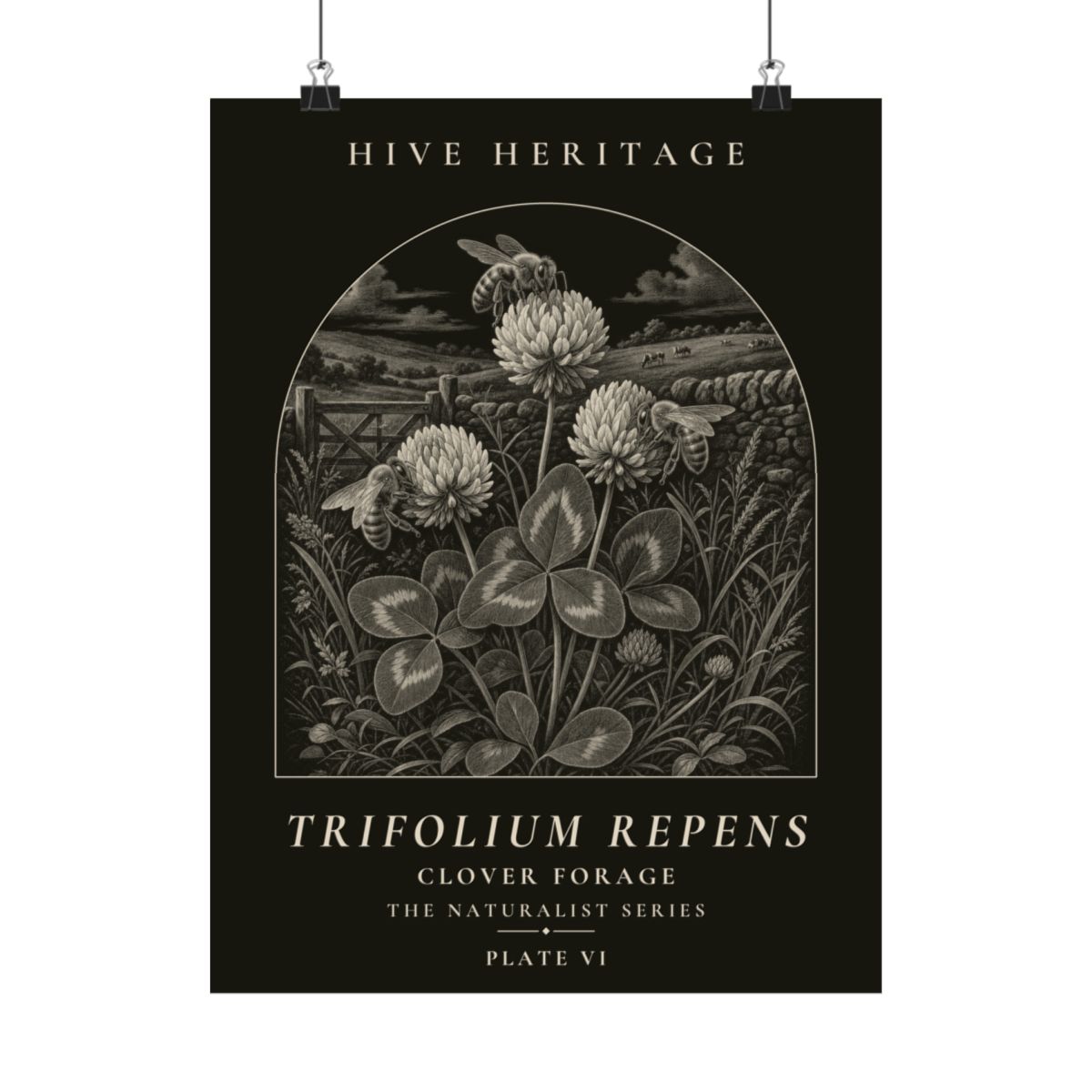
White clover and red clover look similar from a distance, but they offer bees very different rewards. White clover's shallow flowers suit a honeybee's short tongue and are prized mainly for nectar, while red clover's deep, tubular flowers are really built for long-tongued bumblebees, so a red clover field is a better place to watch bumblebees than honeybees.
Our Clover Forage plate is drawn to show that plant at work. What follows is the natural history behind it, set out as plainly as we can, with the folklore kept separate from the facts.
What's the difference between white clover and red clover?
"Clover" is a whole group of plants, the genus Trifolium, whose name comes from the Latin for three leaves. They belong to the pea family, the legumes. Two species matter most for bees in Britain, and they behave quite differently.
White clover, Trifolium repens, is the low one. It creeps along the ground on stems that root as they go, which is why it thrives where grass is mown or grazed short. Its leaves usually carry a pale, curved mark, and its round flower heads are white, sometimes flushed with pink. Each head is not one flower but a crowd of small florets, each one a tiny pea-type blossom, opening in turn.
Red clover, Trifolium pratense, stands taller, with flower heads in a deeper pinkish purple. You find it in meadows, hay fields and rough grassland, and it has a rather more upright, generous look than its white cousin.
Both flower across the warmer part of the year. White clover typically begins in late spring and carries on through summer, often into early autumn, and it will flower again after a lawn or pasture has been cut. Exact timing shifts with the season, the county and the weather, so treat any calendar as a rough guide rather than a promise.
What do bees get from clover: nectar or pollen?
The short answer to "nectar or pollen?" is both, but the balance depends on the plant and on who is visiting.
White clover is best known as a nectar plant. Its florets are shallow enough that a honeybee, with a fairly short tongue, can reach the sugar at the base. It also offers pollen, and bees will gather it, though when people talk about white clover as forage it is nearly always the nectar they mean. The plant leans on insects to set seed, since white clover is largely unable to fertilise itself, so the bee and the flower need each other in a very direct way.
Red clover is a different proposition. Its florets form long narrow tubes, and the nectar sits deep at the bottom. Honeybees generally struggle to reach it with their short tongues. Long-tongued bumblebees, such as the garden bumblebee and the common carder, can. So a field of red clover is a good place to watch bumblebees rather than honeybees, although honeybees may still visit for pollen, or find ways in at flowers whose tubes are shorter or already pierced.
This is the detail that changes how you read a meadow. Two plants with the same family name, similar flowers at a glance, and almost opposite invitations. One is open to a honeybee's short tongue, and the other is set for a bumblebee's long one.
One more thing worth knowing about nectar is that it is not a fixed quantity. A plant does not simply have nectar in the way a jar has honey. How much a flower secretes depends on temperature, sunshine, and soil moisture. Cool, dull weather or a dry spell can leave a clover field looking splendid and yielding rather little. Beekeepers know the frustration of a lush green summer that produces a modest harvest, and clover is one of the plants where it shows.
The plant that feeds the soil
Bees are only part of why clover has been valued. Being a legume, it grows small nodules on its roots that house bacteria able to turn nitrogen from the air into a form the plant can use. When clover dies back or is grazed, some of that nitrogen becomes available to the plants around it.
Farmers have long made use of this. Sowing clover into grass, in a mixed sward or as part of a rotation, is an established way to build fertility in the soil and to feed livestock. The result, whether or not anyone intended it, is a field that flowers. Traditional clover and grass leys, and hay meadows that include red clover, gave bees a great deal of summer forage as a by-product of ordinary farming.
That connection matters when you think about what a landscape offers. Where fields are managed for grass alone, clover tends to be absent. Where it is allowed to grow, the hedgerow, verge and pasture together can hold bees through the summer months. We would rather not overstate this: the health of any bee population depends on many things, and clover alone is not the answer to any of them. It is simply one of the plainest and most dependable sources of food in the British countryside.
What does "clover honey" actually mean?
Clover has a long association with honey, especially in North America, where light, mild clover honey became something of a standard by which other honeys were judged. In Britain white clover is one of the plants that contributes to summer honey, alongside others that flower at the same time, such as bramble and lime in the right places.
Here is where a common assumption needs correcting. A jar labelled clover honey does not mean the bees visited nothing but clover. A honeybee colony flies over a wide area, and within reach of the hive there are usually many plants in flower at once. Honey sold under a single flower name is a claim about what dominated the forage, and beekeepers with the equipment and the experience to check it, using the honey's colour, taste and tests such as pollen analysis, are the ones who can properly say. Where the source is uncertain, "summer blossom" or "local honey" is the honest label. So, if someone tells you their honey is made from clover alone, it is fair to ask how they know.
Beekeepers have also, in some parts of the world, moved their hives to be beside a crop in flower, so that the colonies are in the right place at the right time. Moving bees to good forage is a real and long-established practice, often called migratory beekeeping, though how much of it is done for clover varies enormously from place to place, and we would not want to pin down a region or date without a source in front of us.
We are an apparel and art house, not a honey seller, so we will keep to what the plant does rather than what a jar contains. And we make no claims for honey beyond that it is a food made by bees from nectar.
Luck, leaves and the four-leaf clover
No piece on clover can ignore the four-leaf clover, the folk symbol of luck. It is worth naming as folklore. An extra leaflet is an occasional variation in the plant, and the luck attached to it is tradition, not natural history. It has nothing to do with the bees, and we would not want anyone to think a beehive is luckier for having one nearby.
What is real is the three-part leaf that gave the plant its name, and the pale mark on the leaflets of white clover that many people can spot once they have seen it once. Look for it next time you cross a lawn.
Watching clover for yourself
You do not need a meadow to see any of this. A few things are worth trying if you have a patch of lawn, a verge or a field margin nearby:
- Look at the flower heads of white clover on a warm, sunny day, and watch how a bee works round each head, going floret to floret.
- Find red clover, and see who visits. Notice how often it is a bumblebee rather than a honeybee.
- Compare the same patch on a cool, cloudy day and a warm, bright one. The difference in visitors is usually plain to see.
- If you have a lawn, consider leaving a small corner uncut for a few weeks in summer. It costs little, and the clover in it will flower.
None of that needs equipment, or any special knowledge. It only needs a few minutes of standing still.
The plate
The Clover Forage plate belongs to our Naturalist Series, in which each design is a study of one plant, insect or piece of beekeeping's natural history. It is digital artwork in an engraving style, made for us today rather than any old print, and drawn with the aim of showing the plant carefully, in the spirit of a naturalist's plate. If this article made you look at a lawn differently, that is what the design is for.
You can see the Clover Forage plate, and how it is used on our apparel and art, through the link below.
See it in the Naturalist Series: The Clover Forage plate