
Naturalist Series · 29 September 2026
How a Bumblebee Colony Lives, and Differs From Honey Bees
A bumblebee colony lasts a single year: one queen founds it alone in spring, it grows through summer, and by autumn everything but her mated daughters is dead. A honey bee colony, by contrast, is perennial, with a queen that can live for several years and a hive that carries tens of thousands of bees through the winter on stores it laid down itself. Most of us who keep bees, or simply love them, learned the honey bee first, so it can come as a small shock to watch a bumblebee properly and see how differently the whole enterprise is run.
We put the bumblebee among our Naturalist Series plates because it deserves the same patient looking as its better-known cousin. This is what we have learned about it, and where each fact comes from: the standard natural history of the genus Bombus, as set out by bumblebee specialists and the major bee conservation bodies in Britain and North America.
How is a bumblebee colony different from a honey bee colony?
A honey bee colony is perennial. The queen can live for several years, the colony keeps going through winter by clustering together and eating the stores it laid down, and in due course it reproduces by swarming: the old queen leaves with a portion of the workers and the rest carry on. In a good year a single hive holds tens of thousands of bees. That scale is what makes keeping them, and taking a surplus from them, possible at all.
A bumblebee colony is annual. It is founded in spring by one queen, it grows through the summer, and by autumn it is finished. Only the new queens carry the line forward, and they do it alone. The colony itself is modest by comparison. Most species produce nests of a few dozen to a few hundred bees at their peak, and some far fewer. Nothing is stored against the winter in the way a honey bee colony stores it. Bumblebees do keep a little nectar in small wax pots, but it is a short-term larder, a buffer for a wet week, not a winter supply.
There are other differences you can see with your own eyes. Bumblebees are large, round and furry, and they are not built to a single pattern: workers within a nest vary noticeably in size, which honey bee workers do not. They nest in the ground or in tussocky grass, old rodent burrows, cavities under sheds, in some species in bird boxes or above ground in dense vegetation. The comb is not the tidy hexagonal comb of a hive but a rough cluster of wax cells and pots, made by the bees themselves, that looks as if it were assembled in a hurry. And the honey, to be plain about it, is not a thing anybody harvests. There is too little of it, and the nests do not last.
Bumblebees are also, in the cool northern weather that both Britain and much of North America supply, the bee that keeps working when others sit it out. They warm their flight muscles by shivering them, and their dense coat holds the heat. You will often see a bumblebee foraging in weather that has honey bees staying home.
What is the life cycle of a bumblebee colony?
The year begins in the autumn before. New queens, having mated, feed up hard on nectar and pollen, then find a spot to hibernate on their own: a shallow hole in a bank, loose soil, leaf litter or the base of a tree. They stay there through the winter. Every other bumblebee of that colony, the old queen, the workers, the males, dies.
In spring the queen wakes and comes out, hungry. On the early flowers she feeds, and then she does something a honey bee queen never does: she does all the work herself. She looks for a nest site, builds the first wax cells, gathers pollen, lays her first eggs on a pollen mass and incubates them by sitting on them, keeping them warm with her own body. It is a solitary, precarious few weeks, and many spring queens fail at this stage.
When it works, the first workers hatch. They are all female, and smaller than the queen. From this point the queen stays in the nest, laying, and the daughters forage, feed the young and defend the entrance. The colony now grows quickly.
Late in the season the colony changes what it is producing. It rears new queens and males, and the males leave the nest, feeding on flowers and finding queens from other nests to mate with. They do not work in the nest and do not return to it. The new queens mate and go off to feed and then hibernate. The old queen dies, the workers dwindle, the nest is abandoned. What remains in the chill of late autumn is a scatter of sleeping queens, each of them, if she survives, the start of next year's colony.
There is one twist in the story that we find hard to resist. A few species, the cuckoo bumblebees, have given up the working life entirely. The female enters the nest of a related bumblebee, takes over, and lays her eggs there, leaving the host workers to raise her young. She produces no workers of her own. It is a habit that depends entirely on there being plenty of host colonies, which is one reason a healthy cuckoo population and a healthy population of ordinary bumblebees go together.
What bumblebee species will you see in a garden?
Britain has around two dozen bumblebee species, and a handful of them account for nearly every bumblebee you will see in a garden, park or hedgerow. They are told apart chiefly by the colour of the bands on the body and the tail, though it is a subject where careful observers still disagree over difficult individuals, and we would sooner say so than pretend it is simple.
- The buff-tailed bumblebee has a dull yellowish band at the front, another at the back, and a buff to off-white tail. Its queen is one of the large ones you see early in the year, and it is often found working the first flowers.
- The white-tailed bumblebee is similar, with a clean white tail, and the two are not always separable in the field without a close look.
- The red-tailed bumblebee is black with a bright red tail, striking enough that most people notice it.
- The early bumblebee is small and neat, with a rusty tail, and it is among the first out in spring.
- The garden bumblebee has a long face and a long tongue, which suits it to deep flowers, and yellow bands at both ends.
- The common carder bumblebee is a ginger and brown bee, more muted than the others, with a fuzzy, even coat.
- The tree bumblebee, with its ginger thorax, black abdomen and white tail, is a relative newcomer to Britain, first recorded in the early 2000s.
North America has more than forty species of bumble bee, using the spelling as two words, and the range across the continent is wide. In the east, the common eastern bumble bee is a familiar visitor to gardens and, in a managed form, is used commercially to pollinate crops. The two-spotted bumble bee is another widespread species, with a broad yellow band and a small spot near the head. The American bumble bee, once widely seen across the east and midwest, is now much less often recorded than it was. In the west, the yellow-faced bumble bee is commonly seen along the Pacific coast, with a yellow face and a black and yellow body.
The reason we think the tongue length matters is worth stating briefly. Flowers differ in the depth of their tubes, and bumblebees differ in the length of their tongues. A long-tongued species can reach nectar a short-tongued one cannot. Some short-tongued bumblebees do a bit of cheating instead, biting a hole in the side of a deep flower to get at the nectar without pollinating it. It is the sort of small piece of behaviour that repays an afternoon watching a foxglove.
What bumblebees do that honey bees do not
Some flowers hold their pollen tightly, released only when shaken at a particular frequency. Tomato flowers are an example. A bumblebee grips the flower, disengages its wing muscles from its wings, and vibrates them, a behaviour called buzz pollination. You can hear a change in pitch as it does so. Honey bees do not do this. It is one reason bumblebees have been used for growing tomatoes under cover, and why in the wild they matter to a number of plants that other bees handle badly.
On stinging, a common piece of confusion. A honey bee has a barbed sting that usually stays in mammal skin, and the bee typically dies as a result. A bumblebee's sting is smoother and the bee survives to use it again. Even so, bumblebees are generally placid, and a nest is defended only when disturbed. It is a rare event that a person is stung by one who was not asked for the pleasure.
You will sometimes hear it said that bumblebees are not supposed to be able to fly. It is a myth, and an old one, born from a crude calculation that treated a bee's wing like a fixed aeroplane wing. Insects flap, and their wings move in a way that creates lift by mechanisms a fixed wing does not use. Bumblebees fly perfectly well, and always have.
A small practical point for those who keep honey bees, since we know many of you do. The two are not competitors in the sense of a fight over one flower; they overlap, and where forage is short both can feel it. We would not draw any conclusion from that beyond a reason to plant well and to look at both.
Looking at the plate
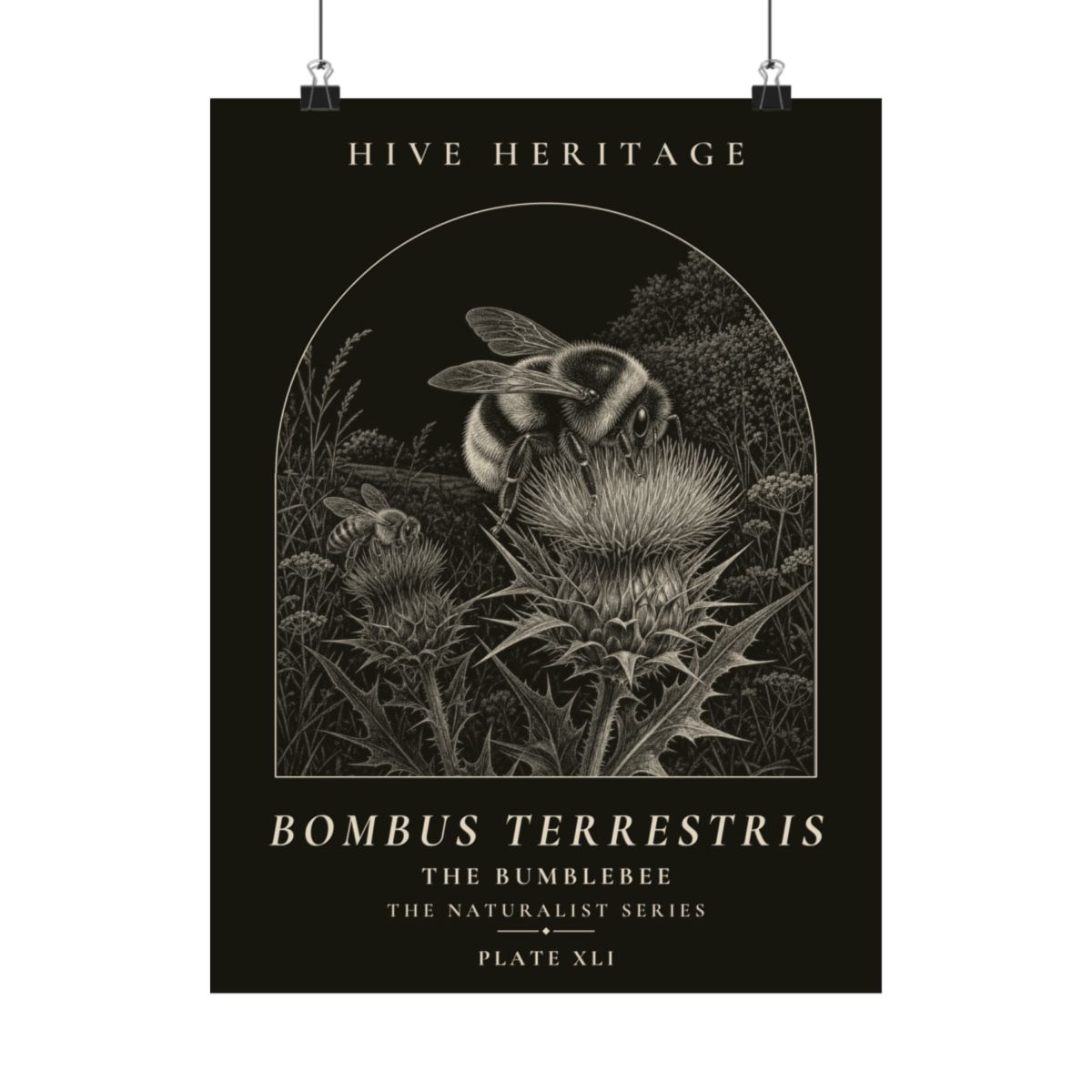
The plate that goes with this article is digital engraving-style artwork, made for our Naturalist Series. It is not an antique and it is not a hand-engraved original, and we would not want you to think so. It is a modern piece of work that borrows the discipline of the old natural-history plate: the single subject, the careful line, the sense that the creature has been looked at rather than merely decorated.
We chose the bumblebee for that series because it rewards being looked at. The round body, the banding and the soft coat are the details that field guides spend paragraphs describing, and a good plate shows them in a glance. If you would like to see how we drew it, the design is linked below.
Whether you keep bees or just stop to watch them on the lavender, we hope the next bumblebee you see is no longer only a bumblebee. It might be a queen alone in spring with a whole colony resting on her, or a worker in a late summer nest, or one of the last new queens looking for somewhere to sleep.
See it in the Naturalist Series: The Bumblebee plate