
Naturalist Series · 29 September 2026
The Black Dwarf Honey Bee and Its Open-Air Comb
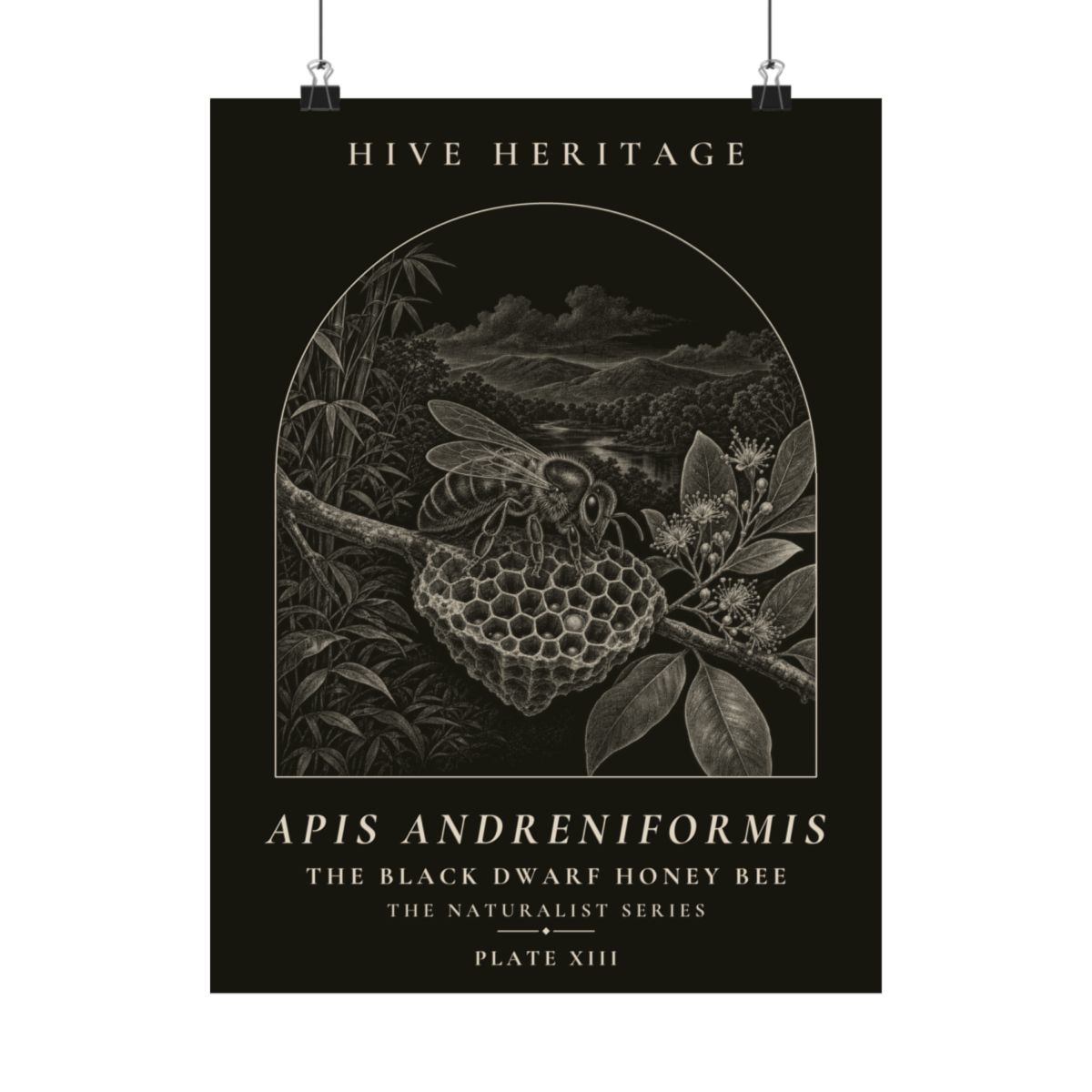
The black dwarf honey bee, Apis andreniformis, builds a single sheet of wax comb in the open air, hanging it from a branch or twig in the forests of South and Southeast Asia rather than sheltering it inside a hollow tree or a hive box. The bees themselves, packed in layers across the comb's surface, are the only walls the nest ever has.
We chose this bee for the Naturalist Series because it shows how much variety sits inside the phrase "honey bee". The plate carries the scientific name and the bee itself, and this article is the longer story behind it, kept to what the published natural history supports. Where the record is thin, we say so.
A small bee with a long name
The black dwarf honey bee is Apis andreniformis, described by the entomologist Frederick Smith in 1858. The species name points to a likeness to Andrena, the genus of mining bees, which are small, solitary and unlike the social honey bees we know. It is a fair hint. Next to a western honey bee, this is a slight, slender insect.
The common name explains itself in two parts. "Dwarf" is about size and "black" is about colour. Its close relative, the red dwarf honey bee (Apis florea), has reddish-orange on the upper abdomen. Apis andreniformis is darker there, and that is the plainest way to tell the two apart when you can see them side by side.
The two dwarf species have not always been kept apart. For a long time andreniformis was treated as little more than a dark form of florea. Later work on morphology and on DNA has treated them as separate species, and that is the position we follow here.
Both belong to the genus Apis, which is often described in three groups:
- The dwarf honey bees, which nest in the open on a single small comb. These are Apis florea and Apis andreniformis.
- The giant honey bees, which also nest in the open on a single comb, but a very large one. Apis dorsata is the best known.
- The cavity-nesting honey bees, which build several parallel combs inside a hollow. This group includes the western honey bee, Apis mellifera, and the eastern honey bee, Apis cerana.
Seen this way, the western honey bee is the odd one out in a mostly Asian genus. The bee in a wooden hive is not the template for all honey bees. It is one branch of the family.
Where does the black dwarf honey bee live?
The black dwarf honey bee is a bee of tropical and subtropical Asia. Its range runs through parts of South and Southeast Asia and into southern China, and it has been recorded across a scatter of mainland and island locations in that region. We are deliberately not giving you a tidy list of countries. The bee is not well surveyed, and boundaries on a range map for a species like this tend to move as more people look for it.
What the literature does agree on is the sort of country it favours. It is usually described as a bee of forested and hilly ground, more often than of open plains, and it tends to nest in the understorey, at modest height, rather than high in the canopy. The red dwarf honey bee overlaps with it in places, and the two can occur in the same region. Where they do, the black dwarf is generally associated with the more wooded and higher country.
That habitat is part of the reason the bee is less familiar than its red cousin. A small dark bee on a small dark comb in a forest thicket is not easy to find, and it has never been kept. Far fewer people have handled it or studied it than have studied the western honey bee, and that gap in knowledge is worth being honest about. We would rather leave a question open than fill it with something that sounds authoritative.
How does the black dwarf honey bee build its nest?
Everything about the way this bee lives follows from one choice: no cavity. A colony builds one comb, hung from a branch or twig and often wrapped around it, and the bees cover the comb's surface in layers. The comb is small. A western honey bee colony will fill a hive with sheets of wax, but a dwarf colony lives on a single piece no larger than you could sensibly picture in your hands.
Because the nest is exposed, the arrangement of the comb matters. Dwarf bees typically store honey in the upper part of the comb, close to the branch where it is attached. Brood cells sit lower down. The cells for workers and the larger cells for drones are found on the same comb. That is a very different arrangement from a hive box, where a keeper can lift out separate frames.
The most striking detail is the flat top. Around the branch, the top of the comb is built out into a broad platform. This is where returning foragers dance to tell nestmates where to find food. Bees in the cavity-nesting group dance on vertical comb, in the dark, and they translate the direction of the sun into an angle relative to gravity. Dwarf bees dance on a horizontal surface, in the open, and the dance points straight at the source. This has been known to bee scientists for a long time and it is one of the things that has made the dwarf species interesting for understanding how the honey bee dance language evolved. We are not going to claim more than that. The point is that a nest without a cave makes its own rules.
Living in the open also carries risks that a cavity nest avoids. A comb in a bush cannot be sealed against a predator or the weather in the way a hollow tree can. The published accounts describe dwarf bees as strongly defensive of the nest surface, with colonies making visible waves of movement across the mass of bees when they are disturbed. That behaviour, known as shimmering, is widely reported in the open-nesting honey bees. It works as a warning to intruders, and as a signal that a colony is watching.
How it differs from the western honey bee
Here is the comparison in plain terms, using only the differences that are well established:
| Feature | Black dwarf honey bee | Western honey bee |
|---|---|---|
| Scientific name | Apis andreniformis | Apis mellifera |
| Nest | One exposed comb hung from a branch | Several parallel combs inside a cavity |
| Native range | South and Southeast Asia, into southern China | Europe, Africa and parts of western Asia |
| Size | Noticeably smaller | Larger |
| Dance | On a horizontal platform, pointing directly at the food | On vertical comb, in the dark, using an angle to gravity |
| Kept by people | No, it is a wild bee | Yes, managed worldwide |
Two of those rows deserve a comment. The first is the native range of the western honey bee. It is native to Europe, Africa and parts of western Asia, and it lives in the Americas and Australasia only because people took it there. The black dwarf honey bee has stayed where it evolved.
The second is the last row. The reason dwarf bees are not kept is not stubbornness on the part of beekeepers. A bee that builds one small open comb and abandons it readily has little in common with a bee that will settle into a box and store surplus honey year after year. The whole craft of moveable-frame beekeeping was built around the behaviour of the cavity-nesting species. It does not carry over.
Is the black dwarf honey bee kept by people?
The relationship between people and the black dwarf honey bee is quieter than the one they have with the bee in the hive. Since the bee is wild and nests in the open, it is met by people who live and work in its habitat, rather than tended by them. There are accounts of people in parts of its range taking honey from wild dwarf bee combs. We do not have the evidence to describe that practice in any detail, and we would not want to generalise from a few reports to a tradition. What can be said is that a small open comb is easy to find once you know where to look, and that people have long paid attention to wild bees.
A note on what we are not saying. We are not making any claim about the honey, the wax or anything else this bee produces. Hive Heritage sells apparel and art, not honey, and we are not the people to tell you what any bee product does for you. Nor will we make claims about how the species is faring in the wild. Its status is not something we can support with a source we would stand behind, so we leave it alone.
What we can say is that the black dwarf honey bee is a useful corrective. It reminds a keeper that the boxes, frames and smokers of our own tradition describe one bee's habits. In the forests of Asia, a bee the size of a fingertip builds an entire society on a sheet of wax in the open air, and tells its sisters the way to the flowers by dancing on the flat roof of its own nest.
That is the story we wanted the plate to hold. It is a digital engraving-style artwork, made for us in the manner of a natural-history illustration rather than taken from any antique original, and it gives Apis andreniformis the same quiet attention we would give any of the more familiar bees in the series. If you have enjoyed reading about it, the plate is waiting for you below.
See it in the Naturalist Series: The Black Dwarf Honey Bee plate