
Naturalist Series · 29 September 2026
The Black-Banded Honey Bee of Sulawesi
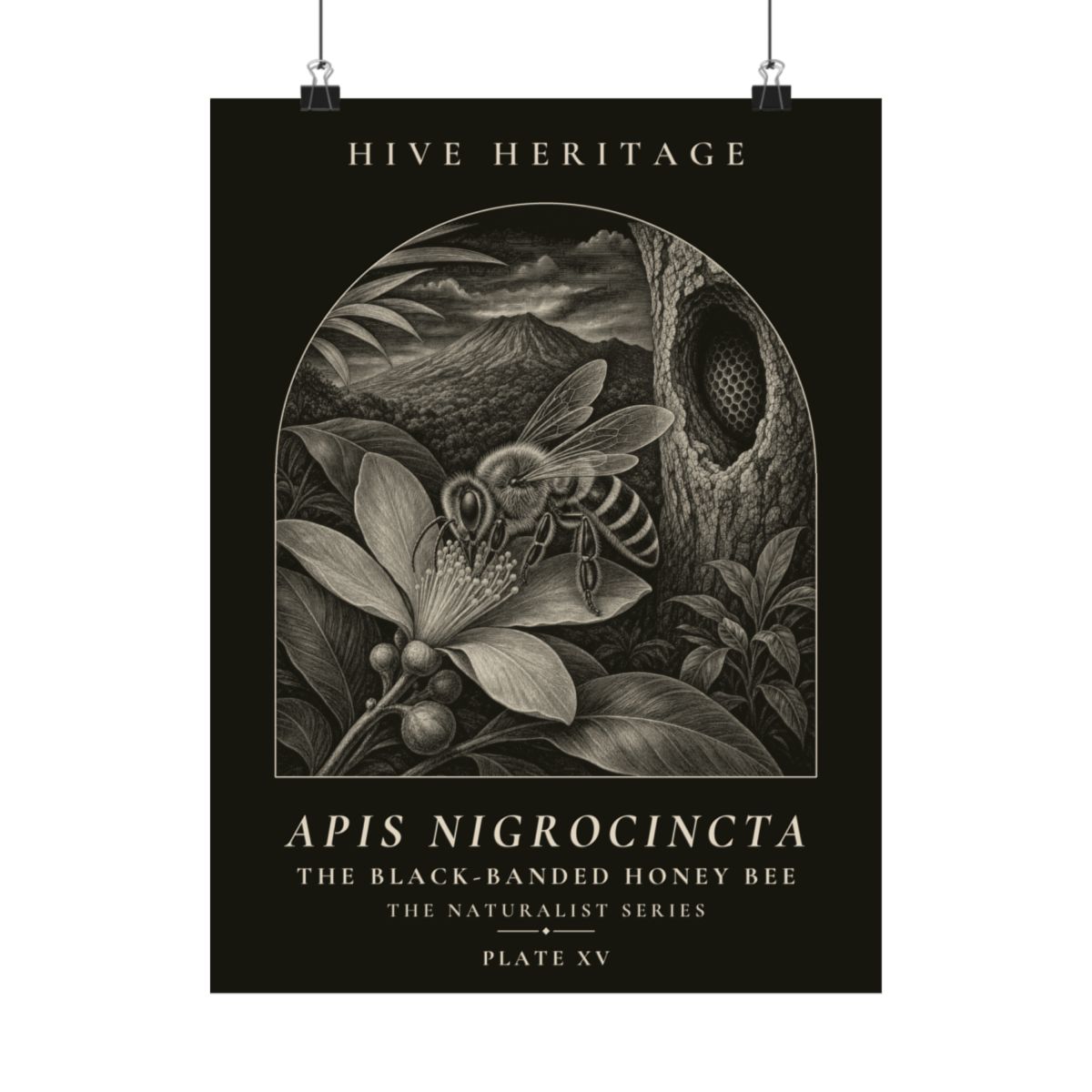
Apis nigrocincta, the Black-Banded Honey Bee, is one of around a dozen honey bee species in the genus Apis, most of them found in Asia. It takes its name from the dark bands across its abdomen and is native to Sulawesi, the large island in the middle of the Indonesian archipelago; it is the bee shown in Plate XV of our Naturalist Series.
This is a species with a thin literature. Some things about it are well established. Others are reported once or twice and have not been tested much since. Where that is the case, we will say so, rather than smooth it over with confident guesswork.
A name from 1861
The species was described by the English entomologist Frederick Smith in 1861, from specimens collected on Sulawesi, which European naturalists of the period still called Celebes. The Latin name is descriptive. Nigrocincta means, roughly, "girdled in black", a reference to the dark bands across the abdomen. Our common name, Black-Banded, follows the same idea.
For much of the twentieth century the bee did not stand alone in the textbooks. Many authors treated it as a local form of the Asian honey bee, Apis cerana, which ranges across a huge part of the continent. The case for treating it as a species in its own right came mainly from morphometric studies in the 1990s, in which researchers, including Hadisoesilo and Otis working in Indonesia, measured the bodies and wings of many workers from across the cerana group. Sulawesi bees fell into a cluster of their own. Later genetic work, including mitochondrial and multi-gene studies, has broadly supported the view that the Sulawesi bees are distinct, though how the cerana group ought to be divided remains a live question among specialists. That is one of the honest caveats about this bee: its rank as a full species is the majority modern view, not a settled fact carved in stone.
Where it lives
The core range is Sulawesi, the large, oddly shaped island in the middle of the Indonesian archipelago. Sulawesi sits in the region called Wallacea, east of the biogeographical boundary that Alfred Russel Wallace noticed in the nineteenth century, where the animals of Asia give way to those of Australasia. Islands in that zone have often produced species found nowhere else, and this bee fits the pattern.
Its range has been reported as extending to some neighbouring islands. Bees on Mindanao, in the southern Philippines, have also been reported as belonging to this species, or to a very close relative, and the current view on how the Philippine populations should be classified is still being worked out. We would rather tell you that plainly than draw a neat line on a map. If you read a source that gives a firm, tidy distribution, treat it with some caution, because the sampling behind such maps is sparse.
How it lives
The Black-Banded Honey Bee is a cavity nester. That places it with the western honey bee and the Asian honey bee, and sets it apart from the open-air nesters of the genus, such as the giant honey bees, which hang a single sheet of comb from a branch or a rock face. Inside a hollow, the colony builds several parallel combs of wax, with a narrow passage between each so that the bees can move freely. This is the same basic architecture that beekeepers exploit when they give a colony a box with frames, and it is one reason the cavity-nesting species are the ones that can be kept in hives at all.
Like every honey bee, the colony is a single queen with a large population of sterile female workers, plus drones in the season for them. The workers forage for nectar and pollen, and they communicate about food sources by the waggle dance, a behaviour shared across the genus. Inside a dark cavity the dance is performed on the vertical comb surface and read by touch and by the sound of the dancer, not by sight.
Beyond that framework, detail on this particular species is scarce. Its close relationship to Apis cerana makes it reasonable to expect similar habits, such as small colonies compared with the western honey bee, a tendency to move on if disturbed, and nests in tree hollows and similar shelters. But an expectation drawn from a relative is not an observation, and we would not present it as one. Published field studies of nigrocincta colonies are far fewer than those of cerana, and much of what a well-read beekeeper "knows" about the group comes from the mainland Asian bee.
The same caution applies to pests, disease and defensive behaviour. The Asian honey bee has a long-studied relationship with the Varroa mite and with hornets, and it is tempting to assume the Black-Banded Honey Bee behaves the same way. The evidence for this species specifically is limited, so we will leave the claim out.
How it differs from the western honey bee
The western honey bee, Apis mellifera, is native to Europe, Africa and the Middle East. It is the bee of the standard hive and of most commercial beekeeping, and it has since been carried to almost every continent. Beside it, the Black-Banded Honey Bee is a different animal in a few respects that are reasonably well documented.
Size is the obvious one. Bees of the cerana group are smaller in the body than the western honey bee, and they build comb with correspondingly smaller cells. Colour is another: the dark abdominal banding that gives our species its name is a feature of the Sulawesi bees, though colour varies within any honey bee species and is not, on its own, a safe way to identify a bee. Specialists separate these species by a combination of measurements, especially of the wings and body, and increasingly by DNA.
The geography matters as much as the anatomy. The western honey bee and the Black-Banded Honey Bee evolved on opposite sides of the Old World, and they have had very different histories with people. The western honey bee has been managed and moved for centuries. The Black-Banded Honey Bee has been confined to a small part of the map, and it has never been shipped around the world in the way its western cousin was.
Bees and people
People in Indonesia have long gathered honey and wax from wild bees and kept the smaller Asian species in hollow logs and simple boxes. It is fair to assume that the bees of Sulawesi have been part of that tradition, but we have not found a source that documents the local use of this species in detail, so we will not invent a story about it. What we can say is that the bee is small, local and easy to overlook, and that its pollination work in island forests and gardens is almost certainly real even if it has been little measured.
There is also a modern complication. The western honey bee has been introduced to parts of Asia for commercial beekeeping, and the arrival of a foreign honey bee species can bring competition and new parasites to the native ones. How that affects nigrocincta in particular is not something we can report on with authority, because the studies are not there. We make no conservation claim about the species either way, since we have not seen a current assessment that would support one.
What we would say is this. A bee with a restricted range, a short research record and an unsettled place in the family tree is a good reason to keep looking, not a reason to guess. It is also a useful reminder that "the honey bee" is a shorthand. The genus holds several very different lives, and the one most of us keep in a hive is only one of them.
A note on sources
The description and naming come from Frederick Smith's 1861 work. The separation of the Sulawesi bees from Apis cerana rests on the morphometric studies of the 1990s and on later genetic work on the cerana group, and the wider picture of honey bee species and their distribution draws on Ruttner's standard reference on the biogeography and taxonomy of honey bees. Where these sources are silent about nigrocincta itself, we have said so above instead of filling the gap.
Plate XV of our Naturalist Series shows the Black-Banded Honey Bee as digital engraving-style artwork, made for the way a bee like this deserves to be looked at: slowly, and with attention to the dark bands that gave it its name. If you would like to see it, the plate is linked below.
See it in the Naturalist Series: The Black-Banded Honey Bee plate