
Naturalist Series · 29 September 2026
The Bee Gum and the Hollow Log Hives of the South
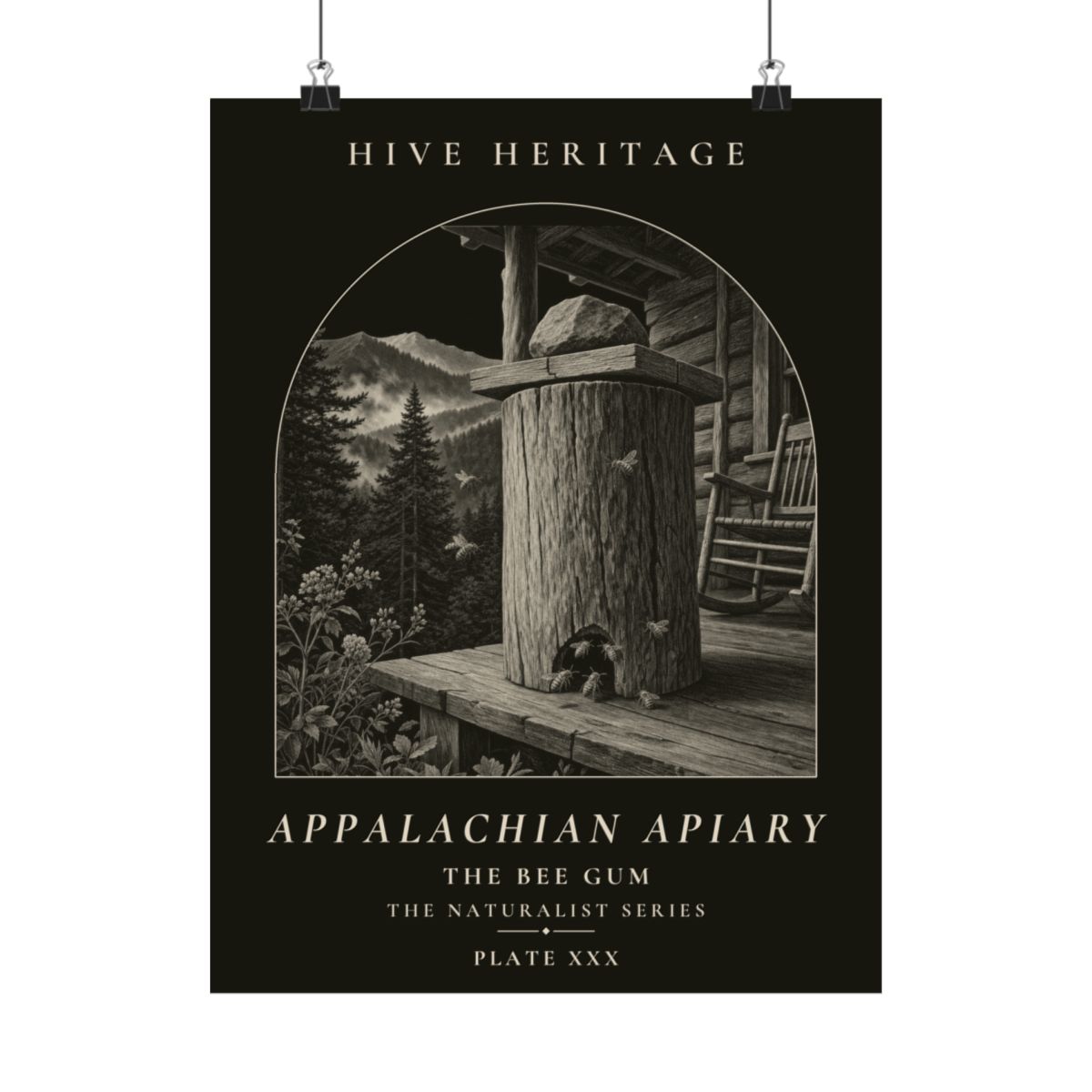
A bee gum was a hollow section of tree trunk, often black gum (Nyssa sylvatica), stood upright with a small entrance cut low down and used as a beehive across the American South and the Appalachian hill country. Nobody patented it or drew it to a plan; it was simply a length of hollow log, given to a swarm of bees and topped with a lid and a stone against the weather, and that is why we wanted it among the plates of the Naturalist Series.
Below is what we can say about it with confidence, and a few places where we have deliberately said less.
What is a bee gum?
In the American South, and especially through the Appalachian hill country, "gum" was a word for a hollow log or a box made from one. It came from the trees themselves. Black gum (Nyssa sylvatica) was a favourite. Its trunks often go hollow with age, and its interlocking grain is reputed to resist splitting, which matters if you are going to leave a length of it out in the weather for years. Other hardwoods were used too, and sawn boards were later nailed into a box shape that still went by the same name.
The usual account runs like this. A hollow trunk was cut into a length, commonly something like three or four feet, though sizes varied with the tree and the maker. It was stood upright on a flat stone or a board, with a small opening cut low down for the bees to come and go. A board or slab went on top to keep the rain out, and often a stone on top of that to keep the wind from taking it. Inside, the beekeeper wedged crossed sticks through the hollow. These were not a refinement so much as a necessity. Bees build their wax comb downwards from the roof of a cavity, and without something to anchor it, a heavy new comb full of honey can break away and fall.
That is the entire hive. There was no frame, no queen excluder, no removable box. It looked much like a short, thick stump with a lid, and a row of them standing in a farmyard or an orchard was a familiar sight in country where bees were kept at all.
Where the bees came from
Honeybees are not native to the Americas. The western honeybee was brought across the Atlantic by European colonists, and hives were being shipped to Virginia in the early seventeenth century. Once bees were in the country, swarms escaped and set up home in hollow trees in the woods, and settlers learned to find them. The practice was called bee hunting or bee lining: a hunter would watch bees leaving a feeding spot and note the direction they flew, then follow that line into the woods until a colony in a hollow tree was found.
The connection to the gum is easy to see. A hollow tree is what a wild colony chooses, and a hollow log is what the gum gave them. The beekeeper was not persuading bees to do anything unnatural. They were offering something close to the cavity the bees would have picked for themselves, but placed by the kitchen door instead of forty feet up a rotten oak.
When a hive swarmed, the beekeeper's job was to catch the cluster and shake or coax it into an empty gum. Bees that hived well would spend the summer building comb and filling it, and the household would take a share of the honey and wax at the end of the season.
How did beekeepers get honey from a bee gum?
This is the part of the story that is easy to romanticise, and we would rather not. The gum, like the straw skep used in Britain and much of Europe for centuries before it, was a fixed-comb hive. The bees fastened their comb to the walls and the sticks, and the beekeeper could not lift a piece of it out and put it back. To see what was going on inside, you were more or less limited to looking up from the bottom or tipping the whole log, neither of which shows you much.
To take honey, the beekeeper usually had to cut the comb out. Some did this by turning the gum over or by cutting into it from the top or side, and accounts describe leaving a portion of comb for the bees to live on through the winter. Other traditional beekeepers, including users of skeps in Europe, are recorded as having killed the colony in autumn, often with the fumes of burning sulphur, in order to take all of the honey at once. We do not have a trustworthy source for how commonly that was done in gums specifically, so we will not claim it was standard practice. What we can say is that, with fixed comb, a beekeeper had two poor choices when it came to inspection: disturb the colony heavily or leave it alone.
Disease was the other problem. Because you could not examine the comb, a colony that was failing could not be properly checked, and there was little a beekeeper could do about one hive passing trouble to another. That is a limitation of the design, not a fault of the people who used it. They were working with the knowledge and tools of their time, and for a household that wanted some honey and wax, a gum was cheap, needed no manufactured parts, and could be made with an axe and a saw.
What replaced the bee gum as a beehive?
The turning point is a well documented one. In 1851 the Reverend Lorenzo Langstroth, a Philadelphia clergyman and beekeeper, worked out that bees keep a consistent gap of roughly a centimetre or a little less (about three eighths of an inch) between comb surfaces, leaving room for a bee to pass. If frames hang in a box with that gap around them, the bees do not glue them down with propolis or fill the space with comb. Frames can be lifted out, examined and put back. Langstroth's patent followed in 1852, and his hive, with its movable frames, became the model for much of the beekeeping world that followed.
Compared with a gum, the change is enormous. You can look at every comb. You can find the queen, count brood, see disease, and take honey from the top of a hive without disturbing the nest beneath. Those things transformed how bees could be managed, and the gum could do none of them.
Even so, the gum did not vanish overnight. Movable-frame hives cost money, and they needed a supplier or a skilled carpenter. In remote country, log gums stayed in use well after Langstroth's design became widely known, and old-timers in the Appalachians were still keeping bees in them in the twentieth century. Beekeeping historians tend to treat them as part of a long chain, from hollow trees to logs and skeps, and on to the frame hives that are used today. The gum belongs to that middle stretch, and it is worth remembering for what it shows: that keeping bees began with borrowing a home the bees already understood.
There are a few things we have left out because we cannot support them. There are stories about the exact date the first gum was used in America, and stories about particular families or valleys that supposedly invented the design. We could not find a source for any of those that we would be willing to stand behind. Folk objects tend to gather tales, and the honest position with the bee gum is that it grew from a widespread, ordinary practice with no single origin.
The plate
Our plate of the Bee Gum shows the object as plainly as we could: the log, its lid, its low entrance and the stone. It is digital artwork in the engraving style. It is not an antique print, and it is not a hand engraving from an earlier century, and we would not want anyone to think so. It is a modern drawing made to sit alongside the other plates in the series, in the manner of a natural history illustration.
We chose the gum because it is the humblest hive there is, and because it makes the later history of beekeeping easier to read. Once you have seen a hollow log with bees living in it, the frame hive stops looking like an obvious box and starts looking like the answer to a very old problem. If you would like to see the plate itself, you will find it linked below.
See it in the Naturalist Series: The Bee Gum plate