
Naturalist Series · 29 September 2026
Basswood, the Summer Tree Bees Wait For
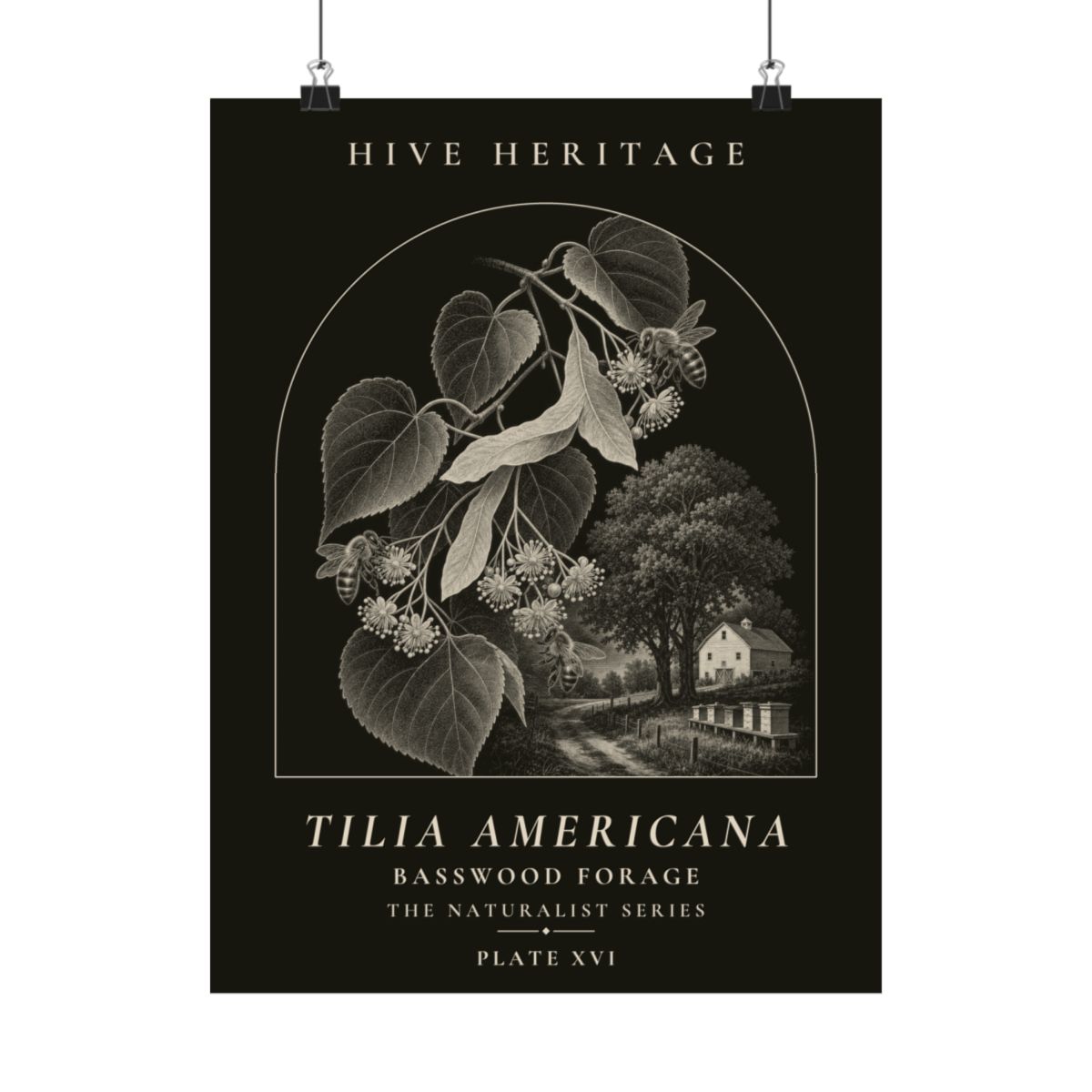
Basswood is the common North American name for Tilia americana, a large native tree of the eastern hardwood forests, and it is the tree many beekeepers keep half an eye on every summer. It flowers only for a short window, usually June into July and lasting about two weeks, and when conditions are right a strong colony can bring in a great deal of nectar in that time.
Stand under a big basswood in bloom and you often hear it before you see anything, a low, steady hum from hundreds of bees working the blossom at once. It is one of the trees behind the Naturalist Series, drawn because it earns its place among bee plants without being the showiest one.
The tree, and what to call it
Basswood is the common name, in North America, for trees of the genus Tilia. The one usually meant is American basswood, Tilia americana, a large deciduous tree native to the eastern half of the continent, from southern Canada down towards the Gulf states. It likes rich, moist soil and turns up in mixed hardwood woodland, often along valleys and lower slopes where the ground holds water.
The same genus grows across Europe and Asia too, and this is where British readers may recognise it under another name. In Britain we call these trees limes, and in much of continental Europe they are lindens. They are the trees that line so many old avenues and sit in parks and churchyards. They are not related to the citrus fruit, which is a common muddle. The small-leaved lime and the large-leaved lime are the two native British species, and the common lime seen in towns is a hybrid of the pair. So when we say basswood, we mean the American tree specifically, but its cousins on this side of the Atlantic do much the same job for bees.
The name itself is worth a moment. Basswood comes from bast, the fibrous inner bark of the tree. That bark can be stripped and separated into strong, flexible strands, and it has long been used to make cord and matting. The wood is another matter entirely: pale, soft and fine grained, and much liked by carvers because it cuts cleanly and does not fight the blade. A tree that gives cordage from its bark, carving wood from its trunk and a summer meal to bees from its flowers is a fairly generous one.
The leaves are the easy way to know it. They are broad and heart shaped, with a slightly lopsided base and a finely toothed edge, and they can be large on a young, vigorous tree. In summer the canopy is dense and dark, which is one reason people still plant these trees for shade.
What the flowers look like, and when they open
Basswood flowers are small, creamy to pale yellow, and sweetly scented. They hang in loose clusters beneath the branches, and here is the detail that makes the tree easy to identify even from a distance: each cluster hangs from a long, narrow, pale green leaf-like bract, joined to the flower stalk for part of its length. It looks a little like a wing or a paddle. Once you have seen it, you notice it on every basswood and lime you pass.
Each individual flower has five petals and five sepals, and a bold puff of stamens at the centre. That open, accessible shape matters for bees. The nectar is not hidden away at the bottom of a deep tube, as it is in many flowers, so a honey bee can reach it easily.
The timing is the other part of the story. In the northern part of its range, basswood typically flowers in June and into July, later than the spring flush of maples, fruit trees and dandelions, and around the time that many beekeepers are thinking about the main summer honey crop. Timing shifts with latitude, altitude and the season, so we will not pretend to a fixed date. The window itself is short. Beekeeping accounts commonly describe a flow of about two weeks, sometimes less, and it can be cut shorter by a spell of cold, wind or heavy rain. When it is good, it is very good. When the weather turns, the bees may have little to show for it.
There is also a well known unevenness from one year to the next. Beekeepers have long observed that a tree can bloom heavily and yet yield little nectar in a year when the weather is wrong, and that warm, humid spells tend to be better than dry ones. We would treat that as experience rather than settled science, and we would not try to put a number on it. What can be said safely is that nectar production by trees is sensitive to weather, and basswood has a name for being a generous forage that is not always dependable.
What bees take from it
The plate is called Basswood Forage, so the honest question is what, exactly, is being foraged. For basswood the answer is mainly nectar. This is a nectar tree first. Honey bees will visit the flowers for pollen as well, and pollen is present in the open blossom, but the reputation of the tree among beekeepers rests on nectar, and it is nectar that ends up as honey in the hive. If you read a source that promises a great deal more about the pollen, be cautious and ask where the claim comes from.
A colony does the work in a particular way. Foragers fly out, collect nectar in the honey stomach, and carry it home. Inside the hive it is passed between workers, reduced by evaporation and turned into honey, then sealed in wax cells once it is ripe. Nothing about that is special to basswood, but the speed of it is. When a tree in flower is heavy with nectar, a strong colony can bring in a lot in a short time, and that is why beekeepers take a short flow so seriously. Supers, the boxes added on top of the hive for honey storage, have to be in place before the flow starts, not after.
Honey made mostly from basswood nectar is generally described as pale, light in colour, and distinctive in flavour. Descriptions vary from person to person, and words like minty or woody come up often, but flavour is a matter of taste and of what else the bees visited, so we would not promise a single character. Bees do not confine themselves to one tree on a given day. Unless a beekeeper has done something deliberate to separate the crop, honey sold under a single plant name is usually a strong tendency rather than a laboratory certainty. We do not sell honey, so that is not a matter we have to settle, but it is a fair thing to know if you buy it.
One more point, because it is often misunderstood. Honey bees are not native to North America. European colonists brought them across in the seventeenth century, and the bees then spread and established feral colonies. Basswood, meanwhile, was there long before. So the pairing of a honey bee and a basswood is a meeting of a native tree and an introduced insect, and it is a reminder that a great many of the bee and plant relationships we think of as timeless were arranged more recently than they feel. The tree also feeds many wild bees and other insects, and honey bees are only one of its visitors.
A note of caution from the lime trees of Europe
It would be a little dishonest to write about lindens and limes without mentioning one puzzle. In Britain and Europe, dead or dying bumblebees are sometimes found beneath lime trees in flower, and this has been reported especially under the silver lime. The cause has been debated. One suggestion is that a sugar in the nectar of some limes is hard for bees to use, another is that the bees simply exhausted themselves on a large crop of flowers late in the season when little else was in bloom. We would not say the matter is closed, and we would not want to put an explanation in your head that the evidence does not fully support. The tree is not a villain, and it is not a hazard for every bee that visits it. It is one more case where a familiar plant turns out to be more complicated than the postcard version.
Another thing British readers may notice is honeydew. Limes are often home to aphids, which feed on the sap and drip a sticky sugary residue onto leaves and anything parked underneath. Bees will collect it. That is a different product from nectar, and it belongs to a different story about how honey gets its character, which is a good reason to be careful when someone tells you a honey came from flowers alone.
Why we drew it
The Naturalist Series is about looking properly at the plants and creatures that surround beekeeping, and giving each one a plate that takes its subject seriously. Basswood suited that. It has a clear, recognisable silhouette, the odd winged bract, a leaf shape anyone can learn, and a role in the beekeeping year that is easy to describe but hard to overstate. It gave us plenty to draw.
The plate is digital artwork in an engraving style. It is made for this series, not copied from an old print, and we would not want you to think of it as an antique or a historical original. What it does is try to show the tree the way a careful observer might, with attention to the leaf, the cluster and the bract that gives the flowers away.
If you keep bees, you may already have your own summer basswood story: a hum in the canopy, a heavy super, or a flow that never came. If you do not, next time you pass a lime tree in July, stop for a moment and listen. Then look up. The plate is there for anyone who would like to keep that tree a little closer to hand.
See it in the Naturalist Series: The Basswood Forage plate